A kind of antibacterial cement mortar and its preparation and application method
Active Publication Date: 2021-11-30
FUZHOU UNIV
View PDF10 Cites 0 Cited by
Summary
Abstract
Description
Claims
Application Information
AI Technical Summary
This helps you quickly interpret patents by identifying the three key elements:
Problems solved by technology
Method used
Benefits of technology
Problems solved by technology
[0003] (1) The mortar is exposed to the external environment for a long time. If the bactericidal coating is directly applied to the surface of the mortar, its service life is short, and it is easy to be damaged or peeled off from the surface of the mortar; after damage or peeling, although it can be repeatedly painted and repaired, However, resources such as manpower and materials need to be continuously invested, and the maintenance cost is relatively high.
[0004] (2) Most of the commonly used fungicides are chemical preparations. Spraying fungicides on the surface of cement mortar may cause certain corrosive damage to the structure of the mortar and affect the service life of cement mortar; There is some pollution in the surrounding environment
In addition, chemical fungicides can only kill bacteria, but cannot decompose substances such as endotoxins released after death. As bacteria accumulate again, the remaining substances provide nutrients for new bacteria instead, which is not conducive to relieving bacteria. Erosion damage to mortar structures
[0005] (3) Since nano-photocatalytic materials are easy to adsorb and agglomerate, it is difficult to mix them evenly with cement and sand when directly mixed into cement or sand
Even if it is added after it is uniformly dispersed in water, its dispersibility cannot be guaranteed, and more nano-photocatalytic materials remain on the inner wall or bottom of the container, resulting in more material loss, which will cause a large error in the amount of nano-photocatalytic materials incorporated. It also affects the bactericidal effect during use
[0006] (4) The environment of cement mortar is generally complex and harsh, and the cement mortar is strongly alkaline, and the cement hydration time is longer
Nano-photocatalytic materials have problems such as reduced photocatalytic performance or structural damage in cement mortar. If only one nano-material is used for photocatalytic sterilization, once its performance is inhibited, it will seriously affect the photocatalytic effect of cement mortar.
Method used
the structure of the environmentally friendly knitted fabric provided by the present invention; figure 2 Flow chart of the yarn wrapping machine for environmentally friendly knitted fabrics and storage devices; image 3 Is the parameter map of the yarn covering machine
View more
Image
Smart Image Click on the blue labels to locate them in the text.
Viewing Examples
Smart Image
Click on the blue label to locate the original text in one second.
Reading with bidirectional positioning of images and text.
Smart Image
Examples
Experimental program
Comparison scheme
Effect test
Embodiment 1
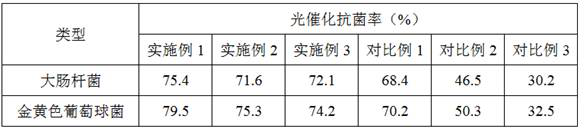
[0055] In this embodiment, the raw material ratio of the antibacterial cement mortar by weight is: 11 parts of cement, 0.75 parts of metakaolin, 32 parts of quartz sand, 0.015 parts of antibacterial agent, and 5.5 parts of deionized water;
[0056] The antibacterial main material is an equal mass combination of nano titanium dioxide, nano graphite phase carbon nitride and nano zirconium dioxide; the antibacterial auxiliary material is nano hexagonal boron nitride.
[0057] In this embodiment, the weight ratio of antibacterial main material and antibacterial auxiliary material is 1:0.15.
[0058] In the present embodiment, the production of the antibacterial agent is carried out as follows: add the main antibacterial material and the antibacterial auxiliary material to tap water at the same time, ultrasonically disperse for 35 minutes, then filter and remove the tap water, and then use a ball mill to mix evenly for 1.6 hours to obtain the antibacterial agent; The volume is 100 ...
Embodiment 2
[0066] In this example, the raw material ratio of antibacterial cement mortar by weight is: 11 parts of cement, 0.75 parts of metakaolin, 32 parts of quartz sand, 0.015 parts of antibacterial agent, and 5.5 parts of deionized water; the main antibacterial ingredients are nano titanium dioxide, nano An equal mass combination of graphite phase carbon nitride and nano zirconium dioxide; the antibacterial auxiliary material is nano silicon dioxide.
[0067] In this embodiment, the weight ratio of antibacterial main material and antibacterial auxiliary material is 1:0.15.
[0068] The preparation method of the present embodiment antibacterial cement mortar is the same as embodiment 1.
Embodiment 3
[0070] In this example, the raw material ratio of antibacterial cement mortar by weight is: 11 parts of cement, 0.75 parts of metakaolin, 32 parts of quartz sand, 0.015 parts of antibacterial agent, and 5.5 parts of deionized water; the main antibacterial ingredients are nano titanium dioxide, nano An equal mass combination of graphite phase carbon nitride and nano zirconium dioxide; the antibacterial auxiliary material is nano calcium carbonate.
[0071] In this embodiment, the weight ratio of antibacterial main material and antibacterial auxiliary material is 1:0.15.
[0072] The preparation method of the present embodiment antibacterial cement mortar is the same as embodiment 1.
the structure of the environmentally friendly knitted fabric provided by the present invention; figure 2 Flow chart of the yarn wrapping machine for environmentally friendly knitted fabrics and storage devices; image 3 Is the parameter map of the yarn covering machine
Login to View More
PUM
Property
Measurement
Unit
particle diameter
aaaaa
aaaaa
particle diameter
aaaaa
aaaaa
particle diameter
aaaaa
aaaaa
Login to View More
Abstract
The invention relates to an antibacterial cement mortar and its preparation and application method. The raw material ratio of the antibacterial cement mortar is: 9.5-14 parts of cement, 0.5-1 part of metakaolin, 25-48 parts of quartz sand, antibacterial 0.01 to 0.03 parts of antibacterial agent, 5 to 9 parts of deionized water; the present invention selects different nanometer photocatalyst materials to mix as antibacterial main ingredients to ensure the stability of antibacterial effect; antibacterial agents are respectively attached to the surface of quartz sand, dispersed in cement and The method of mixing the three in deionized water is used to prepare antibacterial cement mortar, which reduces the uneven dispersion and material loss caused by a single method of incorporation, and at the same time ensures the dispersion and reactive sites of antibacterial agents in cement mortar The number of exposures to achieve the purpose of effective antibacterial.
Description
technical field [0001] The invention belongs to the technical field of building materials, in particular to an antibacterial cement mortar and its preparation and application method. Background technique [0002] Cement mortar is an engineering material with strength after being mixed with cement, fine aggregate and water as the main raw materials. It is mainly used in masonry, plastering and decoration projects. Because the cement mortar is exposed to the air for a long time, a large number of bacteria can easily accumulate on its surface or cracks. How to effectively alleviate the erosion and damage of bacteria to the mortar structure has gradually attracted the attention of experts and scholars. At present, it is common to spray fungicides on the surface of the mortar or apply fungicide coatings to achieve the sterilization effect. Common fungicide coatings include coatings mixed with fungicides and coatings mixed with nano-photocatalytic materials, etc., but there are p...
Claims
the structure of the environmentally friendly knitted fabric provided by the present invention; figure 2 Flow chart of the yarn wrapping machine for environmentally friendly knitted fabrics and storage devices; image 3 Is the parameter map of the yarn covering machine
Login to View More
Application Information
Patent Timeline
Application Date:The date an application was filed.
Publication Date:The date a patent or application was officially published.
First Publication Date:The earliest publication date of a patent with the same application number.
Issue Date:Publication date of the patent grant document.
PCT Entry Date:The Entry date of PCT National Phase.
Estimated Expiry Date:The statutory expiry date of a patent right according to the Patent Law, and it is the longest term of protection that the patent right can achieve without the termination of the patent right due to other reasons(Term extension factor has been taken into account ).
Invalid Date:Actual expiry date is based on effective date or publication date of legal transaction data of invalid patent.


 Login to View More