Balance with a support element for coupling a weighing pan to a weighing cell

a support element and weighing pan technology, applied in the direction of weighing apparatus, weighing apparatus details, instruments, etc., can solve the problems of unfavorable corner load behavior, harmful torque entering the weighing cell, danger, etc., and achieve the effect of convenient cleaning and low friction

US20030188897A1Inactive Publication Date: 2003-10-09METTLER TOLEDO GMBH
7 Cites 15 Cited by

Patent Information

Authority / Receiving Office
US · United States
Patent Type
Applications(United States)
Current Assignee / Owner
Publication Date
2003-10-09
Estimated Expiration
Not applicable · inactive patent

Smart Images

  • Figure 1
    Figure 1
  • Figure 2
    Figure 2
  • Figure 3
    Figure 3
Patent Text Reader

Abstract

A balance includes a weighing cell with a vertically movable load receiver, a weighing pan to receive a weighing load, and a support element to couple the weighing pan to the vertically movable load receiver of the weighing cell. A cantilever arm with a seat for at least one calibration weight is solidly connected to the support element. The balance has a coupling arrangement that constrains the support element with low-friction mobility to the load receiver at three points forming a triangle in a plane that extends orthogonal to the symmetry plane of the weighing cell, wherein the triangle is symmetric to the symmetry plane of the weighing cell. Under the coupling arrangement, the support element is solidly supported on the load receiver in the direction in which the weighing load is acting.
Need to check novelty before this filing date? Find Prior Art

Description

[0001] The invention relates to a balance with a weighing cell including a vertically movable load receiver, with a weighing pan to receive the weighing load, and with a support element to couple the weighing pan to the vertically movable load receiver of the weighing cell, wherein a cantilever support with a seat for at least one calibration weight of a calibration device is solidly connected to the support element.

[0002] Balances in which a cantilever element is connected to the weighing cell and in which a weighing pan and / or a calibration device is arranged at the opposite end of the cantilever from the connection to the weighing cell belong to the known state of the art. Balances of this kind are prone to the risk that the forces acting on the cantilever element may cause a deformation of the vertically movable load receiver which, in turn, may introduce harmful torques into the weighing cell, specifically into the sensitive flexure pivots of the weighing cell. This danger is p...

Examples

Embodiment Construction

is presented below on the basis of exemplary embodiments of a balance according to the invention, specifically of a support element according to the invention, as illustrated in the drawings which represent simplified schematic views of the invention and wherein:

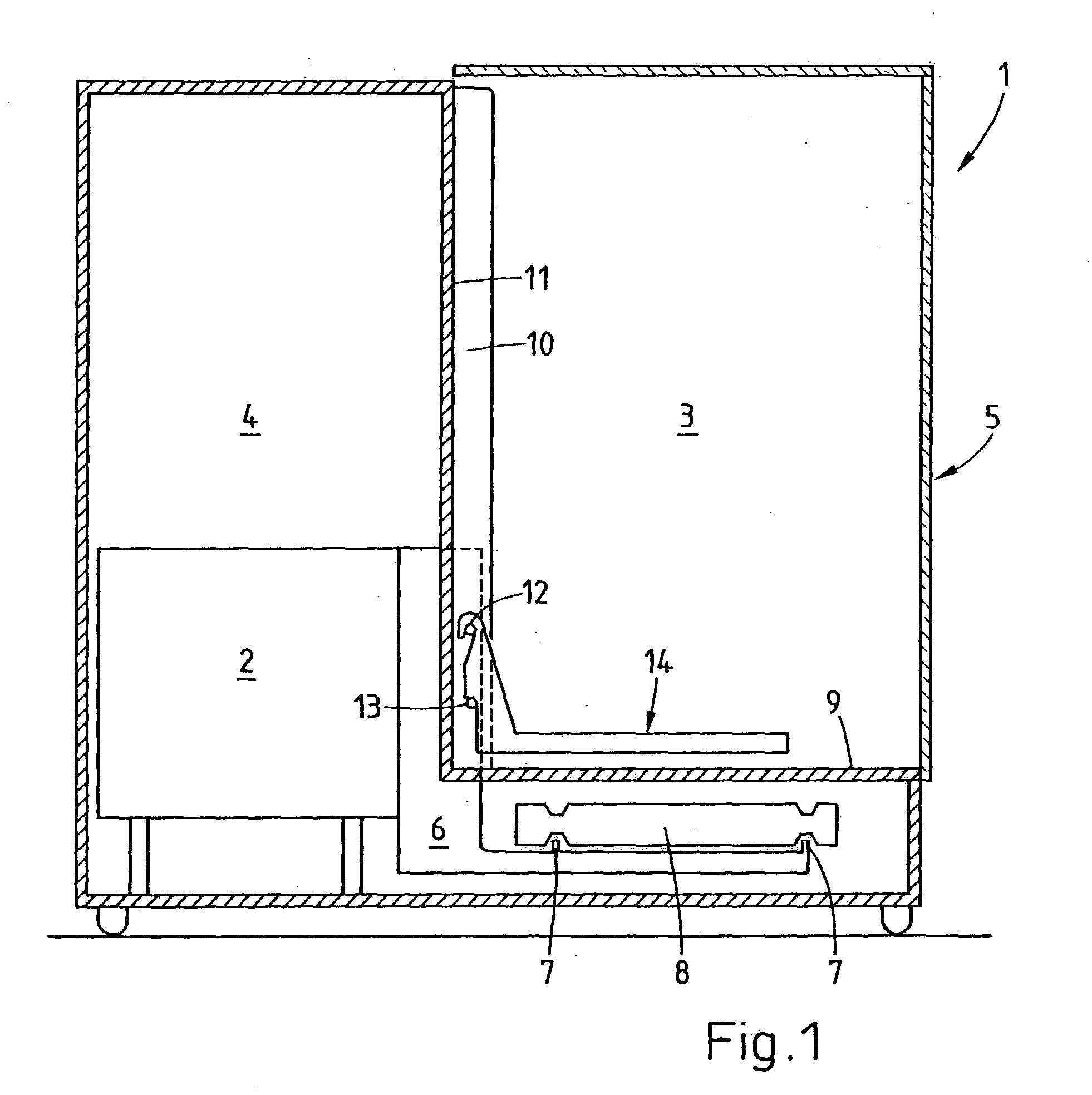
[0019] FIG. 1 represents a side view of the balance,

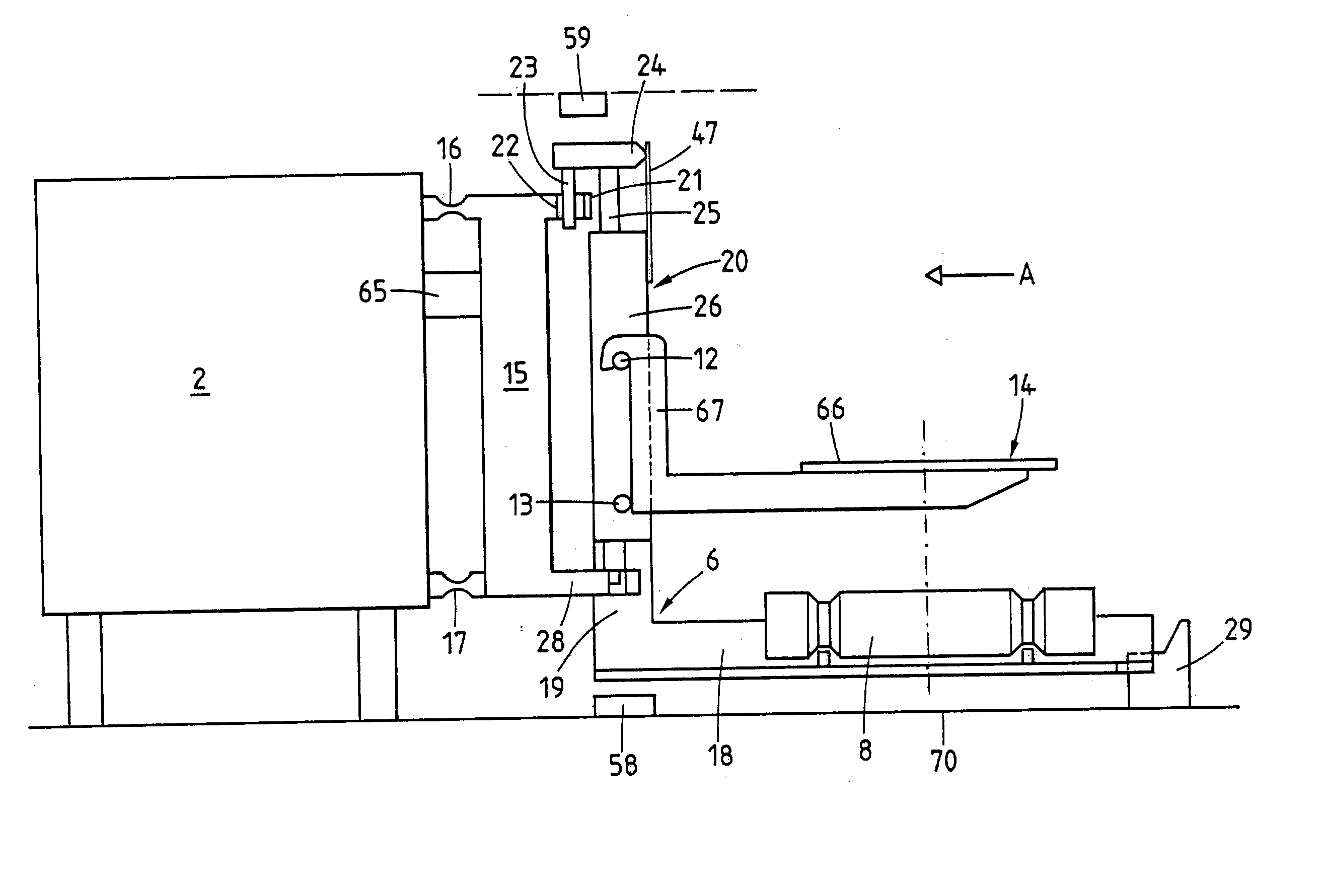
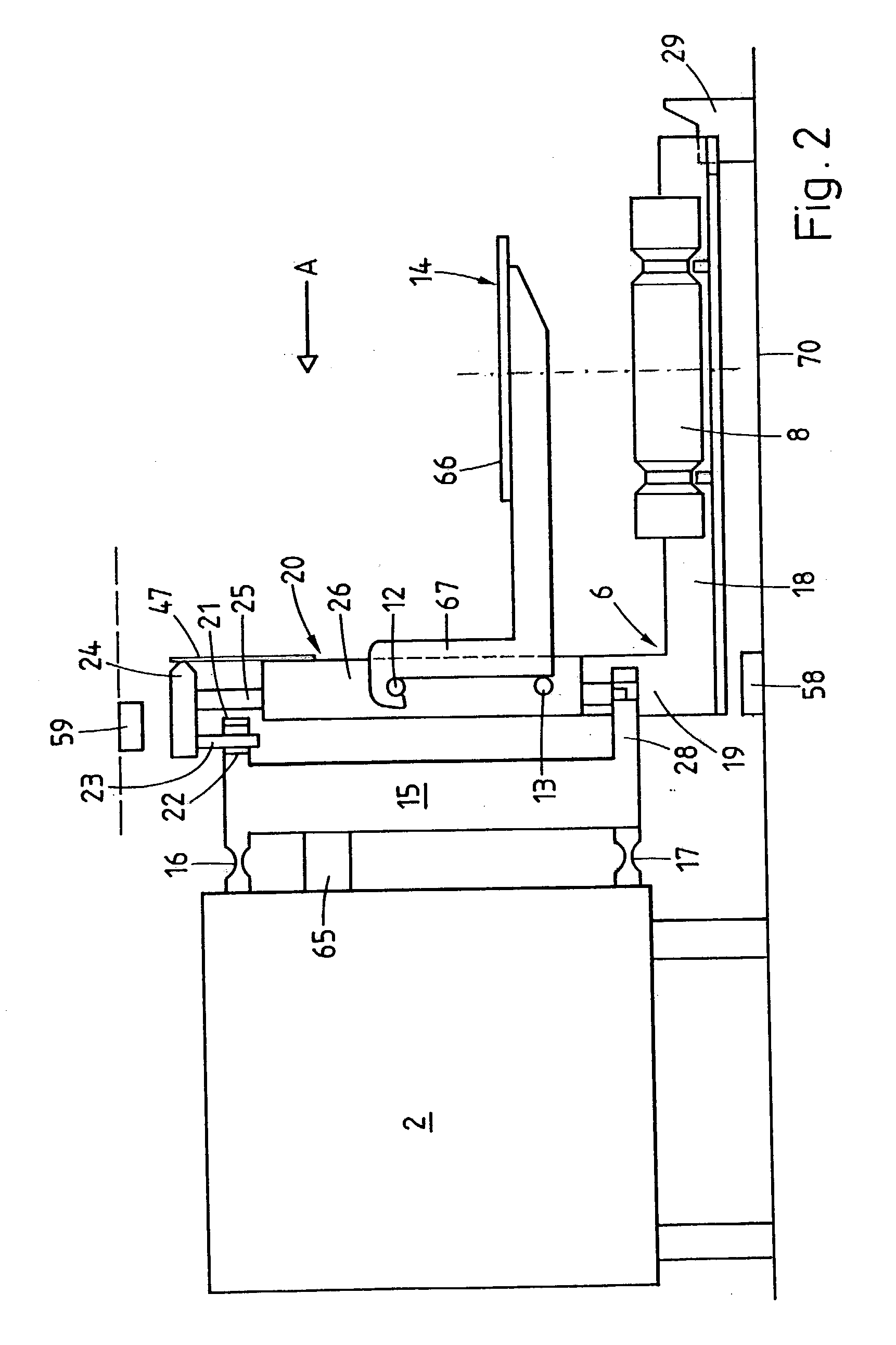
[0020] FIG. 2 represents a side view of a weighing cell, a support element with a cantilever arm, and a weighing pan carrier attached to the cantilever arm in a balance according to the invention,

[0021] FIG. 3 represents a coupling element supported in a suspended position from the upper projection of the load receiver, shown in a sectional view in a plane that is perpendicular to the arrow A of FIG. 2,

[0022] FIG. 4 shows the load receiver with the support element set in place, as seen from above,

[0023] FIG. 5 represents a top view of the load receiver without the support element,

[0024] FIG. 6a represents a simple embodiment of the load receiver without the support element ...