
Microparticles
a technology of microparticles and microparticles, applied in the field of microparticles, can solve the problems of poor encapsulation efficiency of "too small" spheres, poor control of etc., and achieve the effect of controlling drug release rate and sphere size and shell thickness
- Summary
- Abstract
- Description
- Claims
- Application Information
AI Technical Summary
Benefits of technology
Problems solved by technology
Method used
Image

Examples
example 1
Fabrication of Uniform Solid PLGA Microspheres
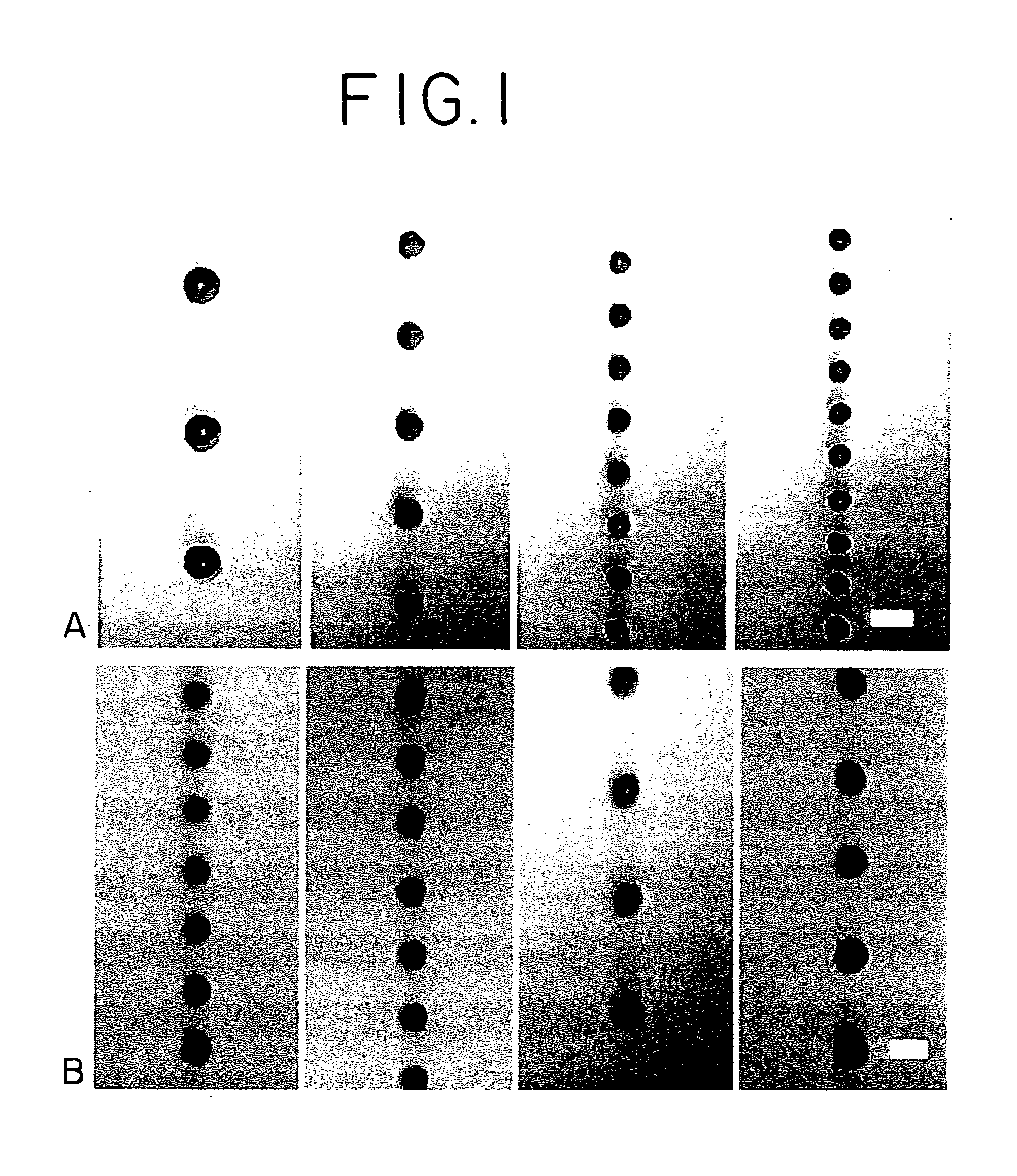
[0129] PLGA was dissolved in ethyl acetate (50 mg / ml) and the solution was pumped through a 60-.mu.m orifice at varying flow rates from 2-3 ml / min. Simultaneously, the acoustic excitation frequency was varied from 14 to 70 kHz. The free-falling spheres were illuminated with a strobe lamp and the images were captured on videotape using a 10.times. microscope objective and a CCD camera. As shown in FIG. 1, spheres that are homogenous in size from 65 to 120 .mu.m have been fabricated (note that the minimum sphere size is only slightly larger than the orifice diameter). The sphere size increased with increasing polymer solution flow rate and decreasing ultrasound frequency.
[0130] Uniform spheres have been formed over a wide range, from 15-500 .mu.m, using the same technique, but varying the orifice diameter, polymer solution flow rates and ultrasound frequency. The microspheres were hardened by solvent extraction / evaporation in an aqueous so...
example 2
Preparing PLGA of Smaller Sphere Size
[0132] The minimum sphere diameter obtainable with this basic technique is governed by the size of the nozzle. Decreasing the orifice size beyond .about.30 .mu.m is problematic for several reasons. First, reproducible fabrication of the nozzles, by pulling capillaries for example, is increasingly difficult as the size decreases. Second, very small nozzles are easily clogged by aggregated polymer or foreign dust particles, and careful washing of all equipment and filtering of solutions is required. These are simply technical problems that could be overcome with careful engineering of the system. A confounding problem, however, is that passing the viscous polymer solutions through the small orifices becomes increasingly difficult and generates larger shear forces as the orifice diameter is decreased. Thus, the electrohydrodynamic spraying technique has been explored to produce microspheres less than about 30 .mu.m in diameter.
[0133] The electrohydr...
example 3
Encapsulation of Drugs
[0135] Finally, the ability to encapsulate drugs within the polymer microspheres using a model compound, rhodamine B has been demonstrated. The rhodamine B, in its free base form, was dissolved in PLGA / ethyl acetate solutions at theoretical loadings of 1, 3 and 5%(mass drug / mass polymer). Microspheres of uniform 35, 50 and 65 .mu.m diameters were fabricated, hardened and collected using the procedures described in the above examples. The presence of rhodamine had no observable effect on particle uniformity. Encapsulation of rhodamine (.about.70% efficiency) was confirmed by fluorescence microscopy (FIG. 6, right). The rhodamine B is released from the spheres over the course of 7-10 days of incubation in PBS and 37.degree. C. The release rate was faster when spheres were smaller (not shown) or contained more drug (FIG. 6, left) as would be expected.
PUM
 Login to View More
 Abstract
Description
Claims
Application Information
 Login to View More