
Disposable diaper
a diaper and dispensing technology, applied in the field of diapers, can solve the problems of inability to reliably absorb and retain body waste, inability of this known diaper to press the pad laid in the depressed zone against the wearer's skin, and inability to reliably entrap body waste, etc., to achieve the effect of restoring the initial thickness
- Summary
- Abstract
- Description
- Claims
- Application Information
AI Technical Summary
Benefits of technology
Problems solved by technology
Method used
Image

Examples
Embodiment Construction
[0038] Details of a disposable diaper according to the present invention will be more fully understood from the description given hereunder with reference to the accompanying drawings.
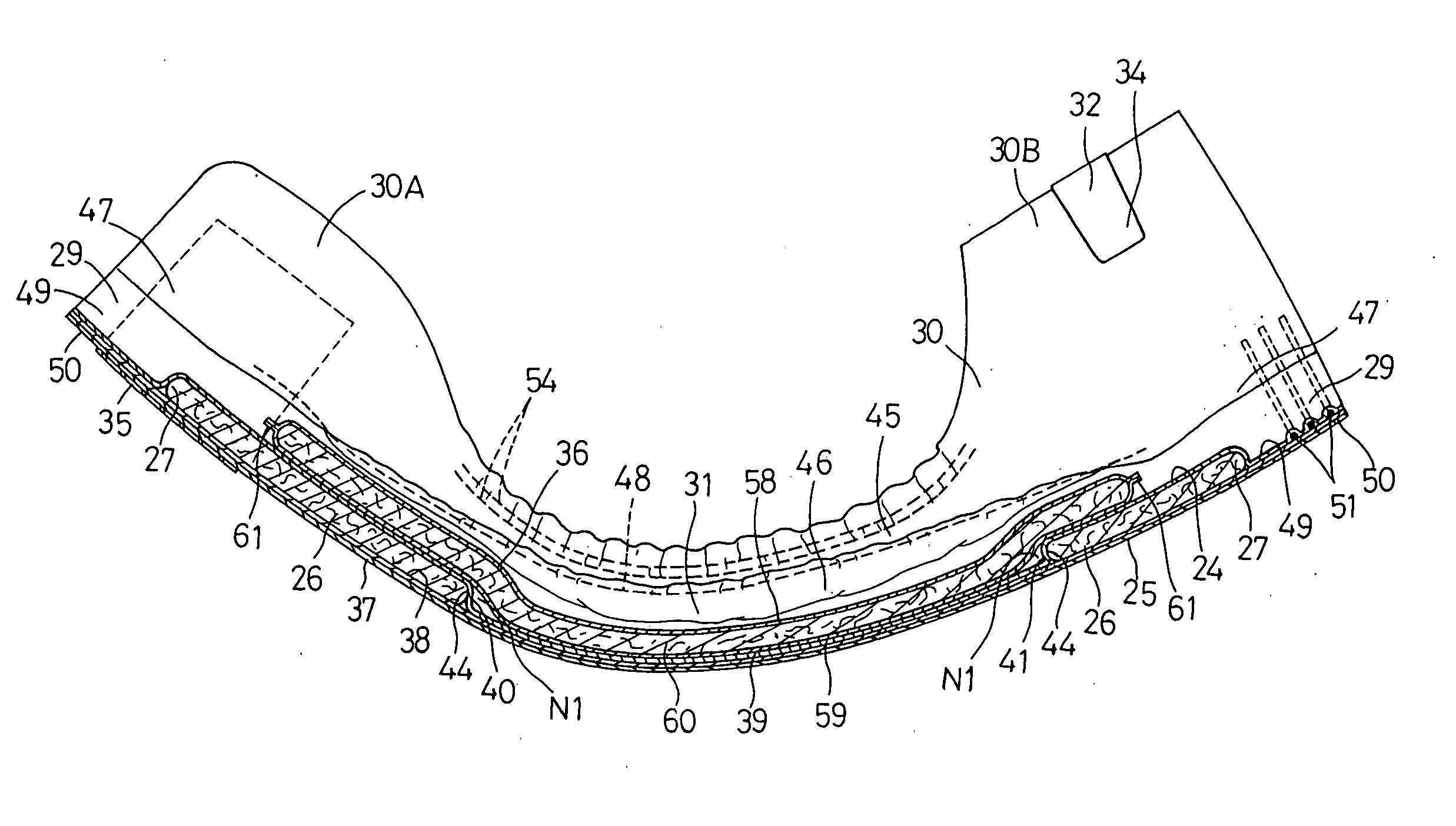
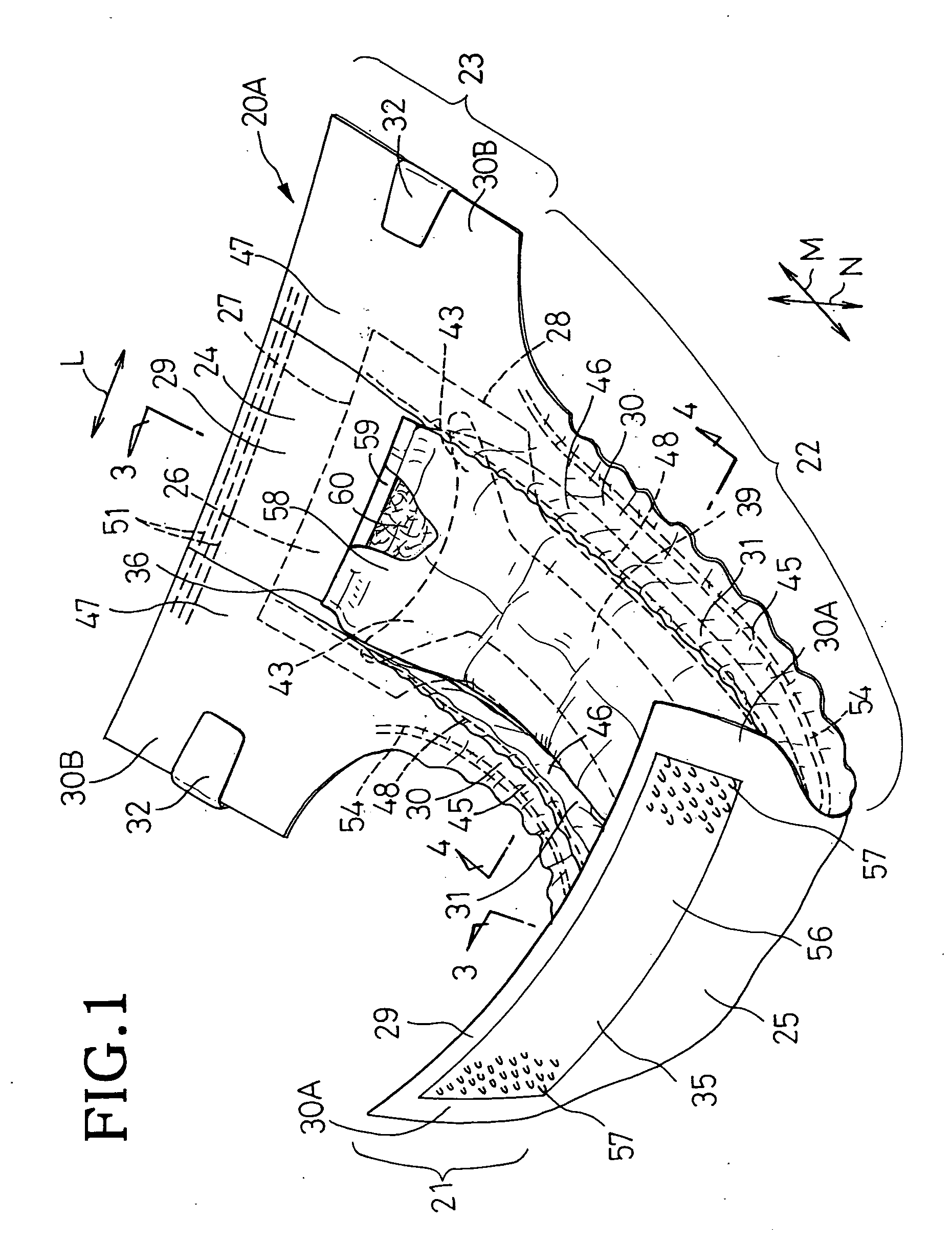
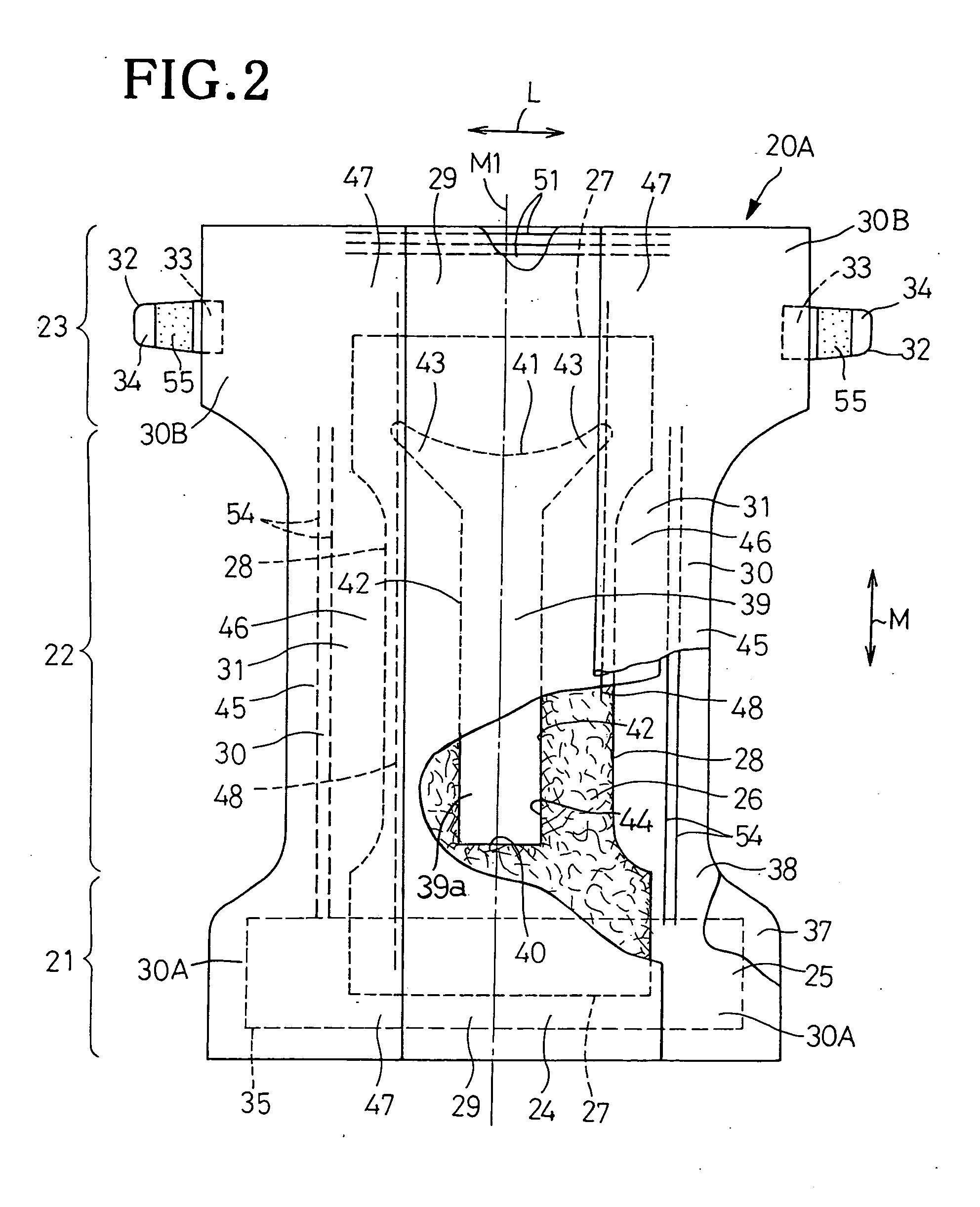
[0039]FIG. 1 is a perspective view showing a disposable diaper 20A with a pad 36 laid in a pad seat 39, FIG. 2 is a partially cutaway plan view showing the diaper 20A of FIG. 1 with the pad 36 not shown, FIG. 3 is a sectional view taken along the line 3-3 in FIG. 1 and FIG. 4 is a sectional view taken along the line 4-4 in FIG. 1. In FIGS. 1 and 2, a transverse direction is indicated by an arrow L, a longitudinal direction is indicated by an arrow M and a thickness direction is indicated by an arrow N (in FIG. 1 alone). FIG. 2 shows the diaper 20A as developed in the longitudinal direction as well as in the transverse direction against contractile force of stretch- and contractible elastic members 48, 51, 54. As used herein, “inner surfaces” of top- and backsheets 24, 25 and leak-barrier sheets 31 con...
PUM
 Login to View More
 Abstract
Description
Claims
Application Information
 Login to View More