
Methods for detecting osteolytic conditions in the body
- Summary
- Abstract
- Description
- Claims
- Application Information
AI Technical Summary
Benefits of technology
Problems solved by technology
Method used
Image

Examples
Embodiment Construction
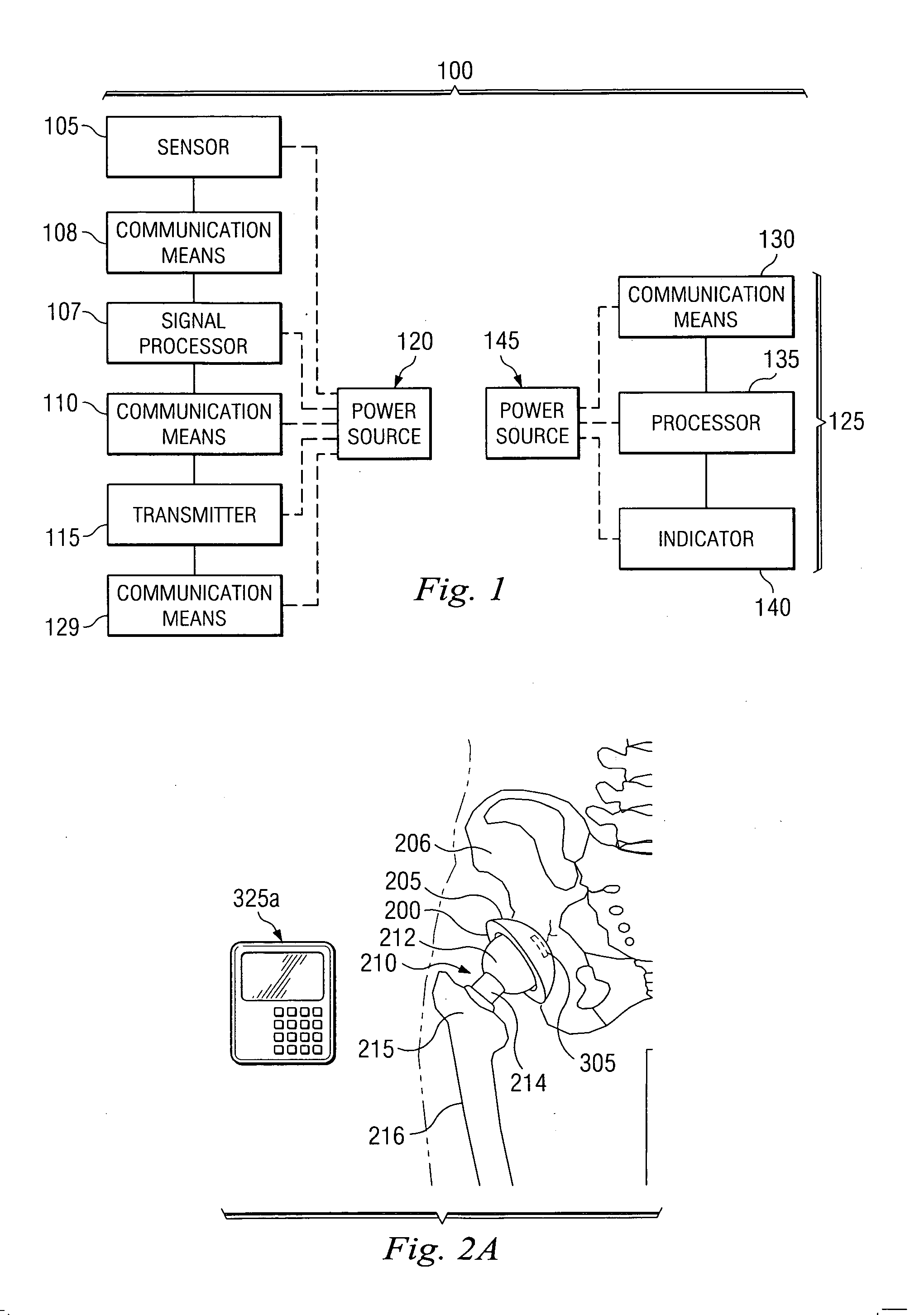
[0024] Referring now to FIG. 1, one embodiment of a system for detecting a condition in the body according to the present disclosure is illustrated.
[0025] According to the embodiment illustrated in FIG. 1, a detection system 100 comprises a sensor 105, a signal processor 107, and a transmitter 115. The sensor 105 and the signal processor 107 are communicatively coupled by communication means 108, and the signal processor 107 and the transmitter 115 are communicatively coupled by communication means 110. Communication means 108 and 110 can be wired or wireless, as will be discussed further herein. In certain embodiments, signal processor 107 could contain a memory unit, or could be communicatively coupled to a memory unit. As will be discussed further herein, a memory unit would store data received from the signal processor.
[0026] For ease of reference, the sensor 105, signal processor 107, and transmitter 115, are illustrated separately in FIG. 1, and are discussed as separate uni...
PUM
 Login to View More
 Abstract
Description
Claims
Application Information
 Login to View More