
Cassette roller leveler with common back-up rolls
a leveler and cassette roller technology, applied in the field of levelers, can solve the problems of increasing the cost, time and maintenance of the leveler unit, and the curvature of the strip, so as to reduce the time to exchange, reduce the overall cost, and facilitate maintenance.
- Summary
- Abstract
- Description
- Claims
- Application Information
AI Technical Summary
Benefits of technology
Problems solved by technology
Method used
Image

Examples
Embodiment Construction
[0025] One of the primary functions of a roller leveler is to remove curvature from a piece of metal strip, sheet or plate. Strip is defined to mean metal which is sufficiently narrow and is rolled sufficiently thin that it can be wrapped into a coil. A sheet is defined as metal that is, for whatever reason, cut into lengths rather than stored in coiled form. Plate is metal which is too thick, as a practical matter, to be formed into a coil.
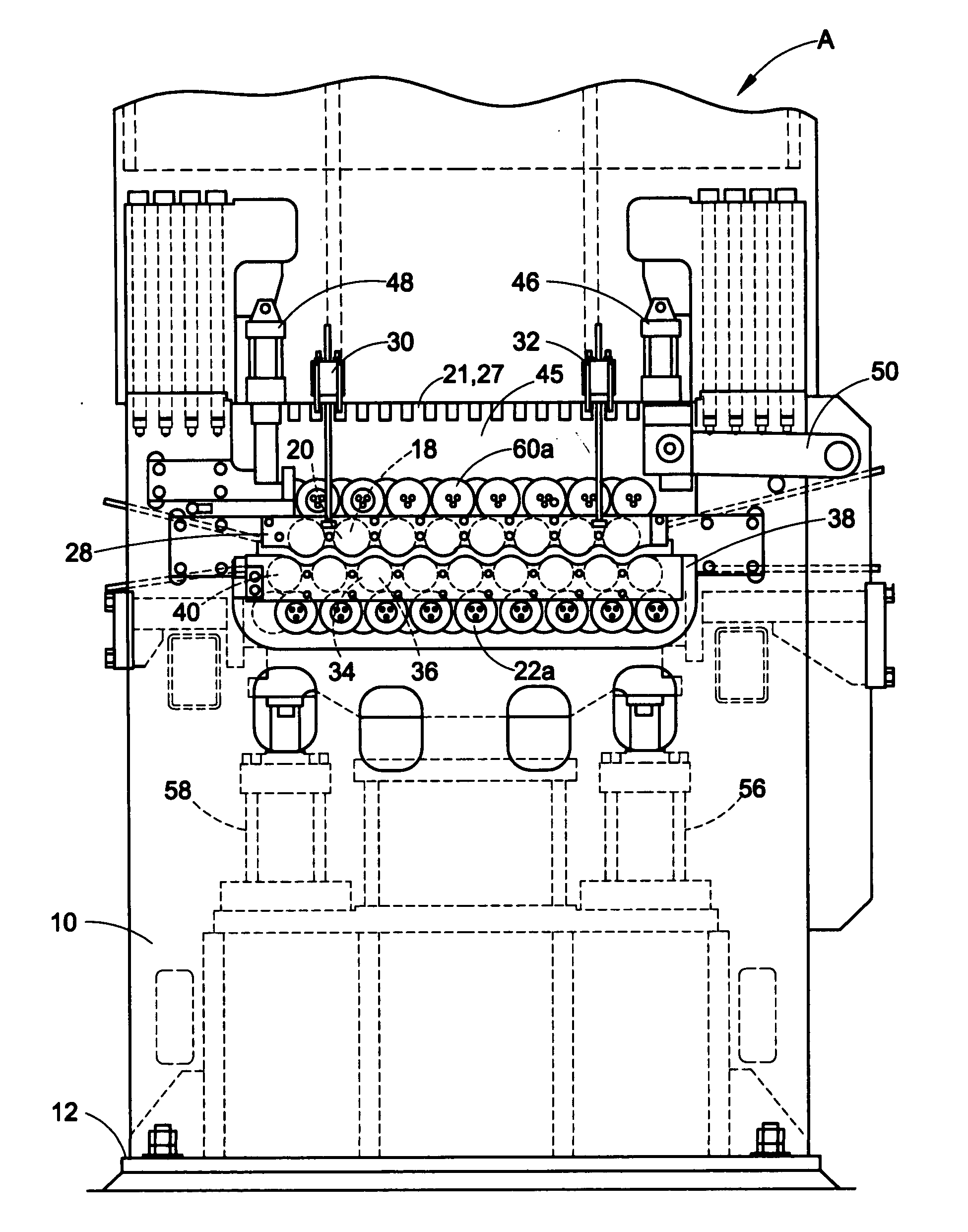
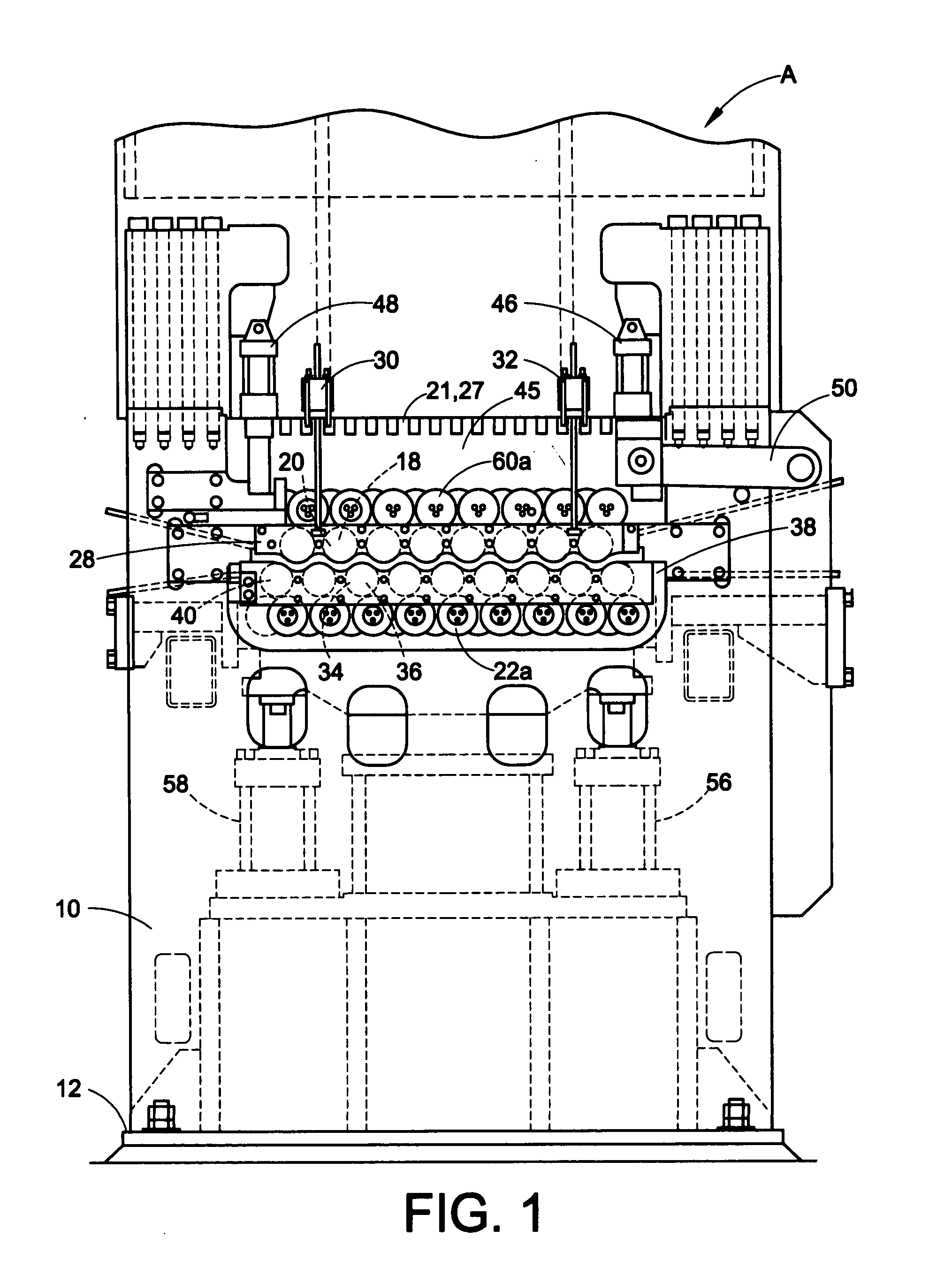
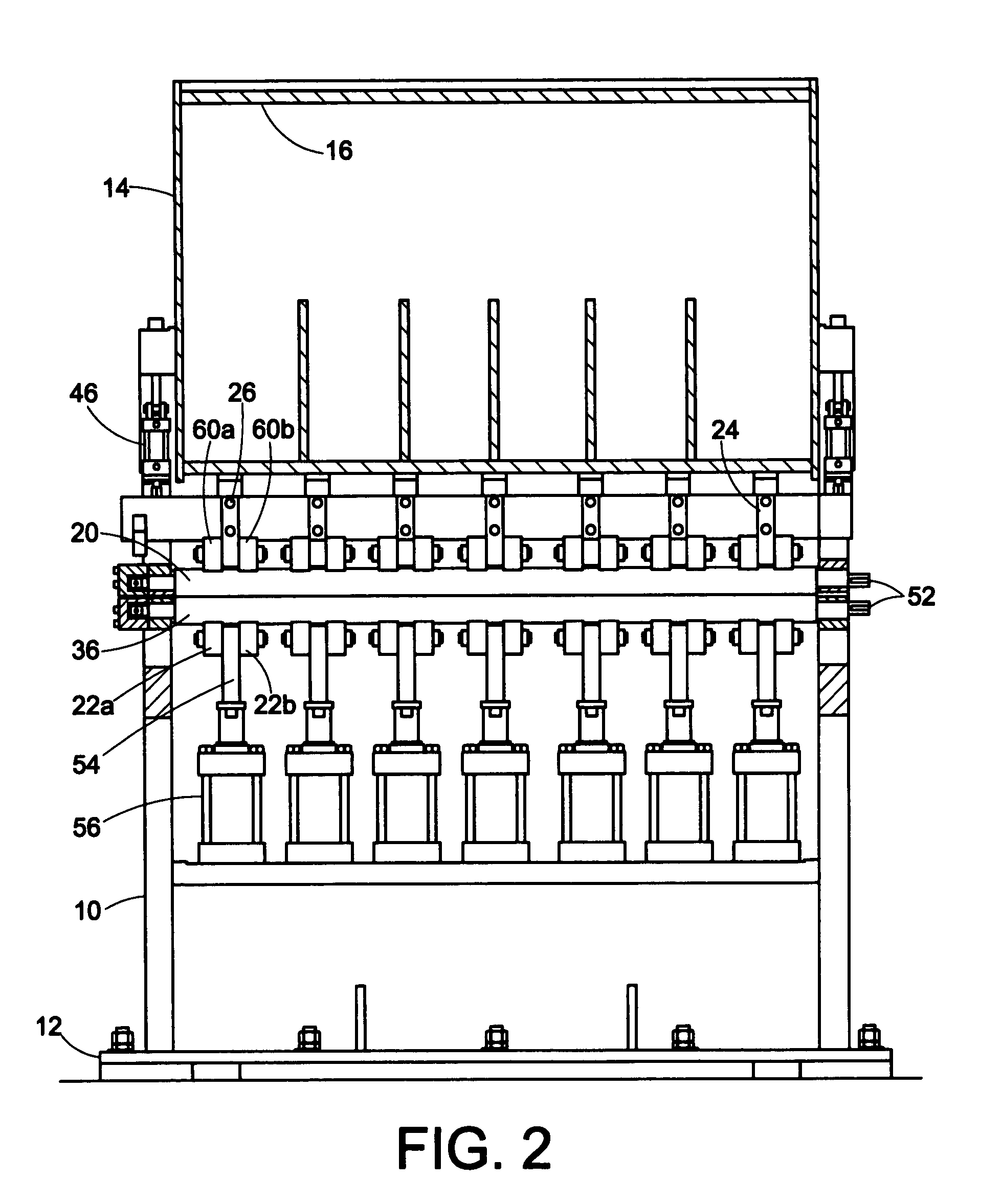
[0026] In the case of sheets and plates, the curvature would normally be of a substantially constant radius and the roller leveler means could be of the simplest form to flatten the sheet or plate. Referring to FIG. 1, for this operation, the roller leveler would theoretically require an upper work roller 20 and a pair of lower work rollers 36. It will be observed that a sheet moving from right to left is flexed downwardly between an upper work roller 20 and a lower work roller 36 to the right of roller 20 and then is reverse flexed between an u...
PUM
| Property | Measurement | Unit |
|---|---|---|
| Diameter | aaaaa | aaaaa |
Abstract
Description
Claims
Application Information
 Login to View More