Method, program and apparatus for generating two-class classification/prediction model

a classification/prediction model and program technology, applied in the field of methods, program and apparatus for generating a classification/prediction model, can solve the problems of difficult to achieve a 100% classification rate, difficult to raise the classification rate, and easy to be misclassified, so as to achieve high reliability, increase the number of samples, and the classification rate does not decrease.

a classification/prediction model and program technology, applied in the field of methods, program and apparatus for generating a classification/prediction model, can solve the problems of difficult to achieve a 100% classification rate, difficult to raise the classification rate, and easy to be misclassified, so as to achieve high reliability, increase the number of samples, and the classification rate does not decrease.

US20090222390A1Active Publication Date: 2009-09-03FUJITSU LTD

Image

Smart Image Click on the blue labels to locate them in the text.
Viewing Examples
Smart Image
  • Method, program and apparatus for generating two-class classification/prediction model
  • Method, program and apparatus for generating two-class classification/prediction model
  • Method, program and apparatus for generating two-class classification/prediction model

Examples

Experimental program
Comparison scheme
Effect test

example

Stage 2

[0119]AN discriminant function: Linear learning machine

[0120]AP discriminant function: Linear learning machine

Stage 3

[0121]AN discriminant function: Bayes discriminant analysis

[0122]AP discriminant function: Bayes discriminant analysis

[System Configuration]

[0123]FIG. 19 is a block diagram depicting the system configuration of a two-class classification / prediction model generating apparatus according to one embodiment of the present invention. The two-class classification / prediction model generating apparatus of this embodiment includes an input device 210 for entering sample data and an output device 220 for outputting the classification results or the necessary data being processed. From the input device 200, sample information necessary for classification training is entered into an input data table 310. The input device 200 is also used to enter initial parameter set data into an initial parameter set table 320. If an analyzing unit 400 has an engine 410 for automatically ...

the structure of the environmentally friendly knitted fabric provided by the present invention; figure 2 Flow chart of the yarn wrapping machine for environmentally friendly knitted fabrics and storage devices; image 3 Is the parameter map of the yarn covering machine
Login to View More

PUM

No PUM Login to View More

Abstract

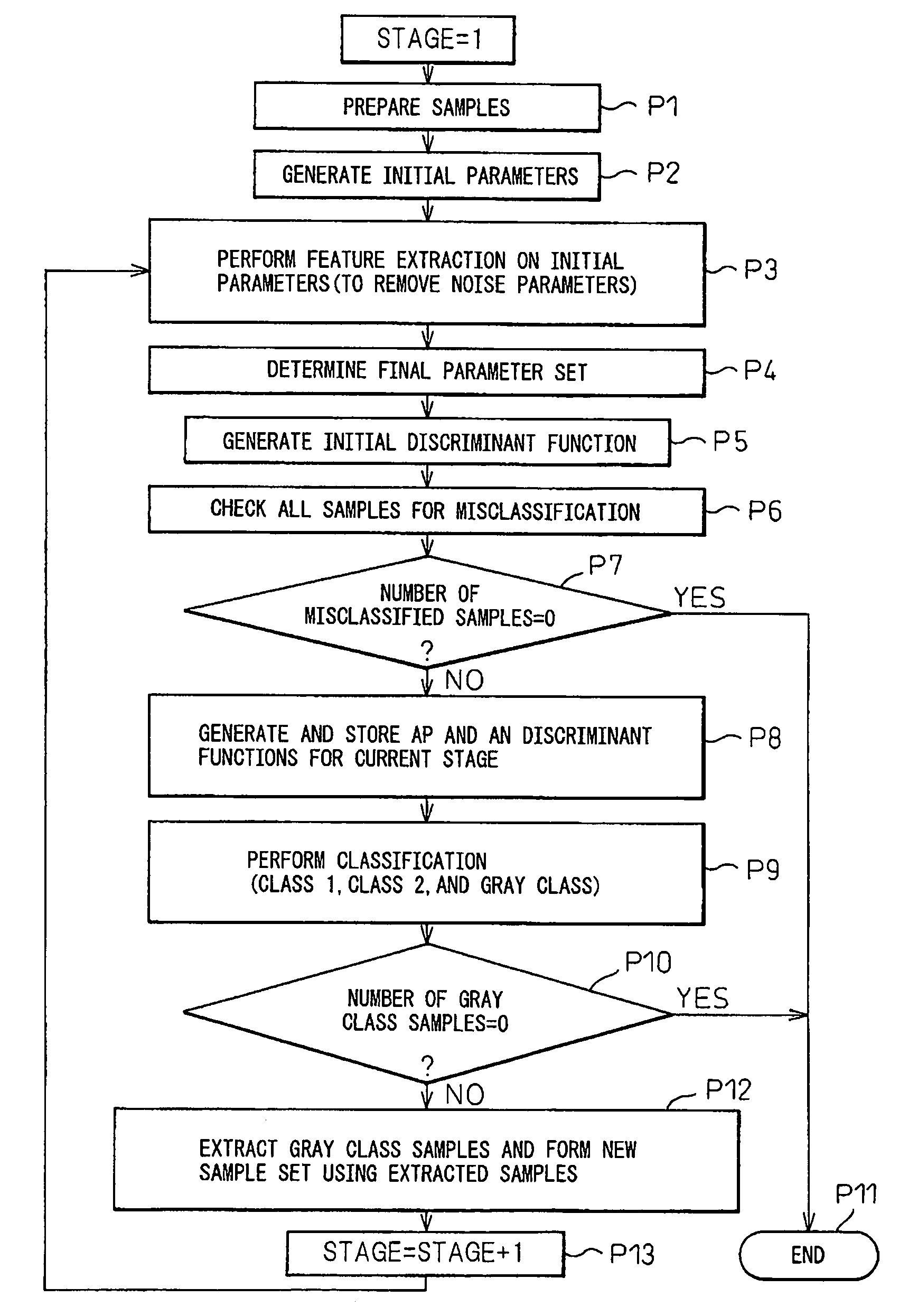
A method includes: a) preparing as training data a sample set that contains a plurality of samples belonging to a first class and a plurality of samples belonging to a second class; b) generating, by performing discriminant analysis on the sample set, a first discriminant function having a high classification characteristic for the first class and a second discriminant function having a high classification characteristic for the second class; c) by classifying the sample set using the first and second discriminant functions, isolating any sample whose classification results by the first and second discriminant functions do not match; d) forming a new sample set by grouping together any sample thus isolated, and repeating b) and c) by using the new sample set; and e) causing d) to stop when the number of samples each of whose classification results do not match in c) has decreased to or below a predetermined value.

Description

CROSS REFERENCE TO RELATED APPLICATION[0001]The present application is a continuation application based on International application No. PCT / JP2007 / 056412, filed on Mar. 27, 2007.TECHNICAL FIELD[0002]The present invention relates to a method, program, and apparatus for generating a classification / prediction model for samples of unknown classes.BACKGROUND ART[0003]A classification problem is a problem that, from a set of samples for which the classes they belong to are known, a rule is learned for classifying the samples into the classes and, using the thus learned rule as a prediction model, predicts the classes to which samples whose classes are not known belong. Among others, a two-class classification which classifies a sample set into two classes has long been used in structure-activity relationship research and, in recent years, has been attracting attention as a useful technique for testing chemicals for toxicity, etc. Methods for learning rules, that is, classification method...

Claims

the structure of the environmentally friendly knitted fabric provided by the present invention; figure 2 Flow chart of the yarn wrapping machine for environmentally friendly knitted fabrics and storage devices; image 3 Is the parameter map of the yarn covering machine
Login to View More

Application Information

Patent Timeline
03 Sep 2009
Publication
US20090222390A1
IPC
G06N3/00; G06N5/04; G06N20/00
CPC
G06F17/30412; G06N99/005; G06F19/707; G06F17/30707; G06F16/353; G06N20/00; G06F16/244; G16C20/70
Inventors
YUTA, KOHTAROU