

Device for real-time streaming of two or more streams in parallel to a solid state memory device array
a solid-state memory and array technology, applied in the field of real-time streaming of two or more data streams in parallel to a solid-state memory device array, can solve the problems of unsolved optimization of hardware layout for the device for real-time streaming and the corresponding bus control method, and the inability to capture and capture live productions or digital cinematography workflows well,
- Summary
- Abstract
- Description
- Claims
- Application Information
AI Technical Summary
Benefits of technology
Problems solved by technology
Method used
Image



Examples
Embodiment Construction
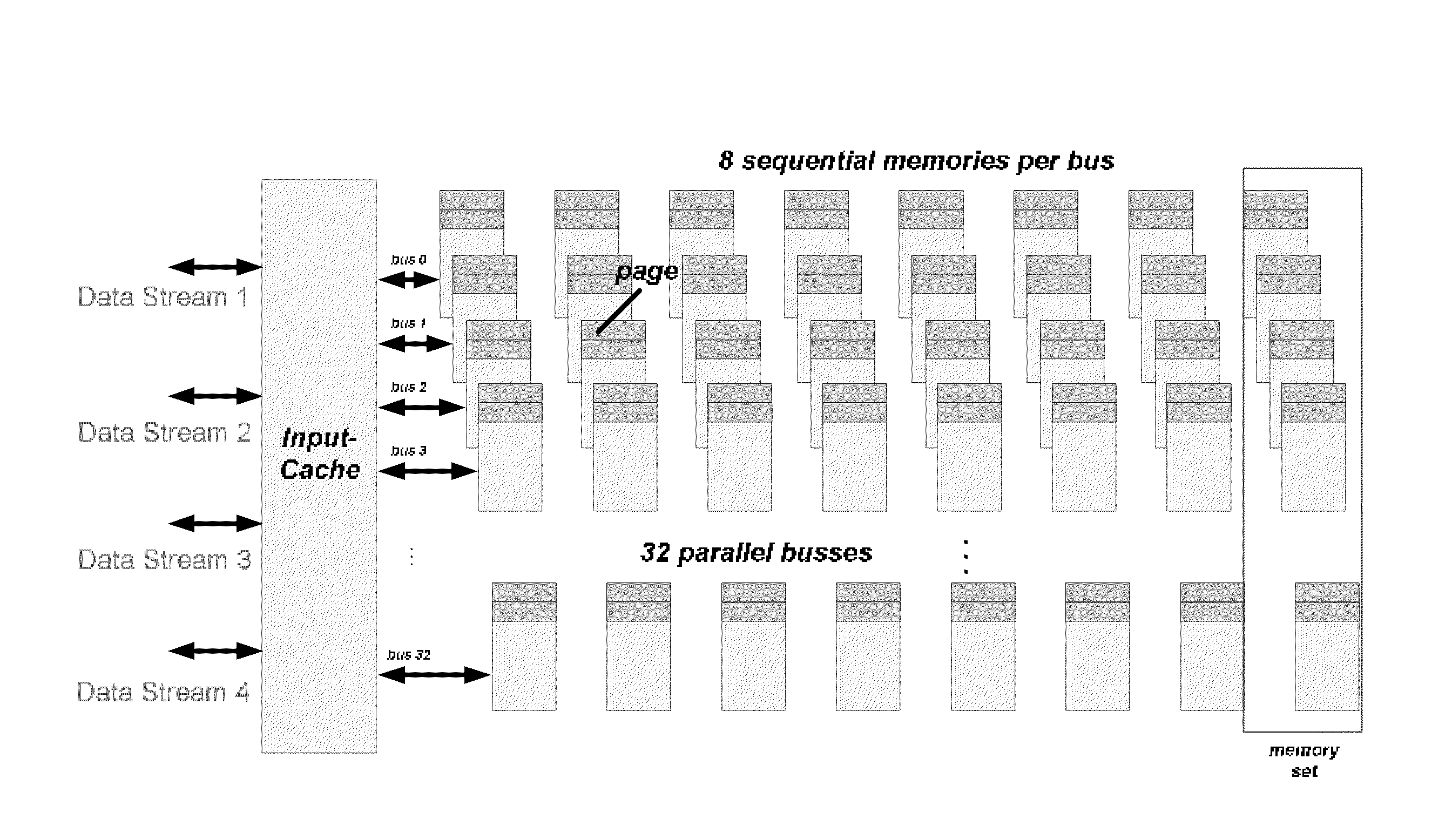
[0023]FIG. 4 shows an exemplary Flash recording device comprising a matrix or array of Flash memories respectively a matrix of memory device sets. The notion of memory device and memory will be used interchangeably.
[0024]This multi-stream recording architecture may use other solid state memories which rely on page-based writing instead of NAND flash memory. In the example depicted in FIG. 4, there are 32 parallel Flash busses with eight sequentially connected Flash memories, each. Whereby, one physical Flash device can contain more than one Flash memories, since today more than one Flash-Dies are combined within one Flash device package. As depicted in FIG. 4 one can define, that a memory device set gathers the same ordered Flash memory on each bus. Assuming in FIG. 5 one memory device set provides an exemplary write data bandwidth of 1,125 Gbit / s, each (see ‘virtual mapping’). Eight memory device sets are supported the busses to completely cover Flash technology write-back penalty ...
PUM
 Login to View More
 Abstract
Description
Claims
Application Information
 Login to View More