Therefore, changes corresponding to an axis configuration are unavoidable in each control process.
As a result, a plurality of functions are entangled and complexity is increased.
Further portions of the control processes relating to the configuration of axes should be extracted and converted to a
black box, each control process should be simplified, and each control process should be facilitated by making common as many portions of the control processes as possible, but the extraction of portions relating to the configuration of axes is incomplete and the conversion to a
black box is impossible.
As a result, the
software greatly increases in size and complexity and the development time and maintenance time are increased.
Accordingly, the problem is to create a
numerical control that can be used as is even when a tool length changes.
However, this approach cannot be directly applied to a five-axis machine tool of a table rotation type that has a rotating axis that rotates the table.
This is because the work rotates as the table rotates and therefore a parallel relationship of the coordinate system of the work and the XYZ coordinate axes of the machine tool is lost.
However, in these tool tip control functions, the commands are different and important issues relating to usage are also different.
However,
numerical control of parallel mechanism machine tools actually tends to be difficult and is handled in a special way.
The description of Japanese
Patent Application Publication No. 2001-92508 shows that each time a control of a parallel mechanism machine tool is developed, it is a time-consuming procedure.
Such a system is effective in the case of an inherently smooth curve such as a circular arc, but is not necessarily effective in applications to a NC program that describes a movement trajectory of a tool by a set of short linear command blocks that are typically used.
H11-149306 is randomly produced on the original
polygonal line since a
tool path is bent on the boundaries of blocks, and therefore subsequent smooth polynomial interpolation is impossible.
Further, a method of changing the
tool path into a smooth curve that is called “nano-
smoothing” has also been suggested, but the conditions under which the
tool path can be smoothly changed by nano-
smoothing are limited.
For example, the conversion into a curve is impossible between the points in which angular deflection of the orientation of an advance
direction vector of the tool path is too large.
Therefore, when the control is performed on the basis of a NC program including sets of short linear blocks, which are typically used, it is impossible not to use the B acceleration-deceleration.
Where the B acceleration / deceleration is used, the
internal rotation error is generated in a smooth movement such as circular arc interpolation.
However, when the Z-axis and the W-axis are used simultaneously, various limitations are involved.
Thus, other functions cannot be used, for example, tool
diameter correction and circular arc interpolation cannot be used.



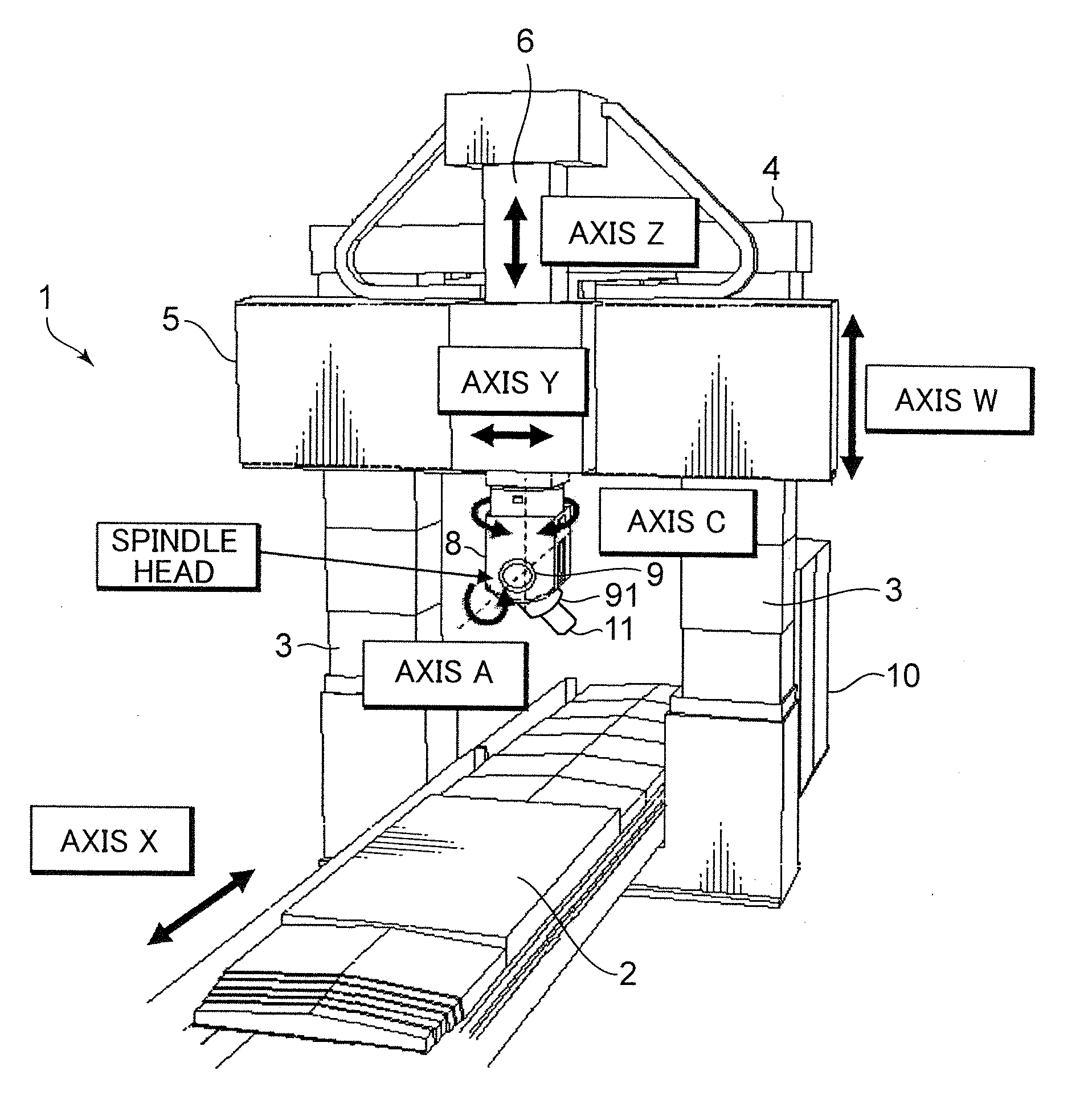
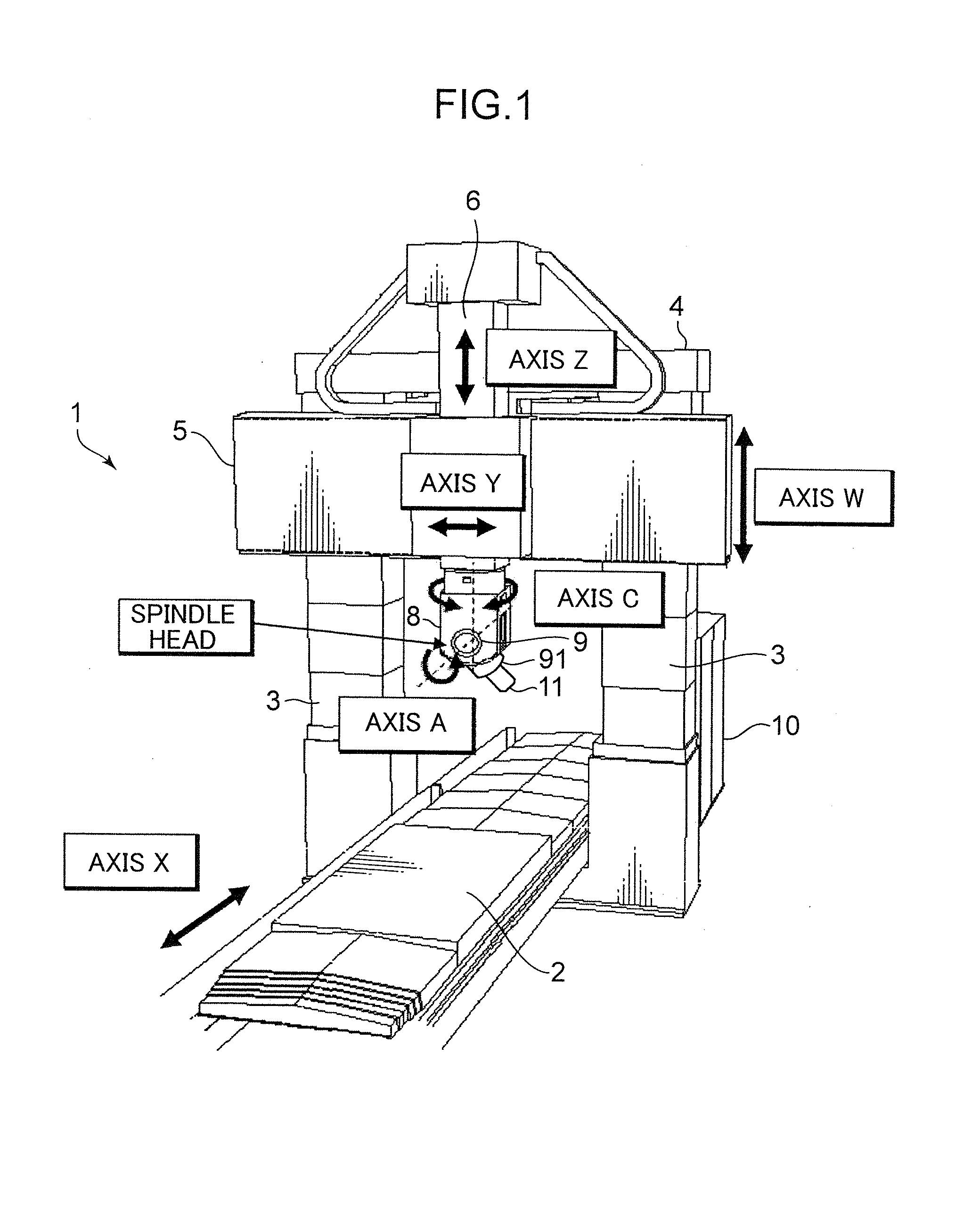
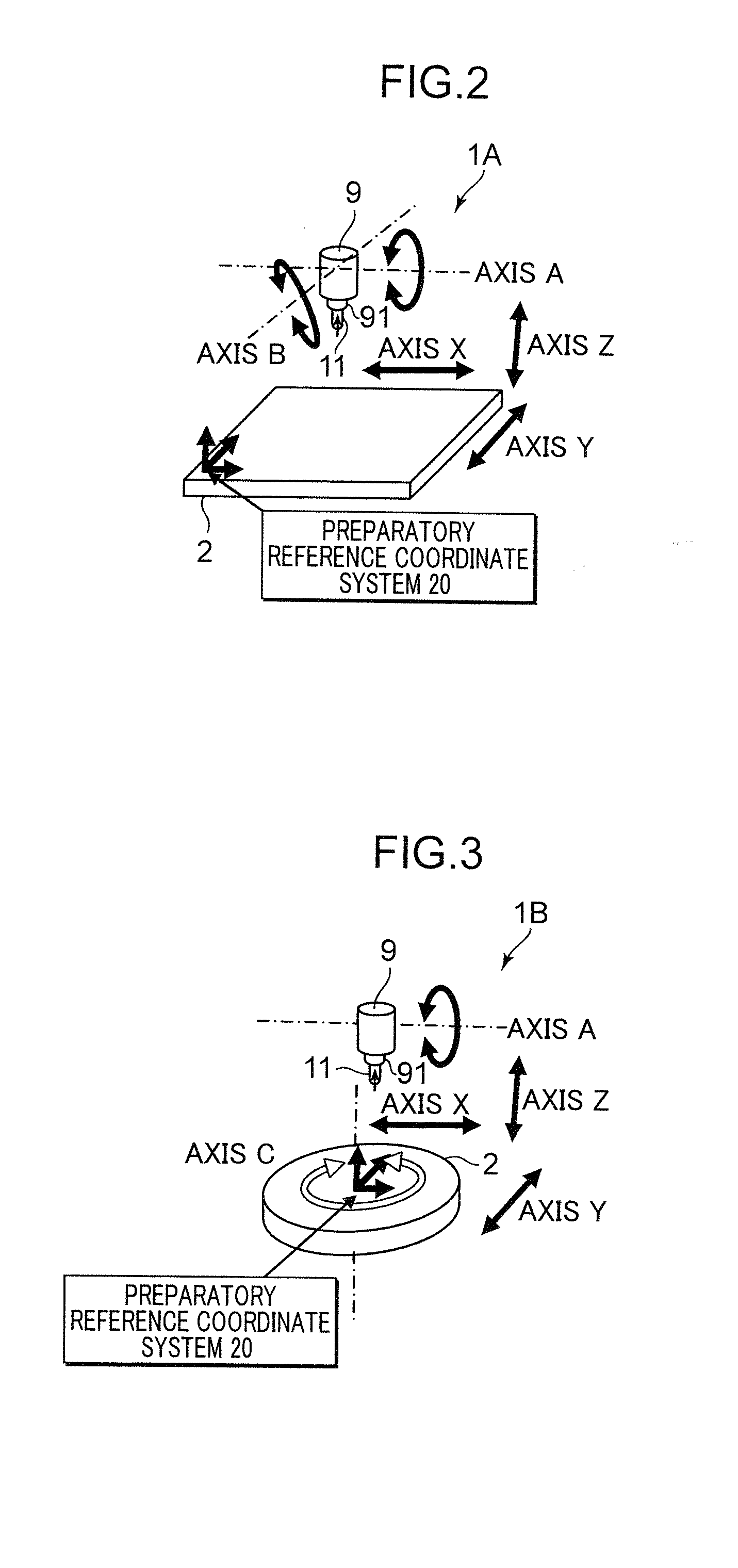
 Login to View More
  Login to View More