Unlock instant, AI-driven research and patent intelligence for your innovation.

System, apparatus and methods for controlling multiple output converters

a voltage converter and multiple output technology, applied in the direction of electric variable regulation, process and machine control, instruments, etc., can solve the problems of not disclosing a single controller for the multiple output converter, walley not disclosing a controller programmed for boost and buck-boost conversion using leading edge modulation, and walley not addressing the stability of the multiple output capacitive buck-boost converter

Active Publication Date: 2012-06-07
BOARD OF RGT THE UNIV OF TEXAS SYST +1
View PDF7 Cites 14 Cited by
  • Summary
  • Abstract
  • Description
  • Claims
  • Application Information

AI Technical Summary

Benefits of technology

[0009]In actuality, the single voltage source, multiple-output voltage converter has inherent coupling between the voltage outputs. What is needed is

Problems solved by technology

However, Cuk et al., does not disclose a single controller for the multiple output converters, instead relying on two or more separate and independent nonisolated feedback loops to independently control the duty cycle of each switch in the converter.
However, Walley does not disclose a controller programmed for boost and buck-boost conversion utilizing leading edge modulation with attention to the zero dynamics or input-output linearization.
Furthermore, Walley does not address stability of the multiple output capacitive buck-boost converter.
Tseng et al. does not disclose any apparatus or methodology for controlling the duty cycles of the switching elements and does not address stability of the multiple output switching regulator.

Method used

the structure of the environmentally friendly knitted fabric provided by the present invention; figure 2 Flow chart of the yarn wrapping machine for environmentally friendly knitted fabrics and storage devices; image 3 Is the parameter map of the yarn covering machine
View more

Image

Smart Image Click on the blue labels to locate them in the text.
Viewing Examples
Smart Image
  • System, apparatus and methods for controlling multiple output converters
  • System, apparatus and methods for controlling multiple output converters
  • System, apparatus and methods for controlling multiple output converters

Examples

Experimental program
Comparison scheme
Effect test

Embodiment Construction

[0026]The disclosed embodiments provide novel concepts that can be applied in a wide variety of situations related to feedback control of non-linear systems. The embodiments disclosed are examples only and do not limit the scope of the claimed invention.

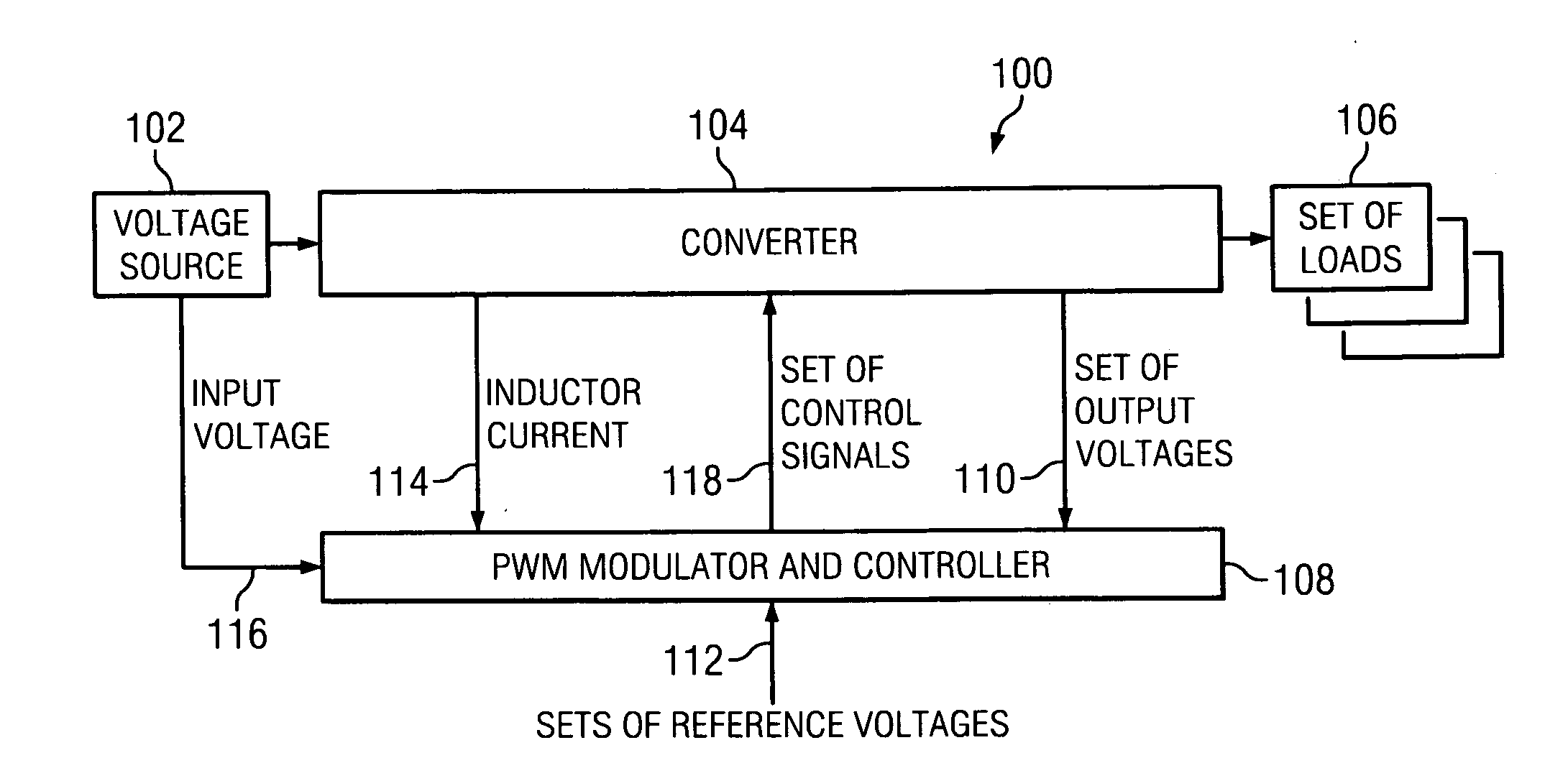
[0027]The disclosed embodiments illustrate a system and method for implementing and controlling a multiple-output converter. In particular, the embodiments employ a generalized Cuk-Middlebrook model to compute a duty ratio vector for a multiple output boost converter or a multiple output buck-boost converter. The apparatus and methods can also be applied to other converter types.

[0028]Many forms of control apparatus and methods are applicable to the present invention. Moreover, the parameters in the control apparatus are programmable, hence lending themselves to implementation in silicon, such as a general purpose CPU, a digital signal processor (DSP), a microcontroller, a controller, a mixed signal SoC, an ASIC, an FPGA or a convent...

the structure of the environmentally friendly knitted fabric provided by the present invention; figure 2 Flow chart of the yarn wrapping machine for environmentally friendly knitted fabrics and storage devices; image 3 Is the parameter map of the yarn covering machine
Login to View More

PUM

No PUM Login to View More

Abstract

An apparatus and method is presented for implementing and controlling a voltage converter with one input voltage and multiple output voltages. In the case of boost and buck-boost converters, a converter circuit with one inductor and a switched group of parallel connection capacitors is realized, one parallel connection for each output voltage. A duty ratio is monitored for the inductor and the switched group of capacitors to provide a set of duty ratios. The duty ratios form a control vector which describes the control inputs. The output voltages are the control outputs describing a MIMO system. A generalized Cuk-Middlebrook modeling approach is applied to the voltage converter, along with linearization and MIMO control methods to regulate all output voltages to desired levels.

Description

CROSS-REFERENCE TO RELATED APPLICATIONS[0001]This application claims priority to provisional application No. 61 / 458,850 filed on Dec. 2, 2010. This application is also a continuation-in-part of patent application no. 12 / 487,242 filed on Jun. 18, 2009.FIELD OF THE INVENTION[0002]This application relates to the development of an apparatus and methods for controlling multiple output voltages from a voltage converter, utilizing multiple input multiple output (MIMO) models based on a generalized Cuk-Middlebrook state-space averaging.BACKGROUND[0003]There is an ever increasing need for single voltage source, multiple output voltage converters. Hence, there are a variety of methods in the prior art that treat this as a single input, multiple output (SIMO) problem by decomposing the system into multiple single-input single-output (SISO) systems. These can involve various hardware configurations or can involve manipulating switching times in each switching period, but all of these essentiall...

Claims

the structure of the environmentally friendly knitted fabric provided by the present invention; figure 2 Flow chart of the yarn wrapping machine for environmentally friendly knitted fabrics and storage devices; image 3 Is the parameter map of the yarn covering machine
Login to View More

Application Information

Patent Timeline
no application Login to View More
IPC IPC(8): G05F1/10
CPCH02M3/156H03K7/08H02M2001/009H02M3/158H02M1/009
Inventor HUNT, LOUIS ROBERTSBHATIA, DINESH KUMARBALSARA, PORAS T.
Owner BOARD OF RGT THE UNIV OF TEXAS SYST