
System and Methods for Multi-Objective Cell Switch-Off in Wireless Networks
- Summary
- Abstract
- Description
- Claims
- Application Information
AI Technical Summary
Benefits of technology
Problems solved by technology
Method used
Image

Examples
Embodiment Construction
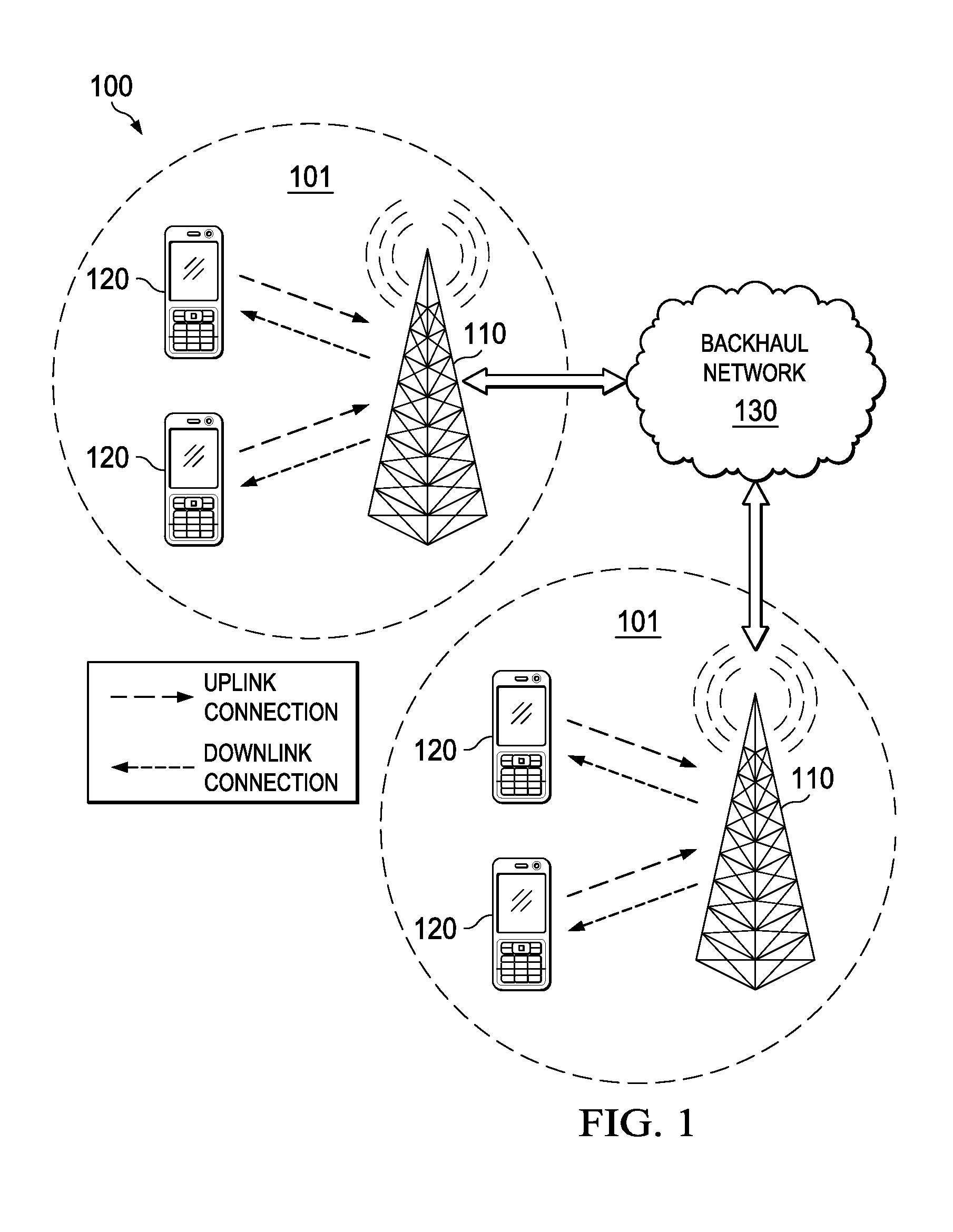
[0026]The making and using of the presently preferred embodiments are discussed in detail below. It should be appreciated, however, that the present invention provides many applicable inventive concepts that can be embodied in a wide variety of specific contexts. The specific embodiments discussed are merely illustrative of specific ways to make and use the invention, and do not limit the scope of the invention.
[0027]Typical CSO schemes for solving the CSO problem include snapshot based CSO schemes. Such schemes use network-wide scheduling in each snapshot of a determined time period with the goal of minimizing the number of cells or base stations in the network. The terms base stations and cells are used herein interchangeably to refer to radio serving nodes and their coverage regions. In such schemes, traffic information is taken into account explicitly (e.g., user locations and channel states are assumed to be known) to make the cell switch on / off decisions. The decisions are mad...
PUM
 Login to View More
 Abstract
Description
Claims
Application Information
 Login to View More