
System and Method for Assessing Impulse Control Disorder
a system and impulse control technology, applied in the field of system and method for assessing impulse control disorder, can solve the problems of difficult diagnosis of icd, inconvenient diagnosis and treatment, and inability to accurately diagnose icd, etc., and achieve the effects of less inhibited, less expensive, and less time-consuming
- Summary
- Abstract
- Description
- Claims
- Application Information
AI Technical Summary
Benefits of technology
Problems solved by technology
Method used
Image

Examples
example 1
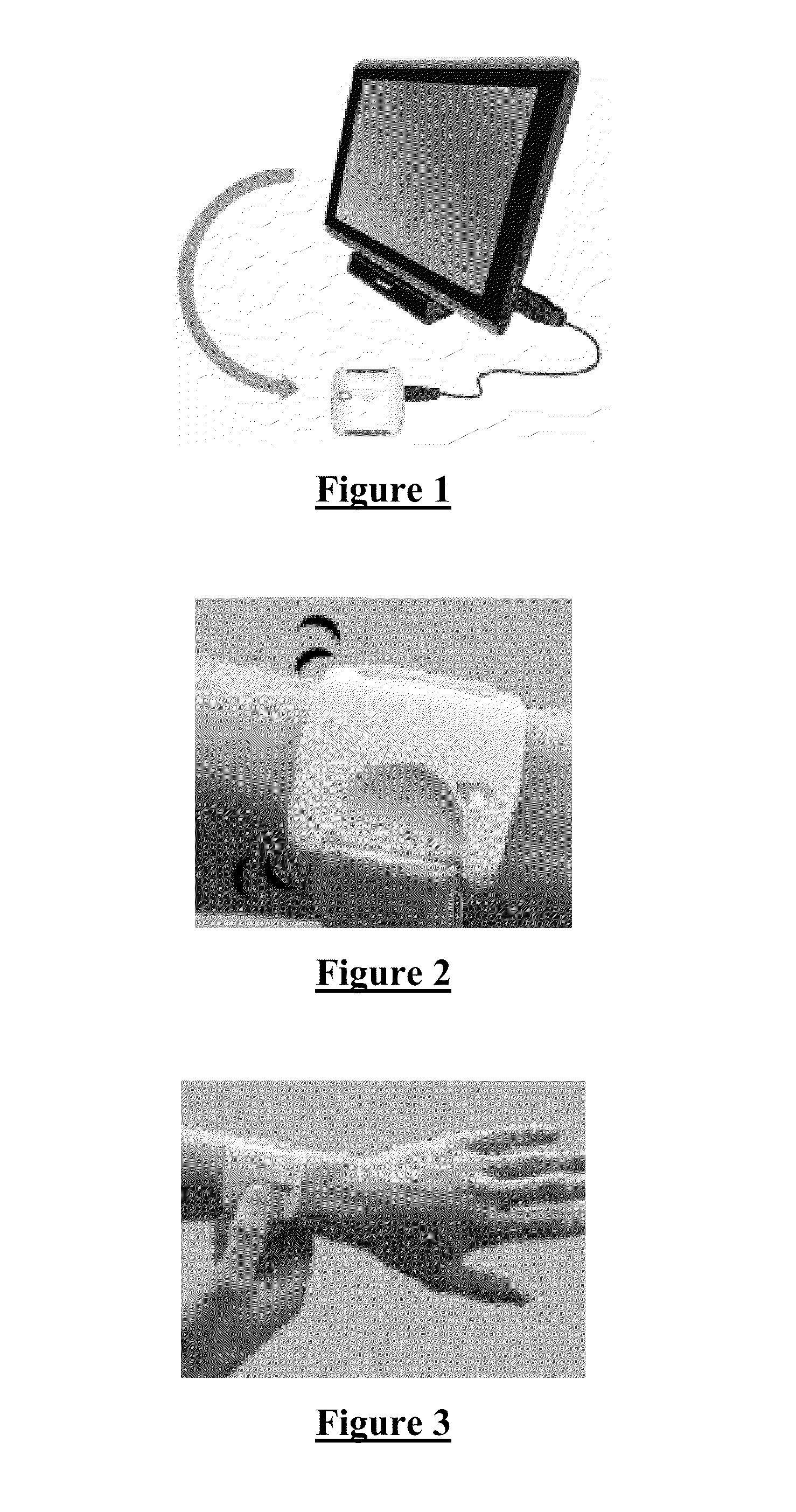
[0035]The Parkinson's Kinetigraph (PKG) of Global Kinetics Corporation Pty Ltd was used to provide a remote monitoring system and user actuator. Each patient was provided with a wrist-worn data logger. Each wrist-worn data logger was programmed to remind the respective patient when to take their levodopa medication (FIG. 1).
[0036]When it is time for the patient to take their levodopa medication, the wrist-worn data logger will vibrate and a light will flash for 10 seconds (FIG. 2).
[0037]The individual was instructed that, once they had taken the prescribed medication, they should press the button on the wrist-worn device to deactivate the reminder. The wrist-worn data logger continues to remind the patient to take their medication until they have confirmed that you have done so, by pressing the button (FIG. 3). User confirmation is effected by the user holding their thumb in the thumb groove on the top of the wrist-worn data logger for three seconds, at which time the light will com...
example 2
[0047]The Parkinson's Kinetigraph (PKG) of Global Kinetics Corporation Pty Ltd was used to provide a remote monitoring system and user actuator, in a similar manner as described for Example 1 above in relation to FIGS. 1 to 3. Additionally, if at times other than the pre-programmed medication times the subject places their thumb on the wrist-worn data logger for 3 seconds, this triggers a brief (1 s) vibration and is recorded as a “redundant response”. The timing of both correct responses associated with a reminder, and redundant responses not associated with a reminder, was recorded.
TABLE 2UPDRSACE-SCOPA-BIS / PercentileAgeDurat'nLEDUPDRS 1UPDRS 2UPDRS 3UPDRS 4TotalRCOGBDIBASSTAIASLow RR25th516525067217912666653550th73107282814433962877063775th7614100031323740973210778611High RR25th64146541119633862387360350th69161207312198449130157777775th752221005172810539532217910517False Neg25th61568211314332842286378850th64910902141863994291072821175th7513179142040873943513799814
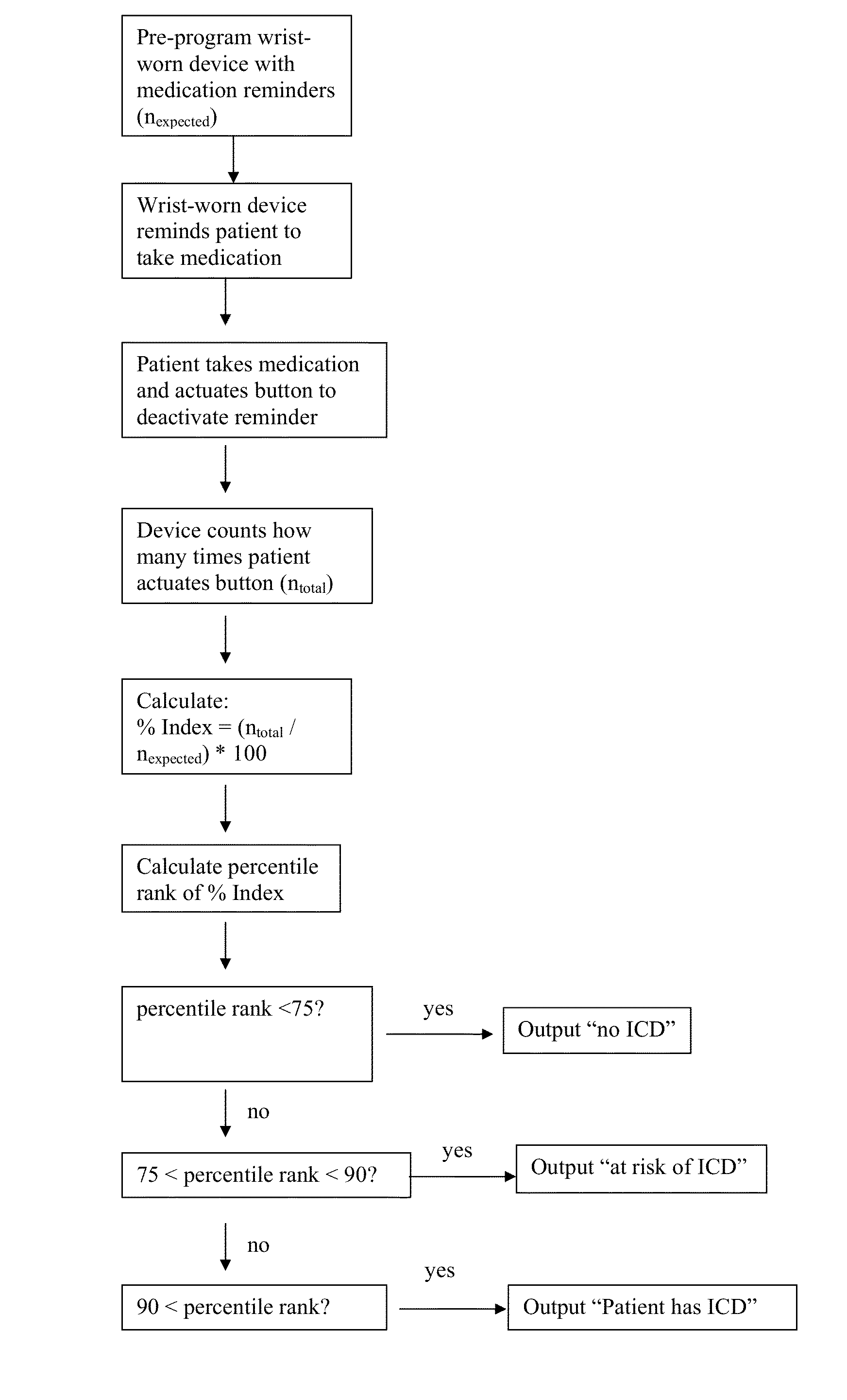
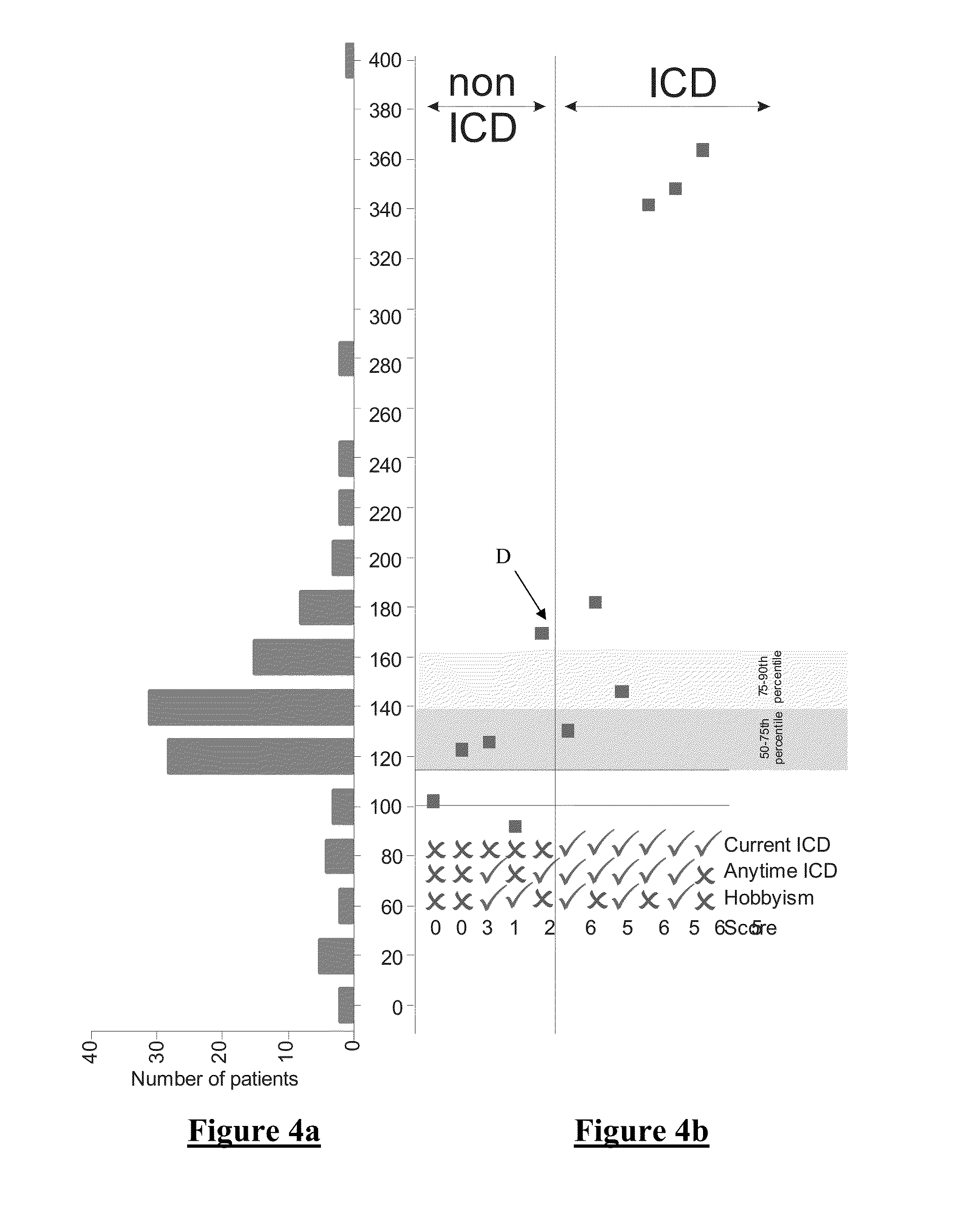
[0048]To obtain ...
PUM
 Login to View More
 Abstract
Description
Claims
Application Information
 Login to View More