
Compositions and methods for use in surface decontamination
a technology of disinfectant agents and compositions, applied in the direction of detergent compounding agents, chemical indicators, investigating sterilization degree, etc., can solve the problems of inability to carry around or install ultraviolet light sources, inability to provide proper training on proper removal of personal protective equipment, and inability to be easily accessible. , to achieve the effect of adequate decontamination or disinfection of the surface, complete coverage of the surfa
- Summary
- Abstract
- Description
- Claims
- Application Information
AI Technical Summary
Benefits of technology
Problems solved by technology
Method used
Image

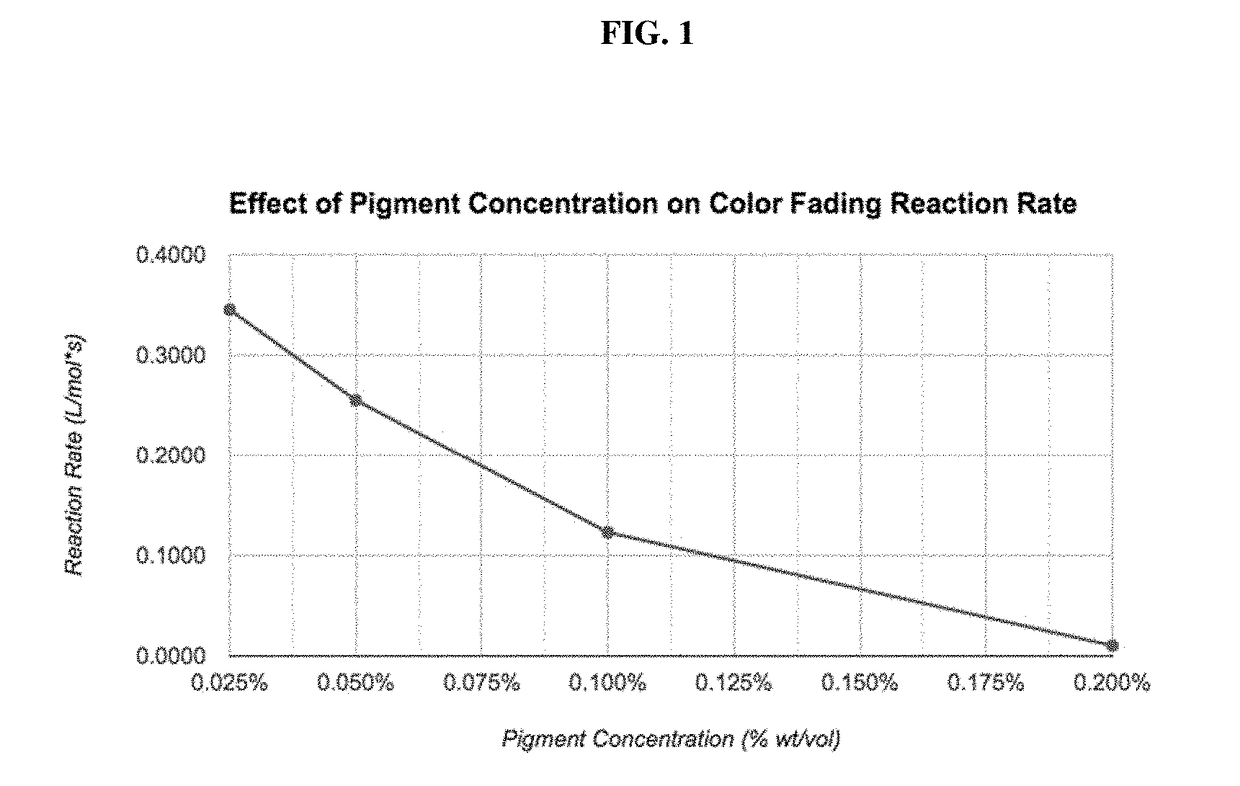
Examples
example 1
[0124]Powdered compositions were made consisting of:
% Wt. / Wt.Compo-Compo-Compo-Compo-Ingredientsition Asition Bsition Csition DFD&C Blue 11.182.334.558.70Surfactant (SDS)94.1293.0290.9186.96Alkaline builder4.714.654.554.35(NaOH)
[0125]The procedure was to blend the ingredients and stir into 0.525% sodium hypochlorite diluted in water. 200 μl of the resulting mixtures was pipetted in quadruplets into separate wells of a 24-well plate. A spectrophotometer was used to measure absorbance (620 nm) 1, 2, 3, 5, 8, 12, 15, 20, and 30 minutes after the mixture was prepared. Reaction rates were averaged across the quadruplet wells and plotted against time.
[0126]When these formulas are mixed into 0.525% sodium hypochlorite diluted in water, the resulting mixtures are light to deep blue solutions. Compositions A, B, C, and D fade in 2, 5, 10, and 18 minutes when applied to a surface, respectively. All compositions are stable in color for 45 minutes when left in solution.
[0127]The purpose of this...
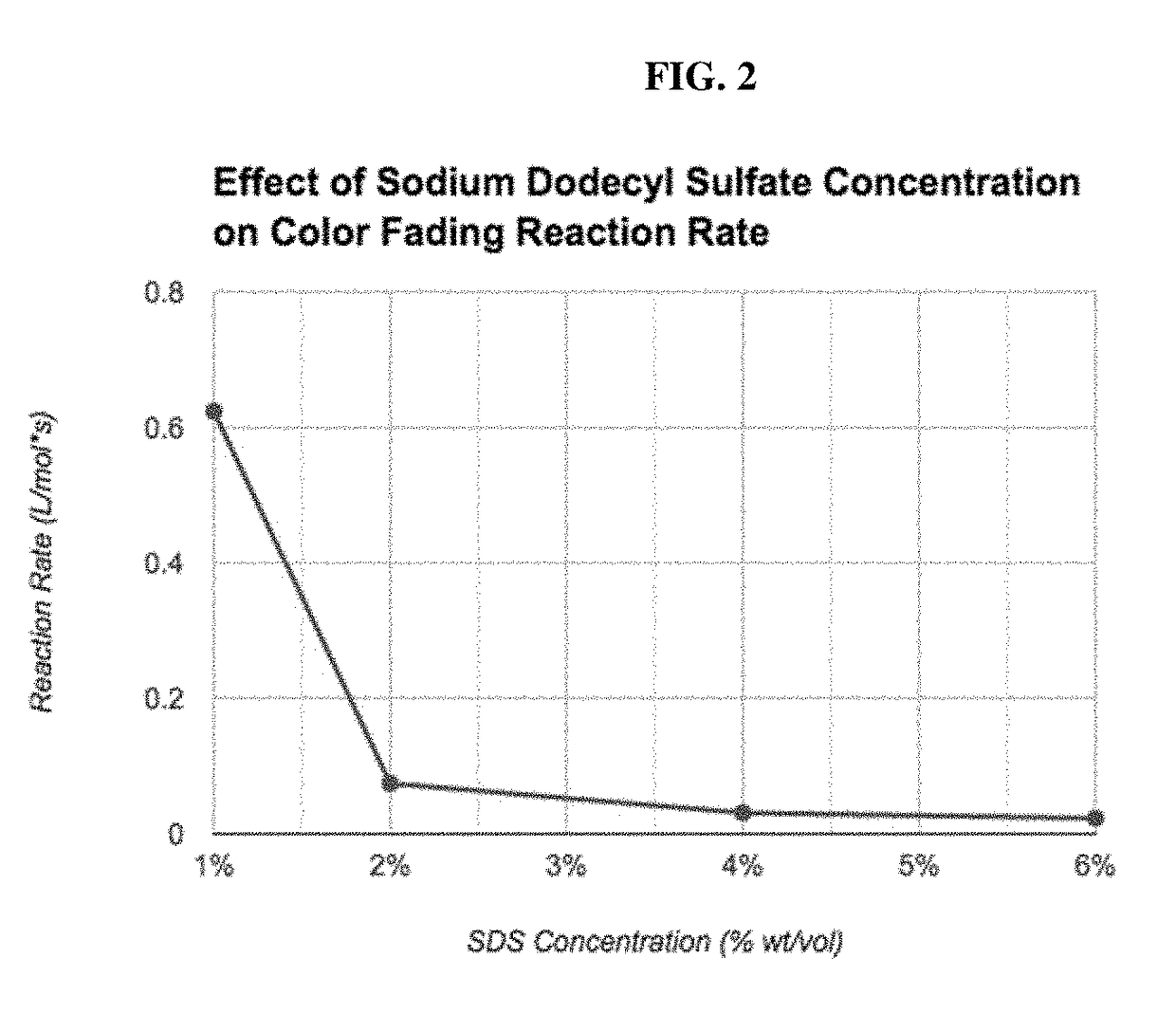
example 2
[0128]Powdered compositions were made consisting of:
% Wt. / Wt.Compo-Compo-Compo-Compo-Ingredientsition Asition Bsition Csition DFD&C Blue 18.334.552.381.61Surfactant (SDS)83.3390.9195.2496.77Alkaline builder8.334.552.381.61(NaOH)
[0129]The procedure was to blend the ingredients and stir into 0.525% sodium hypochlorite diluted in water. 200 μl of the resulting mixtures was pipetted in quadruplets into separate wells of a 24-well plate. A spectrophotometer was used to measure absorbance (620 nm) 1, 2, 3, 5, 8, 12, 15, 20, and 30 minutes after the mixture was prepared. Reaction rates were averaged across the quadruplet wells and plotted against time.
[0130]When these formulas are mixed into 0.525% sodium hypochlorite diluted in water, the resulting mixtures are deep blue solutions. Compositions A, B, C, and D fade in 8, 10, 12, and 15 minutes when applied to a surface, respectively. Compositions A and B are stable in color for 45 minutes when left in solution. Compositions C and D are sta...
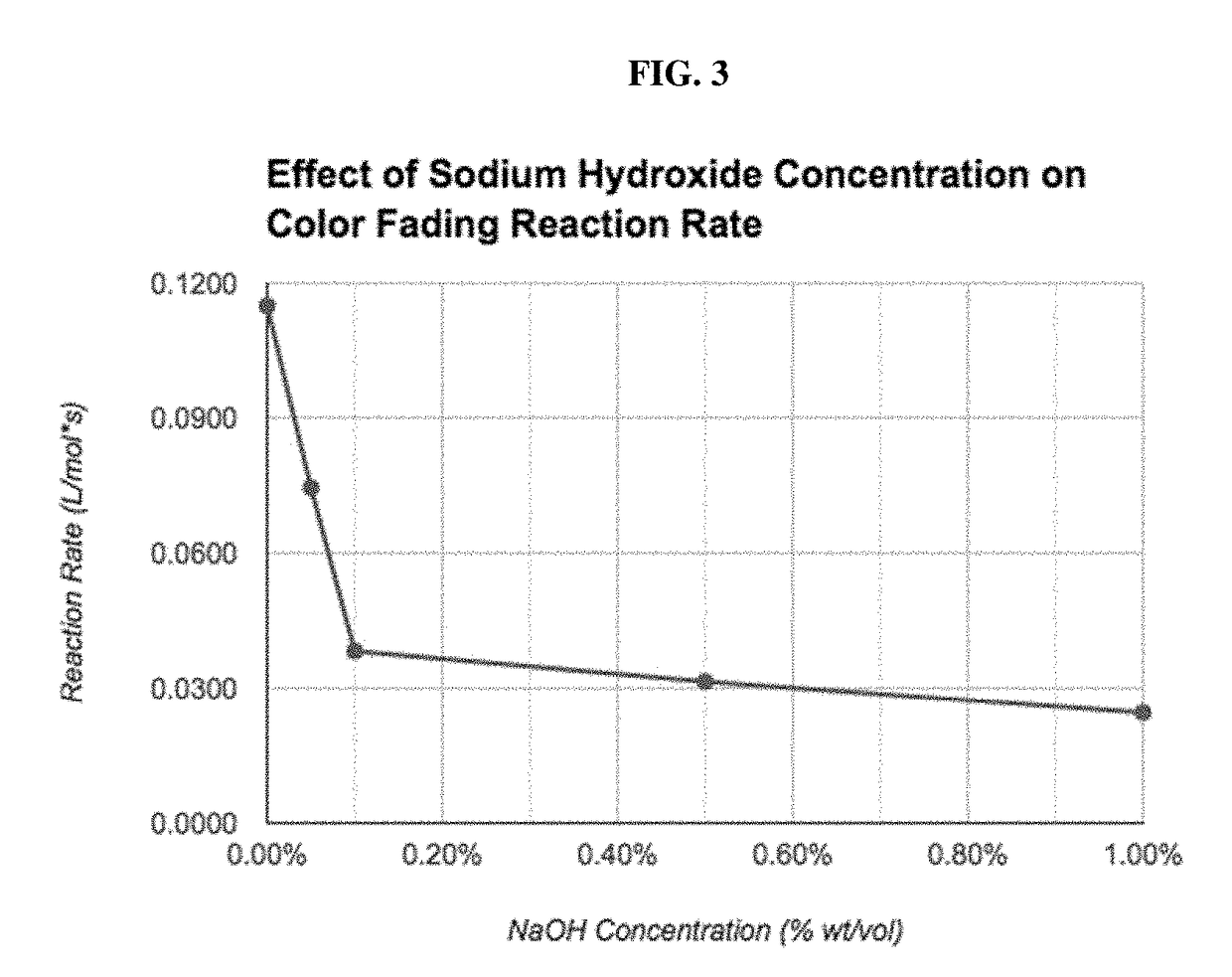
example 3
[0132]Powdered compositions were made consisting of:
% Wt. / Wt.Comp.Comp.Comp.Comp.Comp.IngredientABCDEFD&C Blue 14.764.654.553.853.23Surfactant (SDS)95.2493.0290.9176.9264.52Alkaline builder0.002.334.5519.2332.26(NaOH)
[0133]The procedure was to blend the ingredients and stir into 0.525% sodium hypochlorite diluted in water. 200 μl of the resulting mixtures was pipetted in quadruplets into separate wells of a 24-well plate. A spectrophotometer was used to measure absorbance (620 nm) 1, 2, 3, 5, 8, 12, 15, 20, and 30 minutes after the mixture was prepared. Reaction rates were averaged across the quadruplet wells and plotted against time.
[0134]When these formulas are mixed into 0.525% sodium hypochlorite diluted in water, the resulting mixtures are deep blue solutions. Compositions A, B, C, D, and E fade in 2, 4, 10, 12, and 15 minutes when applied to a surface, respectively. Compositions A, B, C, D, and E are stable in color for 12, 20, 45, 60, and 70 minutes when left in solution, res...
PUM
| Property | Measurement | Unit |
|---|---|---|
| time | aaaaa | aaaaa |
| time | aaaaa | aaaaa |
| pH | aaaaa | aaaaa |
Abstract
Description
Claims
Application Information
 Login to View More