Athletic traction sock

a technology of traction socks and socks, applied in the field of athletic socks, can solve the problems of unnecessarily long response time, the sock associated, and the sock/foot combination or just the sock, so as to reduce the possibility of slippage of the foot of an individual, reduce the delay in complete reactivity, and increase the friction between the socks

a technology of traction socks and socks, applied in the field of athletic socks, can solve the problems of unnecessarily long response time, the sock associated, and the sock/foot combination or just the sock, so as to reduce the possibility of slippage of the foot of an individual, reduce the delay in complete reactivity, and increase the friction between the socks

US20190082746A1Inactive Publication Date: 2019-03-21STORELLI SPORTS INC

Image

Smart Image Click on the blue labels to locate them in the text.
Viewing Examples
Smart Image
  • Athletic traction sock
  • Athletic traction sock
  • Athletic traction sock

Examples

Experimental program
Comparison scheme
Effect test

Embodiment Construction

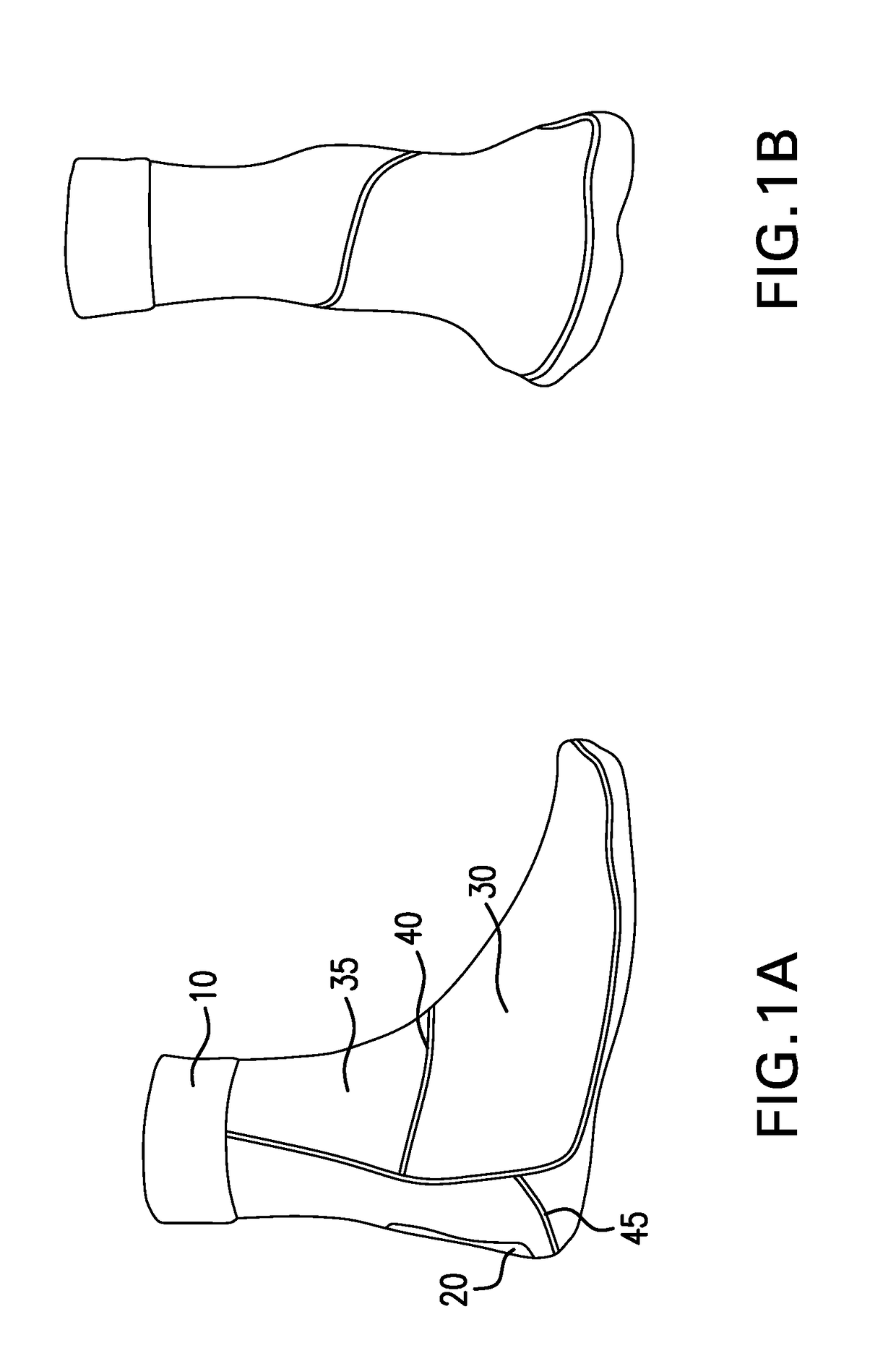
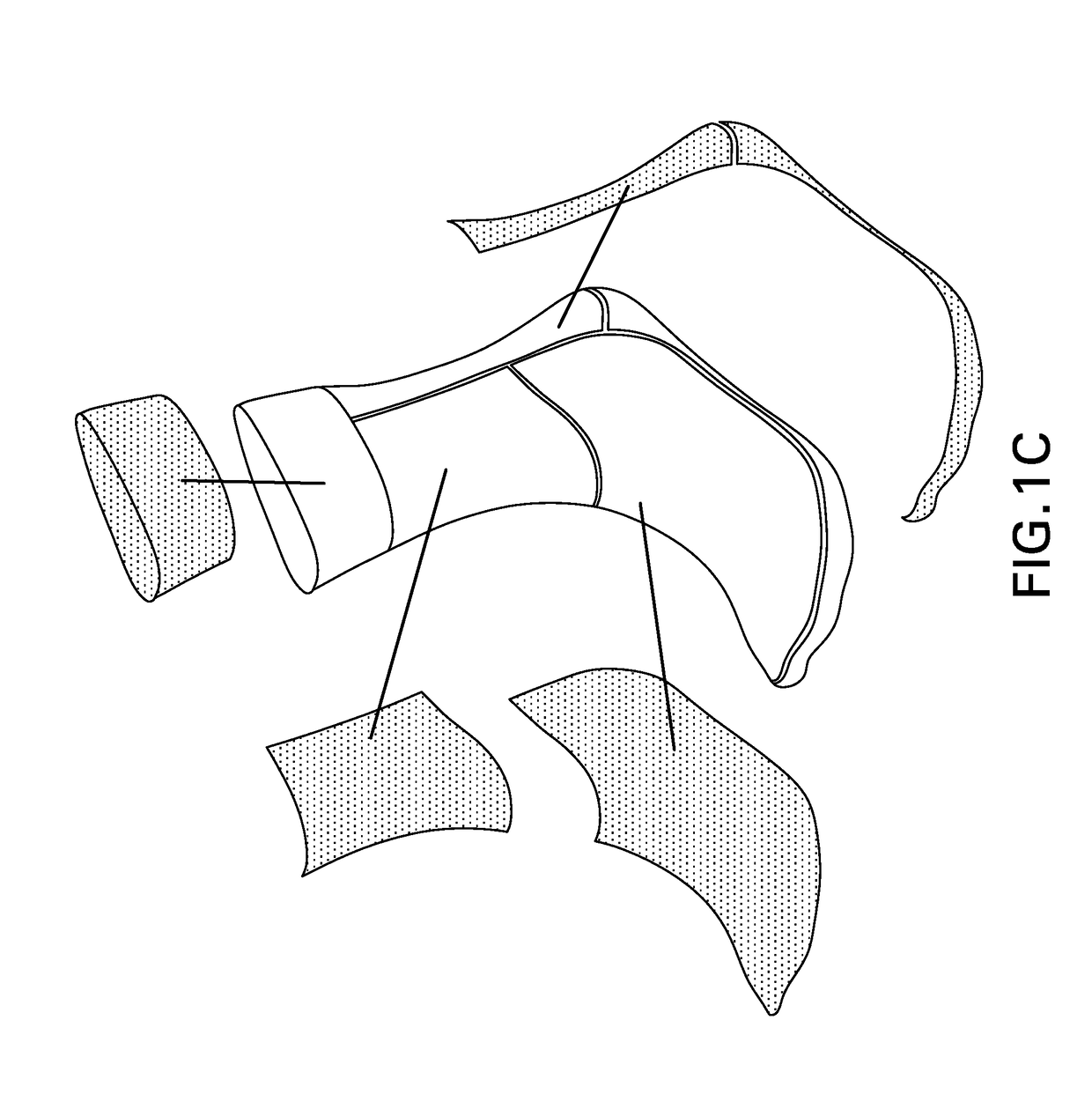
[0031]With reference now to the drawings, FIGS. 1A, 1B, and 1C depict an embodiment of a sock constructed by a “cut and sew” method as opposed to knitting. The sock is comprised of a plurality of pieces of material (see, e.g., FIG. 1C) that are cut into desired shapes and sewn or otherwise attached together to form a sock. Sewing is as seamless as possible.

[0032]As shown in FIGS. 1A and 1B, different pieces of material, at times formed of different compositions, are attached together. As shown in an example in FIG. 1A, portion 10 may be an elasticized section for holding the sock up the leg, portion 20 may be friction elements so as to avoid slippage and may be formed using, for example, micro suede gripping material, portions 30 and 35 may have wicking and / or air flow functionality, and attaching elements 40 and 45 may be bonding attributes between elements.

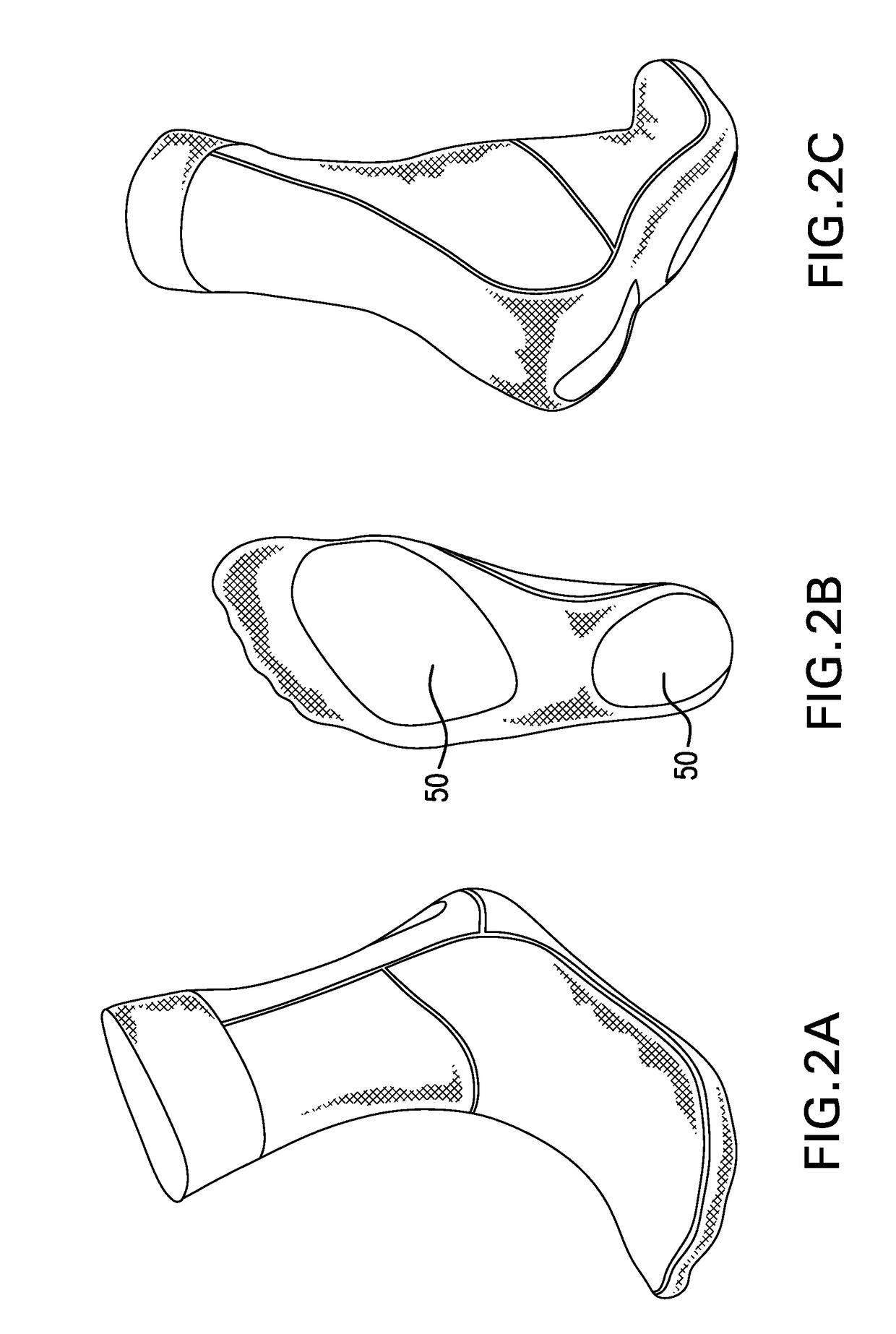
[0033]FIGS. 2A-2E depict various combinations of materials that can be used to form the sock. In one embodiment, the materials...

the structure of the environmentally friendly knitted fabric provided by the present invention; figure 2 Flow chart of the yarn wrapping machine for environmentally friendly knitted fabrics and storage devices; image 3 Is the parameter map of the yarn covering machine
Login to View More

PUM

No PUM Login to View More

Abstract

A single-layer sock preferably formed of interconnected pieces with at least one of the pieces strategically placed for stabilizing a foot within a shoe and at least one piece comprised of gripping material.

Description

FIELD OF THE INVENTION[0001]The present invention relates generally to the field of athletic socks, and more specifically, to a sock that is constructed preferably by a “cut and sew” or “cut and bond” method wherein gripping material, synthetic or otherwise, is used for portions of the sock, such as but not limited to the sole and heel portions of the sock, and not as an overlay to an otherwise complete sock. This novel sock with gripping material provides benefits including but not limited to stabilizing an individual's foot via the sock within a shoe (thanks to increased traction), thus improving the individual's response time in reaction and explosiveness of movement.BACKGROUND OF THE INVENTION[0002]Athletic socks are commonly worn by individuals (e.g., athletes) and ordinarily in conjunction with athletic shoes. However, not all shoes are alike and shoe fitting is not typically snug throughout. An individual's foot and a sock worn by the individual commonly do not fill the entir...

Claims

the structure of the environmentally friendly knitted fabric provided by the present invention; figure 2 Flow chart of the yarn wrapping machine for environmentally friendly knitted fabrics and storage devices; image 3 Is the parameter map of the yarn covering machine
Login to View More

Application Information

Patent Timeline
21 Mar 2019
Publication
US20190082746A1
IPC
A41B11/00; A41B11/12
CPC
A41B11/008; A41B11/003; A41B11/12; A41B2500/30; A41B2400/82; A41B2400/60; A41B2400/20
Inventors
STORELLI, CLAUDIO; MARCHESI, THOMAS VINCENT