Unlock instant, AI-driven research and patent intelligence for your innovation.

Method of creating a transit schedule

a transit schedule and method technology, applied in the field of creating a transit schedule, can solve the problem that passengers and connections use updates of minimal us

Inactive Publication Date: 2020-10-08
ENTRIKEN WILLIAM
View PDF0 Cites 0 Cited by
  • Summary
  • Abstract
  • Description
  • Claims
  • Application Information

AI Technical Summary

Benefits of technology

The invention aims to create a new and accurate schedule for transit systems by using comprehensive data from an operational transit system that was previously planned. The data includes actual arrival and departure times, as well as information about the type of service and the route being walked. The system takes into account real-time data, such as weather or traffic, to adjust for changes in the schedule. The new schedule can be printed, displayed, or used for planning and navigation purposes. The invention solves the problem of weaknesses in previous systems by providing a more accurate and fixed schedule based on actual data.

Problems solved by technology

Such updates are of minimal use for passengers and connections because it does not allow for advance planning by those parties.

Method used

the structure of the environmentally friendly knitted fabric provided by the present invention; figure 2 Flow chart of the yarn wrapping machine for environmentally friendly knitted fabrics and storage devices; image 3 Is the parameter map of the yarn covering machine
View more

Image

Smart Image Click on the blue labels to locate them in the text.
Viewing Examples
Smart Image
  • Method of creating a transit schedule
  • Method of creating a transit schedule
  • Method of creating a transit schedule

Examples

Experimental program
Comparison scheme
Effect test

Embodiment Construction

[0023]Scenarios and options are non-limiting embodiments.

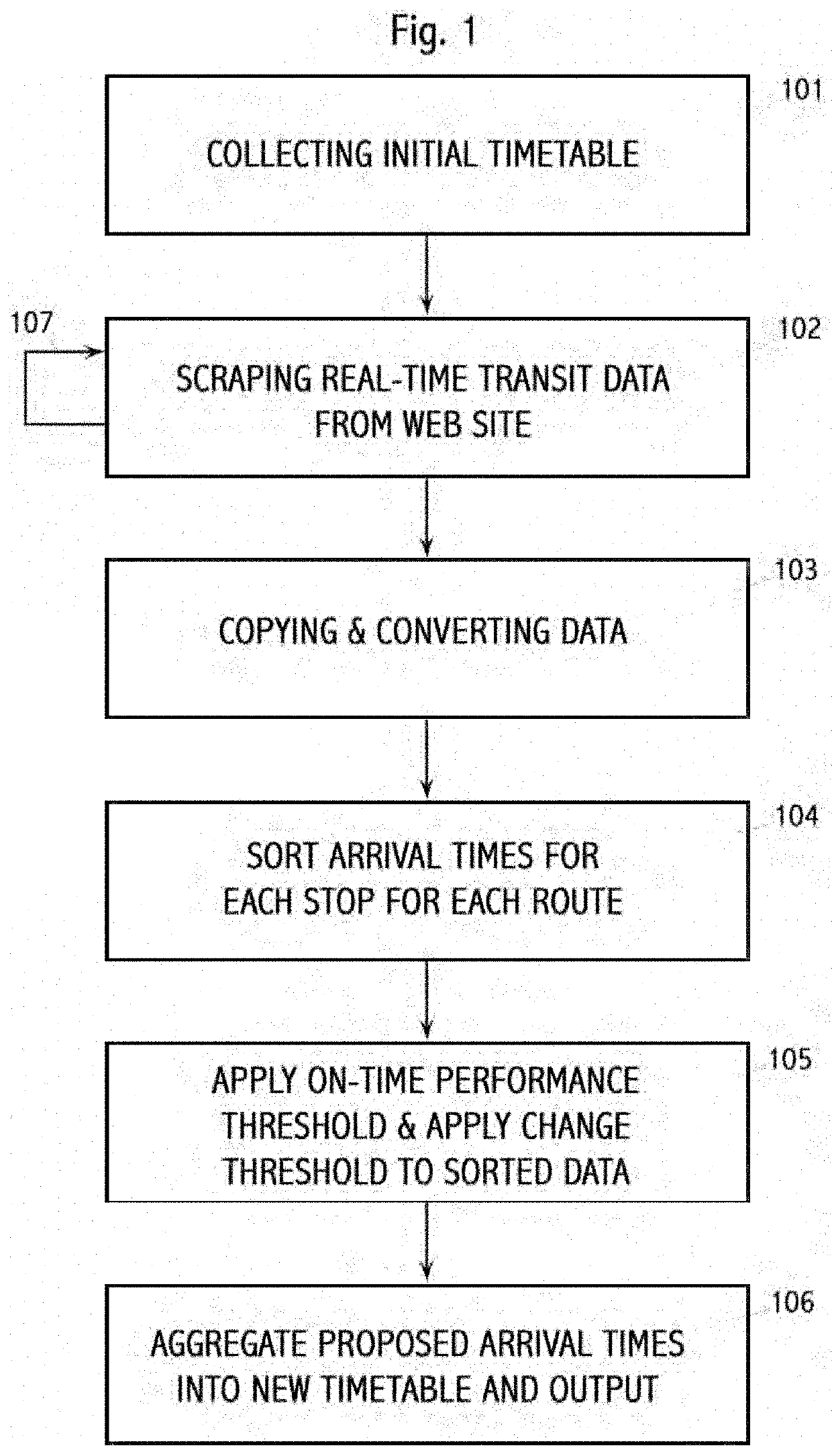
[0024]The technical problem to solve is: creating accurate, new transit timetables for a route and stops, based on historical performance.

[0025]Collecting data on actual, historical performance of transit agency trips is non-trivial. One method is to look at real-time data of individual trips. This information is continually updated, but only shows “current” trips. Thus, any such web site must be continually monitored in order to collect data on all trips. This is an interactive, on-going process, as typically information, such as a flight number or train number, must be entered into the web site before it will display time data about that trip. An app on a personal electronic device, such as a smart phone, smart watch, tablet, personal computer, virtual reality or augmented reality screen, or heads-up display, is for the purposes of this patent application, also a web site.

[0026]For convenience we refer to any organization wi...

the structure of the environmentally friendly knitted fabric provided by the present invention; figure 2 Flow chart of the yarn wrapping machine for environmentally friendly knitted fabrics and storage devices; image 3 Is the parameter map of the yarn covering machine
Login to View More

PUM

No PUM Login to View More

Abstract

A method of generating an improved transit schedule is described that incorporates real-time arrival time data, such as actual minutes of lateness for each stop for each train in a train transit district. Lateness data is collected over a time period, such as a year. After sorting the collected arrival times for each stop for each route, the list is sorted for ascending lateness. A performance percentage is used to select a time from the list such that the performance percentage of trips would have been on time. This is a proposed arrival time for a new timetable. Finally, a change threshold is applied so that changes below the threshold, such as two minutes, are left the same as on the initial schedule. The final new timetable is published or printed, or otherwise made available.

Description

BACKGROUND OF THE INVENTION[0001]Transportation timetables, such as train schedules, bus schedules and flight schedules, are typically created by the associated transit agency using models to compute an estimated transit time between stops. The models are often complex, considering factors such as distance, type of road or rail, time of day, time of year, day of week, typical weather, expected traffic, equipment to be used, and the like, etc. This approach suffers from two weaknesses. First, this modeling approach often does not produce an accurate schedule. For example, one particular train may typically run 20 minutes late from this a planned model-based schedule. As another example, one particular fight might typically arrive 20 minutes early. Prior art schedules may be viewed as “planned” performance. A second weakness is that modeling generally assumes that equipment is ready at the planned departure time. However, in many cases the equipment arrives late, as an incoming train ...

Claims

the structure of the environmentally friendly knitted fabric provided by the present invention; figure 2 Flow chart of the yarn wrapping machine for environmentally friendly knitted fabrics and storage devices; image 3 Is the parameter map of the yarn covering machine
Login to View More

Application Information

Patent Timeline
no application Login to View More
IPC IPC(8): B61L27/00G08G1/127G06F16/953
CPCG06F16/953B61L27/0022G06Q50/30G08G1/127B61L27/0016B61L27/12B61L27/14G06Q50/40
Inventor ENTRIKEN, WILLIAM
Owner ENTRIKEN WILLIAM
Features
  • R&D
  • Intellectual Property
  • Life Sciences
  • Materials
  • Tech Scout
Why Patsnap Eureka
  • Unparalleled Data Quality
  • Higher Quality Content
  • 60% Fewer Hallucinations
Social media
Patsnap Eureka Blog
Learn More