

Functional complex polysaccharide particle
- Summary
- Abstract
- Description
- Claims
- Application Information
AI Technical Summary
Benefits of technology
Problems solved by technology
Method used
Image

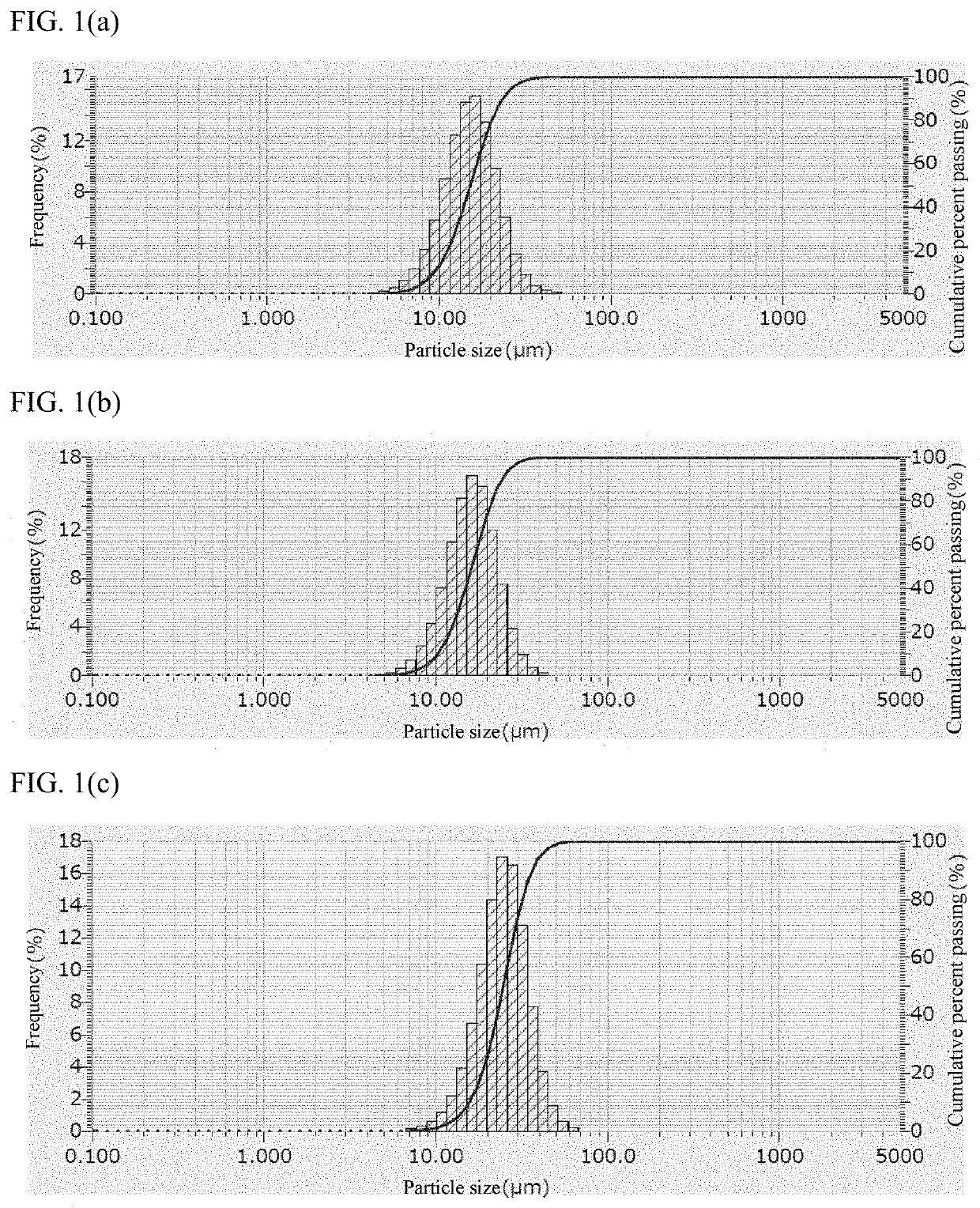


Examples
example 1
[0048]A mixed liquid comprising 200 g of the microcrystalline cellulose dispersion obtained in Reference Synthetic Example 1 and 200 g of 1% by mass aqueous dispersion of talc (available from Nippon Talc Co., Ltd.) was stirred and spray-dried at an atomizer rotation speed of 20,000 rpm, an inlet temperature of 160° C., and a cyclone differential pressure of 0.5 kPa to obtain 3.5 g of powder as the title particles.
example 2
[0049]A mixed liquid comprising 200 g of the microcrystalline cellulose dispersion obtained in Reference Synthetic Example 1 and 200 g of 4% by mass aqueous dispersion of talc (available from Nippon Talc Co., Ltd.) was stirred and spray-dried at an atomizer rotation speed of 20,000 rpm, an inlet temperature of 160° C., and a cyclone differential pressure of 0.5 kPa to obtain 5.0 g of powder as the title particles.
example 3
of Cellulose:Talc=1:4.5 w / w
[0050]A mixed liquid comprising 200 g of the microcrystalline cellulose dispersion obtained in Reference Synthetic Example 1 and 200 g of 9% by mass aqueous dispersion of talc (available from Nippon Talc Co., Ltd.) was stirred and spray-dried at an atomizer rotation speed of 20,000 rpm, an inlet temperature of 160° C., and a cyclone differential pressure of 0.5 kPa to obtain 11.3 g of powder as the title particles.
PUM
| Property | Measurement | Unit |
|---|---|---|
| Fraction | aaaaa | aaaaa |
| Fraction | aaaaa | aaaaa |
| Fraction | aaaaa | aaaaa |
Abstract
Description
Claims
Application Information
 Login to View More