Method of using multiple populations with cross-breeding in a genetic algorithm

Inactive Publication Date: 2005-02-22
HEWLETT PACKARD DEV CO LP
View PDF13 Cites 10 Cited by
  • Summary
  • Abstract
  • Description
  • Claims
  • Application Information

AI Technical Summary

Benefits of technology

A method is disclosed for processing data to identify optimal solutions to a problem using a genetic algorithm. Multiple data populations are created and kept separate from each other. Each population has multiple data entries, referred to as solutions. The initial solutions in the population may be selected at random, based on input parameters related to a problem. Solutions are rated based on their desirability. Solutions from one population are combined, or “cross-bred,” with solutions from another population to create offspring solutions. The offspring of the cross-over are us associated with one of the parent populations and rated. A selection process the

Problems solved by technology

The process of intra-population is overly degenerative, thereby causing a lack of diversity in the resulting solutions.
Because of this lack of diversity, the solution generated by a population tends to be optimal only with respect to similar solutions and may not be optimal when considered in context of the entire problem.
Mutation may provide some diversity, but does not solve the problem.
The problem with this method is that it keeps potentially bad solutions in the population and still results in less optimal solutions.

Method used

the structure of the environmentally friendly knitted fabric provided by the present invention; figure 2 Flow chart of the yarn wrapping machine for environmentally friendly knitted fabrics and storage devices; image 3 Is the parameter map of the yarn covering machine
View more

Image

Smart Image Click on the blue labels to locate them in the text.
Viewing Examples
Smart Image
  • Method of using multiple populations with cross-breeding in a genetic algorithm
  • Method of using multiple populations with cross-breeding in a genetic algorithm
  • Method of using multiple populations with cross-breeding in a genetic algorithm

Examples

Experimental program
Comparison scheme
Effect test

Embodiment Construction

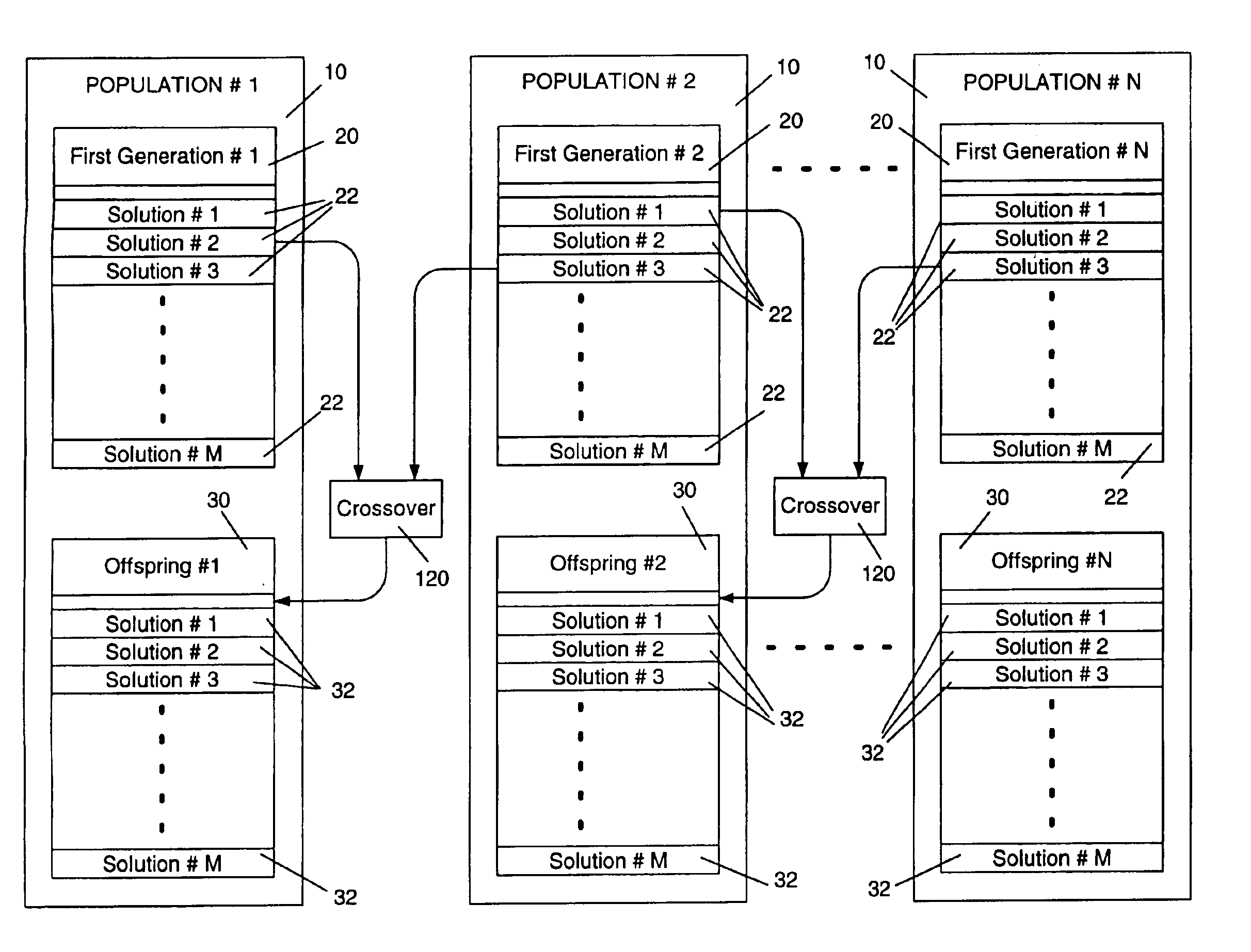
FIG. 1 shows a flow chart of the method 100. Populations of solutions are created 110. As used herein, solutions include any entry or item of data in a population. Solutions may also be referred to as chromosomes. The current generation of solutions in the populations may evolve from one generation to the next using the method 100. Solutions from one population (the first generation or parent generation) are cross-bred 120 with first-generation solutions from another population using known cross-over methods. As used herein, the terms “combine,”“cross-over,”“cross-breed,” and “cross” refer to any method of combining attributes from two or more solutions to create another solution, and may include, for example, any known genetic algorithms for combining solutions. The offspring created by the cross-over 120 are grouped with the population of one of the parents. The next generation of solutions for that population is selected 130 from solutions that comprise the parent generation and ...

the structure of the environmentally friendly knitted fabric provided by the present invention; figure 2 Flow chart of the yarn wrapping machine for environmentally friendly knitted fabrics and storage devices; image 3 Is the parameter map of the yarn covering machine
Login to View More

PUM

No PUM Login to View More

Abstract

A method is disclosed for processing data to identify optimal solutions to a problem using a genetic algorithm. Multiple populations of data entries, referred to as solutions, are created and kept separate from each other. Solutions are rated based on their desirability. Solutions from one population are combined, or “cross-bred,” with solutions from another population to create offspring solutions. The offspring of the cross-over are associated with one of the parent populations and rated. The most desirable solutions within a population are selected from the parent and offspring solutions to form the next generation of solutions. The remaining solutions may be discarded from the population. The cross-over and selection steps may then be repeated using second-generation solutions to create a third generation. The method may be implemented, for example, to design the layout of a circuit board. Diversity of solutions is increased by keeping the populations separate but allowing cross-breeding.

Description

FIELD OF INVENTIONThe present invention relates generally to software methods for identifying optimal solutions to problems. More particularly, it relates to a genetic algorithm for combining solutions from various populations to identify optimal solutions.BACKGROUNDVarious software methods are known for identifying optimal solutions to complicated problems. Some methods use genetic algorithms to identify various solutions. Genetic algorithms may be used to resolve any problem having parameters that define the scope of the problem and solution criteria used to judge the solution. Genetic algorithms may be used, for example, in an application for laying out an integrated circuit, where various layout solutions are possible. The algorithm may, for example, determine where components or cells of components should be positioned to achieve optimal utilization of chip area.Genetic algorithms start with one or more populations of potential solutions, also referred to as chromosomes or gene...

Claims

the structure of the environmentally friendly knitted fabric provided by the present invention; figure 2 Flow chart of the yarn wrapping machine for environmentally friendly knitted fabrics and storage devices; image 3 Is the parameter map of the yarn covering machine
Login to View More

Application Information

Patent Timeline
no application Login to View More
IPC IPC(8): G06N5/00G06F17/50G06N3/12
CPCG06N3/126G06F17/5068G06F30/39
InventorSEWARD, ROBERT Y.
OwnerHEWLETT PACKARD DEV CO LP