
Method of generating pseudo 8B/10B code and apparatus for generating the same
a pseudo 8b/10b code and code technology, applied in the direction of code conversion, pulse conversion, digital transmission, etc., can solve the problem that the known prbs generator using the rom table is not well suited to being implemented in a semiconductor, and achieves the effect of simple configuration and ease of implementation
- Summary
- Abstract
- Description
- Claims
- Application Information
AI Technical Summary
Benefits of technology
Problems solved by technology
Method used
Image

Examples
example 1
[0068]d〈0〉d〈1〉d〈2〉d〈3〉d〈4〉d〈5〉d〈6〉d〈7〉d〈8〉d〈9〉0001000000.
[0069]In Example 1, the bits d0:2> of upper 6 bits d0:5> have the same binary value “000”, the 2 consecutive bits d2:3> adjacent to d0:2> do not have the same binary value (namely not “00” nor “11”), and the 2 consecutive bits d3:4> of the other bits (d3>, d4>, d5>) of the upper 6 bits d0:5> (other than d0:2>) do not have the same binary value. Since bits d4:5> and d5,0>, respectively, have “00”, then the last bits d5> and d0> of each of d4:5> and d5,0> are inverted, and thus the following parallel bit sequence is provided as a result.
[0070]enc〈0〉enc〈1〉enc〈2〉enc〈3〉enc〈4〉enc〈5〉100101
[0071]Since the lower 4 bits d6:9> in Example 1 have “0000”, then bits d7> and d9> are inverted, and thus the following parallel bit sequence is provided as a result.
[0072]enc〈0〉enc〈1〉enc〈2〉enc〈3〉enc〈4〉enc〈5〉enc〈6〉enc〈7〉enc〈8〉enc〈9〉0110101101
[0073]Consider a second example (Example 2).
example 2
[0074]d〈0〉d〈1〉d〈2〉d〈3〉d〈4〉d〈5〉d〈6〉d〈7〉d〈8〉d〈9〉0110101101
[0075]In Example 2, since there is no group of 3 consecutive bits of the upper (bits d0:5>) which take the pattern “111” or “000”, and no group of 3 consecutive bits of the lower 4 bits d6:9> have the binary value “111”, then the middle bit d6> of the consecutive bits d5:7> is inverted, and thus the following parallel bit sequence is provided as a result.
[0076]enc〈0〉enc〈1〉enc〈2〉enc〈3〉enc〈4〉enc〈5〉enc〈6〉enc〈7〉enc〈8〉enc〈9〉0110100101
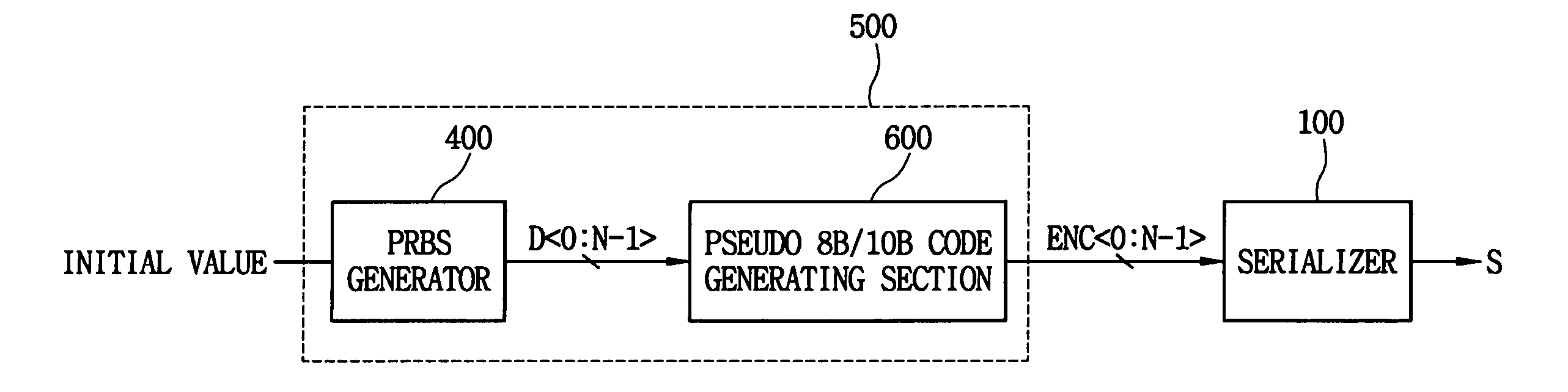
[0077]FIG. 8 is a circuit diagram showing in more detail an example implementation of 8B / 10B-like code generating section 600 of FIG. 5, according to an embodiment of the present invention.
[0078]Referring to FIG. 8, an 8B / 10B-like code generating section 600 includes a transforming section 610, a first inverting section 630 and a second inverting section 640. Transforming section 610 includes first, second, third, fourth, fifth and sixth detecting sections 612, 614, 616, 618, 620 and...
PUM
 Login to View More
 Abstract
Description
Claims
Application Information
 Login to View More