
Electronic camera
a technology of electronic cameras and digital cameras, applied in still video cameras, instruments, television systems, etc., can solve the problems of inability to achieve user-satisfactory gray-scale transformation, image may lose distinctiveness in brightness, and the effect of high speed
- Summary
- Abstract
- Description
- Claims
- Application Information
AI Technical Summary
Benefits of technology
Problems solved by technology
Method used
Image

Examples
Embodiment Construction
[0021]In the following the embodiments of the present invention will be described in reference to the drawings.
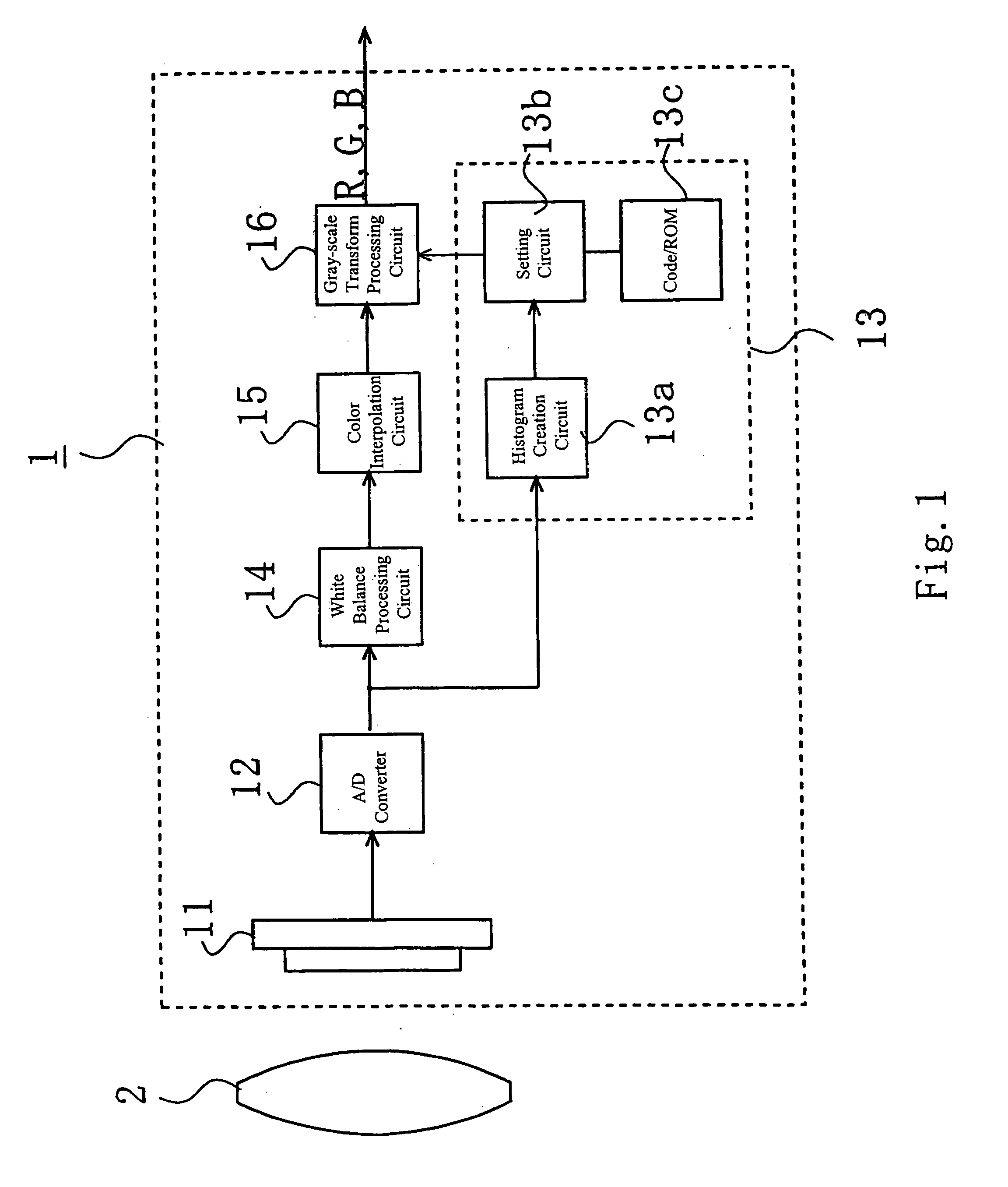
[0022]FIG. 1 shows the basic configuration of the electronic camera according to the present embodiments.
[0023]A camera body 1 includes an image sensor 11, an A / D converter 12, a white balance processing circuit 14, a color interpolation circuit 15, a gray-scale transformation processing circuit 16, a transformation characteristic setting circuit 13 and others.
[0024]An image of a subject is formed on the image sensor 11 through lens 2. An output signal from the image sensor 111 is inputted to the A / D converter 12 via a not-shown analog gain controller and converted into a digital signal therein. On the digital signal performed are white balance processing by the white balance processing circuit 14, color interpolation processing by the color interpolation circuit 15, and gray-scale transformation processing by the gray-scale transformation processing circuit 16.
[0025]Note t...
PUM
 Login to View More
 Abstract
Description
Claims
Application Information
 Login to View More