
System and method for managing risk and opportunity
a technology of system and opportunity, applied in the field of system and method for managing risk and opportunity, can solve the problems of increasing risks, increasing competition, and accelerating the development and use of new and complex technologies, and avoiding risks
- Summary
- Abstract
- Description
- Claims
- Application Information
AI Technical Summary
Benefits of technology
Problems solved by technology
Method used
Image

Examples
Embodiment Construction
[0015]The present invention may be further understood with reference to the following description and the appended drawings, wherein like elements are provided with the same reference numerals. In describing the exemplary embodiments of the present invention, the specification generally refers to the entities engaging in business and commerce as corporations. Examples of entities, other than corporations, that engage in commercial transactions include partnerships, sole proprietorships, etc. Those skilled in the art will understand that the present invention may be implemented by any “for-profit” entity, as well as charities, foundations, non-profit organizations, etc.
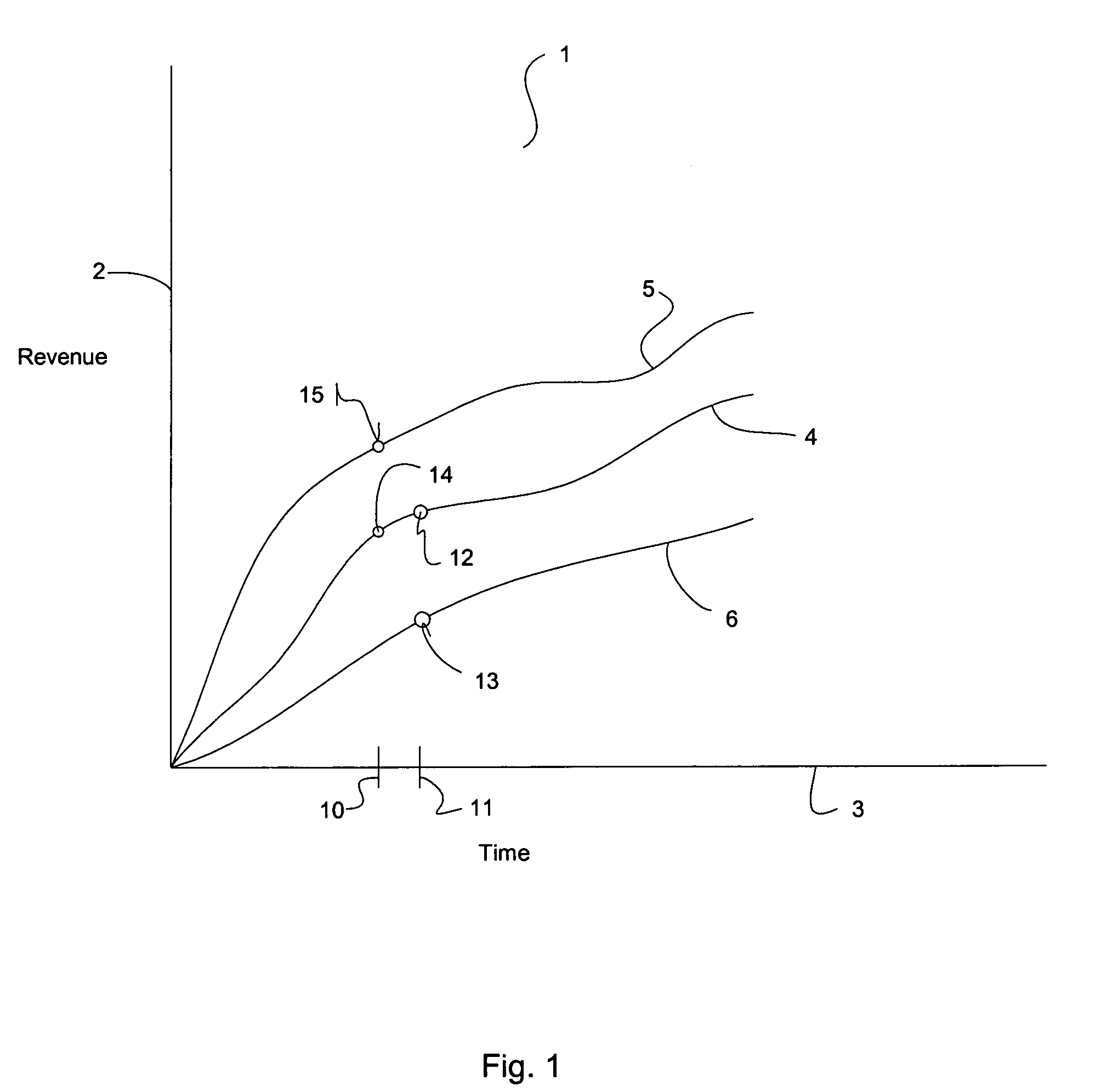
[0016]FIG. 1 shows an exemplary revenue forecast chart 1 for a corporation. Expected revenue 2 is charted against time 3 resulting in exemplary revenue curve 4. However, there are factors that can move the revenue forecast in either the positive or the negative direction. Positive changes may result in the revenue fore...
PUM
 Login to View More
 Abstract
Description
Claims
Application Information
 Login to View More