
Flash memory device and program method
a flash memory and program technology, applied in the field of flash memory devices, can solve the problems of reducing the width of the line, affecting neighboring cells sharing the same word line, and reducing the area efficiency of the program, and achieve the effect of increasing the area efficiency
- Summary
- Abstract
- Description
- Claims
- Application Information
AI Technical Summary
Benefits of technology
Problems solved by technology
Method used
Image


Examples
first embodiment
[0027]FIG. 3A is a block diagram of a flash memory device according to the present invention.
[0028]Referring to FIG. 3A, the flash memory device includes a memory cell array 100 having a plurality of cell strings S1 to Si (i is an integer). Each of the plurality of cell strings S1 to Si includes a plurality of memory cells (not shown) for storing data. The plurality of cell strings S1 to Si are connected to a plurality of page buffers PB1 to PBi, respectively, through bit lines BL1 to BLi. That is, one cell string corresponds to one page buffer. Accordingly, the page buffer and the cell string perform a program operation on a word line basis in a corresponding manner one by one. This is described below in detail with reference to FIG. 3B.
[0029]FIG. 3B is a detailed circuit diagram of FIG. 3A.
[0030]The memory cell array 100 includes the plurality of cell strings S1 to Si. The cell strings S1 includes a drain select transistor DST1, a source select transistor SST1 and a plurality of m...
second embodiment
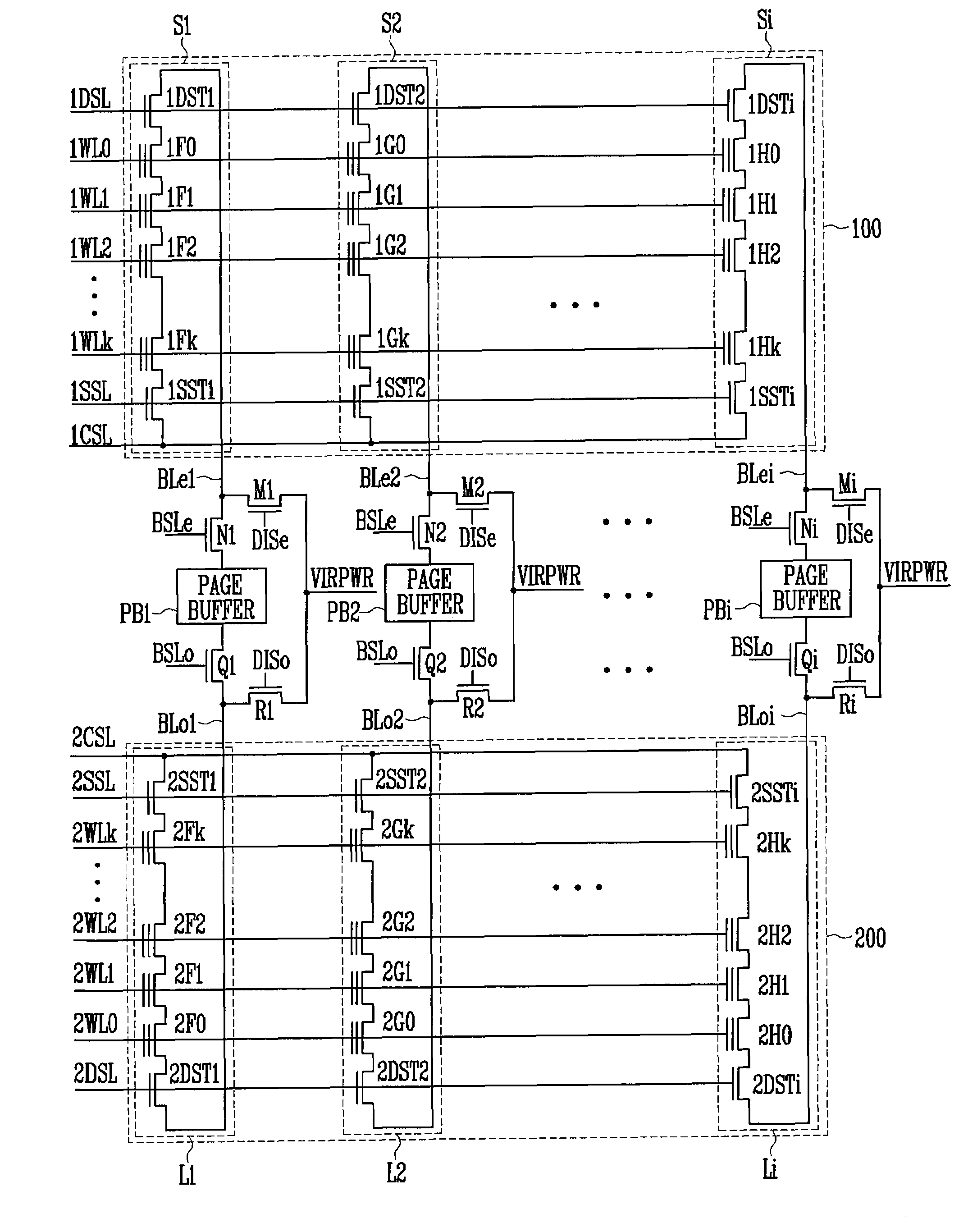
[0033]FIG. 4A is a block diagram of the flash memory device according to the present invention. According to the embodiment of FIG. 3B, the interference phenomenon between the memory cells is reduced, but the area is increased since each cell string requires its own page buffer. Thus, a memory cell array sharing the plurality of page buffers may be further included in order to increase the area efficiency.
[0034]The plurality of page buffers PB1 to PBi form pairs with two memory cell arrays 100 and 200. The memory cell array 100 includes a plurality of cell strings S1 to Si. The memory cell array 200 includes a plurality of cell strings L1 to Li. Page buffers PB1 to PBi are disposed between the cell strings S1 to Si and the cell strings L1 to Li so that the cell strings S1 to Si and the cell strings L1 to Li are symmetrical to each other. Each of the cell arrays S1 to Si share a page buffer PB1 to PBi with each of the cell arrays L1 to Li as can be seen in FIG. 4A. That is, since two...
PUM
 Login to View More
 Abstract
Description
Claims
Application Information
 Login to View More