System and method for distributed querying and presentation of information from heterogeneous data sources

US7702617B2Inactive Publication Date: 2010-04-20IBM CORP
17 Cites 0 Cited by

Patent Information

Authority / Receiving Office
US · United States
Current Assignee / Owner
Publication Date
2010-04-20
Estimated Expiration
Not applicable · inactive patent

Smart Images

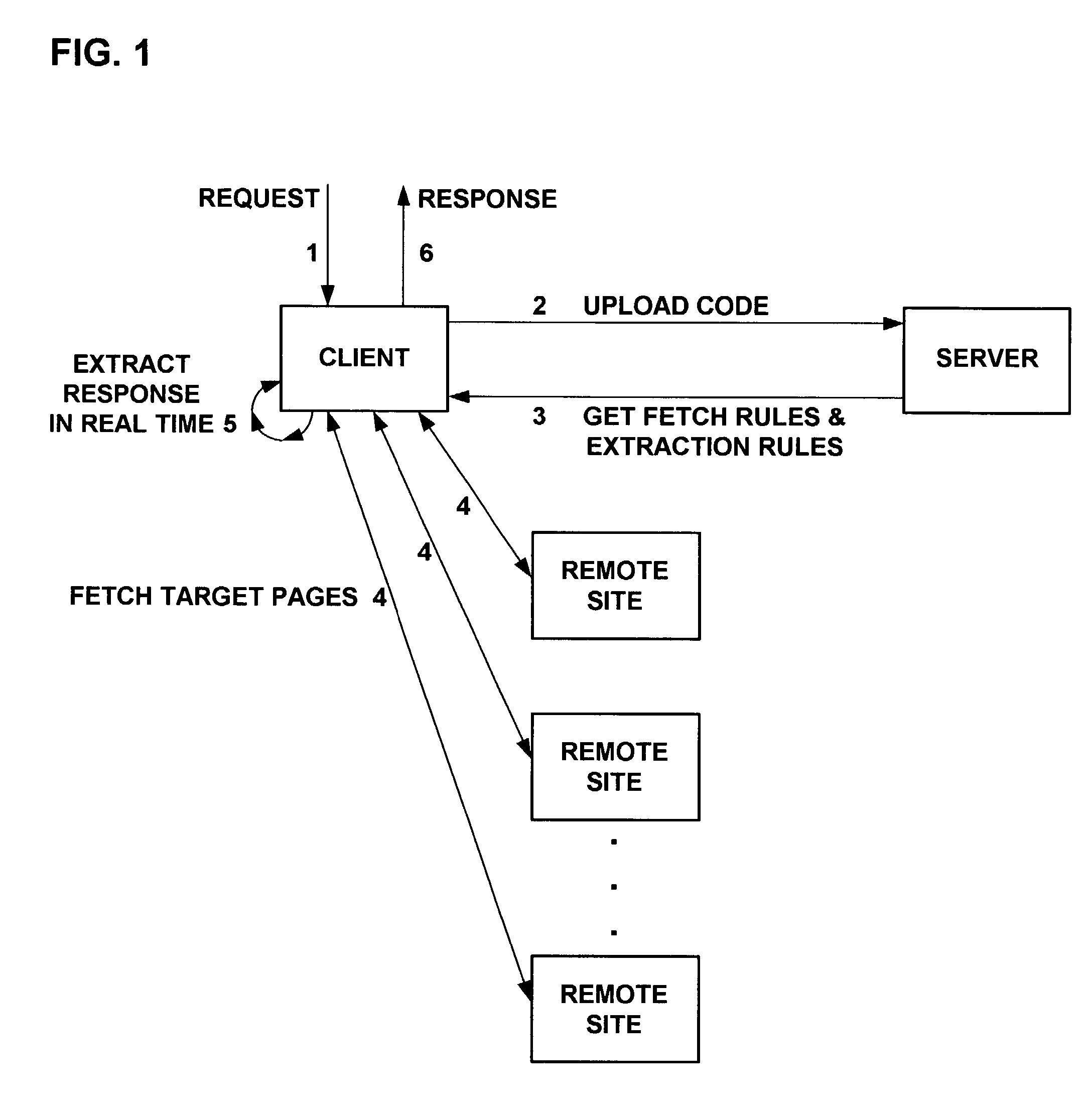
  • Figure 1
    Figure 1
  • Figure 2
    Figure 2
Patent Text Reader

Abstract

A method, system, business method, and computer program product for retrieving and organizing networked data, wherein fetch rules and extraction rules enable a user to automatically collect and extract information from a remote network site. The fetch rules reproduce the interaction a client executes if interacting directly with the remote site, so a server cannot be shut out. The extraction rules allow the client, preferably via an applet, to glean relevant information from the acquired pages for presentation in a general interface. As an electronic commerce business method, information about remote site responsiveness, fetch rules, and extraction rules may be shared between server and client for a fee. The server accumulates vendor contacts, stores query rules, and provides common interface rules. The invention can gather statistics on vendor responsiveness and can resell information to vendors or others.
Need to check novelty before this filing date? Find Prior Art

Description

FIELD OF THE INVENTION

[0001] This invention relates to client-server computing, and more specifically to automated querying of heterogeneous data sources and presentation of query results via a common interface.BACKGROUND OF THE INVENTION

[0002] Client-server computing has been the dominant computing paradigm for the last several years. With the advent of the World Wide Web, client-server computing has been manifested in the form of remote site servers supporting databases of information, and client-side applications (like web browsers) querying the remote site servers and presenting the results to a user. This is how most of the Web looks today.

[0003] A new class of applications has been developing recently, designed to help database owners make their information more accessible from the Web. For example, if a design engineer wants to find information such as price and availability for components they are considering for a circuit board, manufacturers of such components have a strong i...

Examples

Embodiment Construction

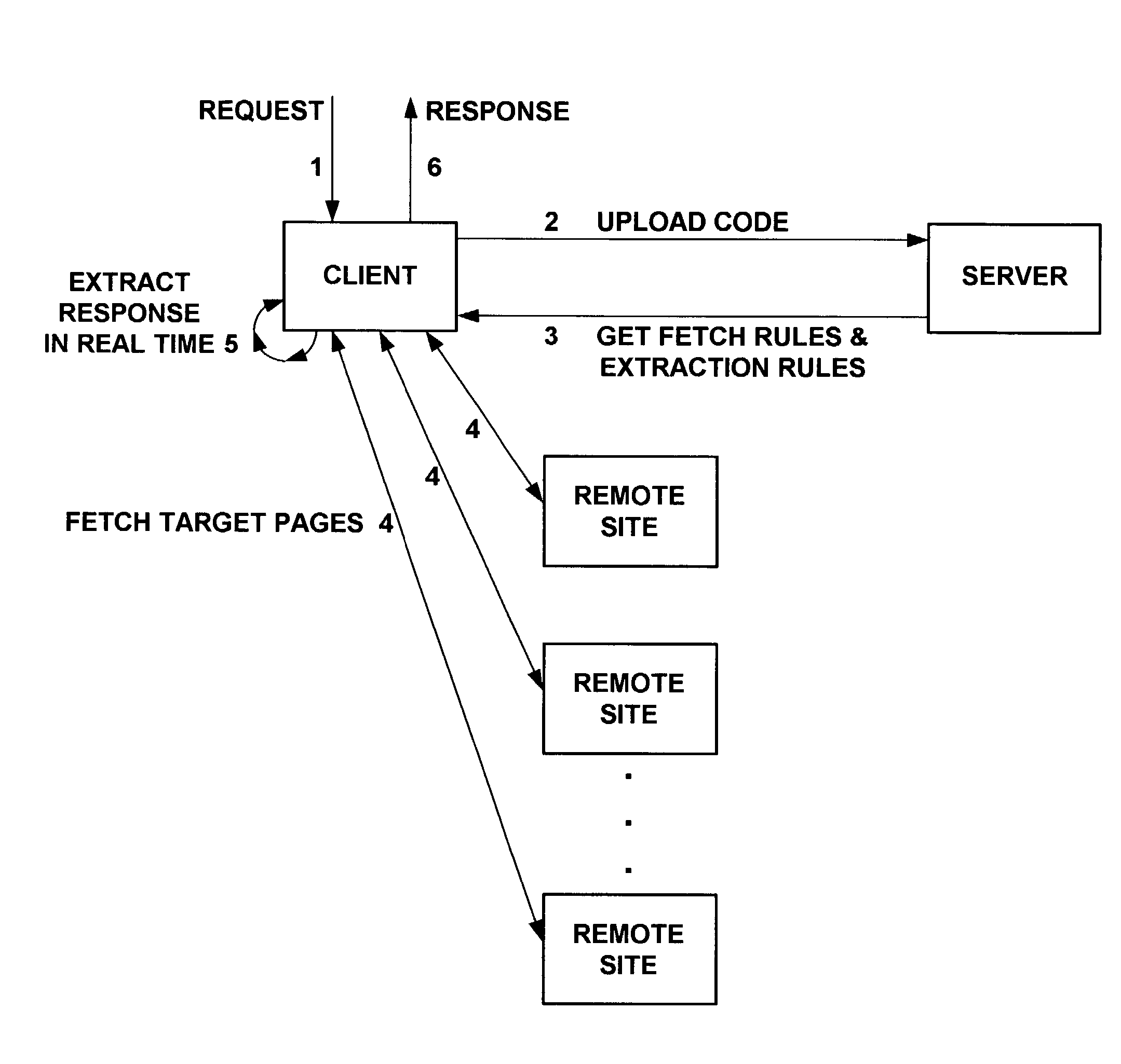
[0012]Referring now to FIG. 1, an overview of the invention is shown. The FIGURE depicts the system components and the method steps the components execute in an exemplary sequential flow diagram. The major steps performed by the method are numbered and labeled to indicate the general order of operations and transfer of information between the system components. The system components of a preferred embodiment include a client, at least one server, a communications link between the client and the server, and a Java applet. Only one instance of a server is shown for clarity, but multiple servers may be employed to enhance the reliability and scalability of the system.

[0013]Any type of communications link between the client and the server will suffice, but the invention is quite amenable to use with the World Wide Web and its associated communications protocols as are well known in the art. The client and the server are preferably capable of performing their tasks with sufficient speed ...