Method and apparatus for transporting a client layer signal over an optical transport network (OTN)

a client layer and optical transport technology, applied in the field of telecommunications, can solve the problems of enormous bandwidth waste, high cost, and inability to map 1 gbit/s signals into sdh virtual containers (sdh vcs), and achieve the effect of solving the economic burden and double the capacity of 1 gbit/s

US7742502B2Inactive Publication Date: 2010-06-22RPX CORP
10 Cites 27 Cited by

Patent Information

Authority / Receiving Office
US · United States
Patent Type
Patents(United States)
Current Assignee / Owner
Publication Date
2010-06-22
Estimated Expiration
Not applicable · inactive patent

Smart Images

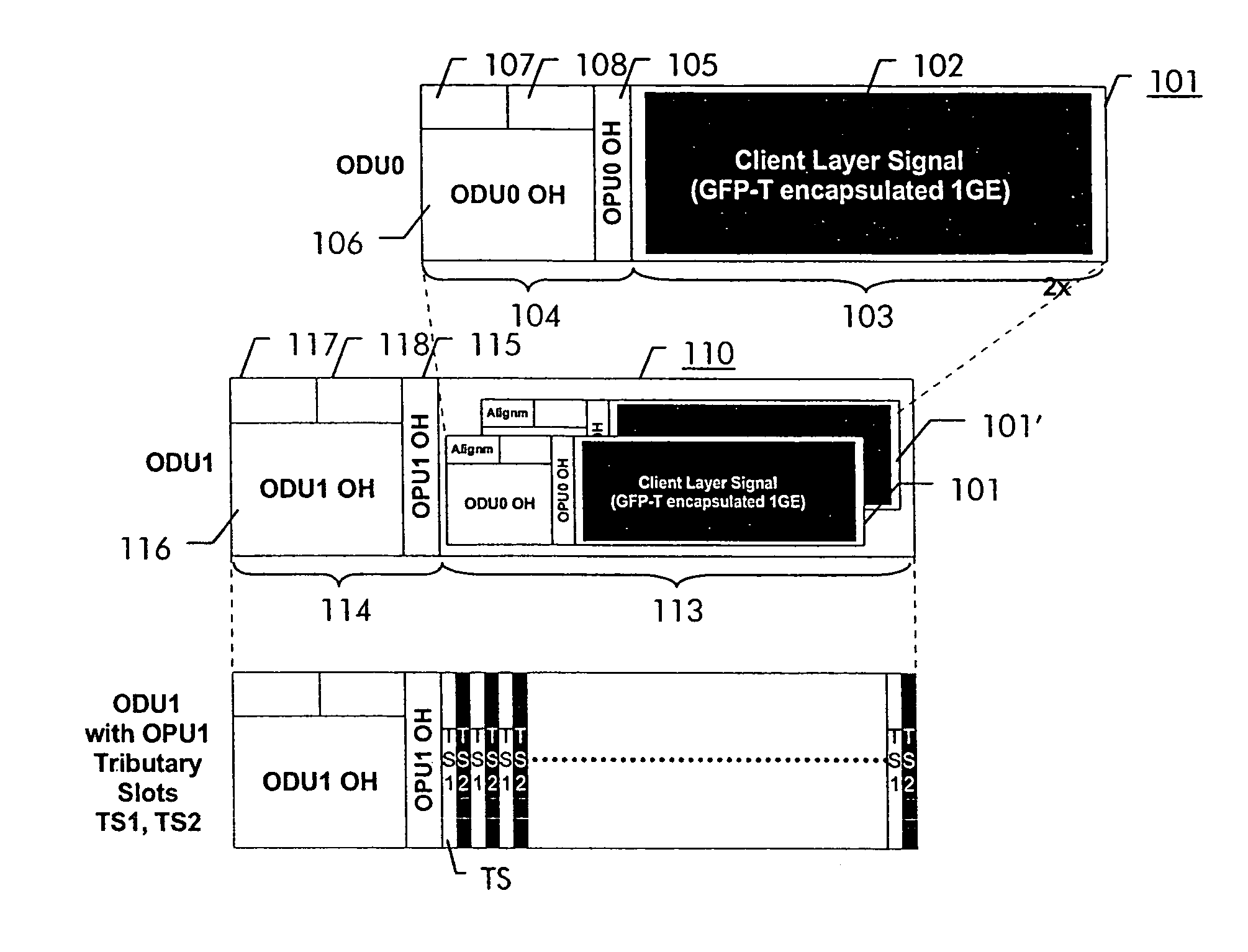
  • Figure 1
    Figure 1
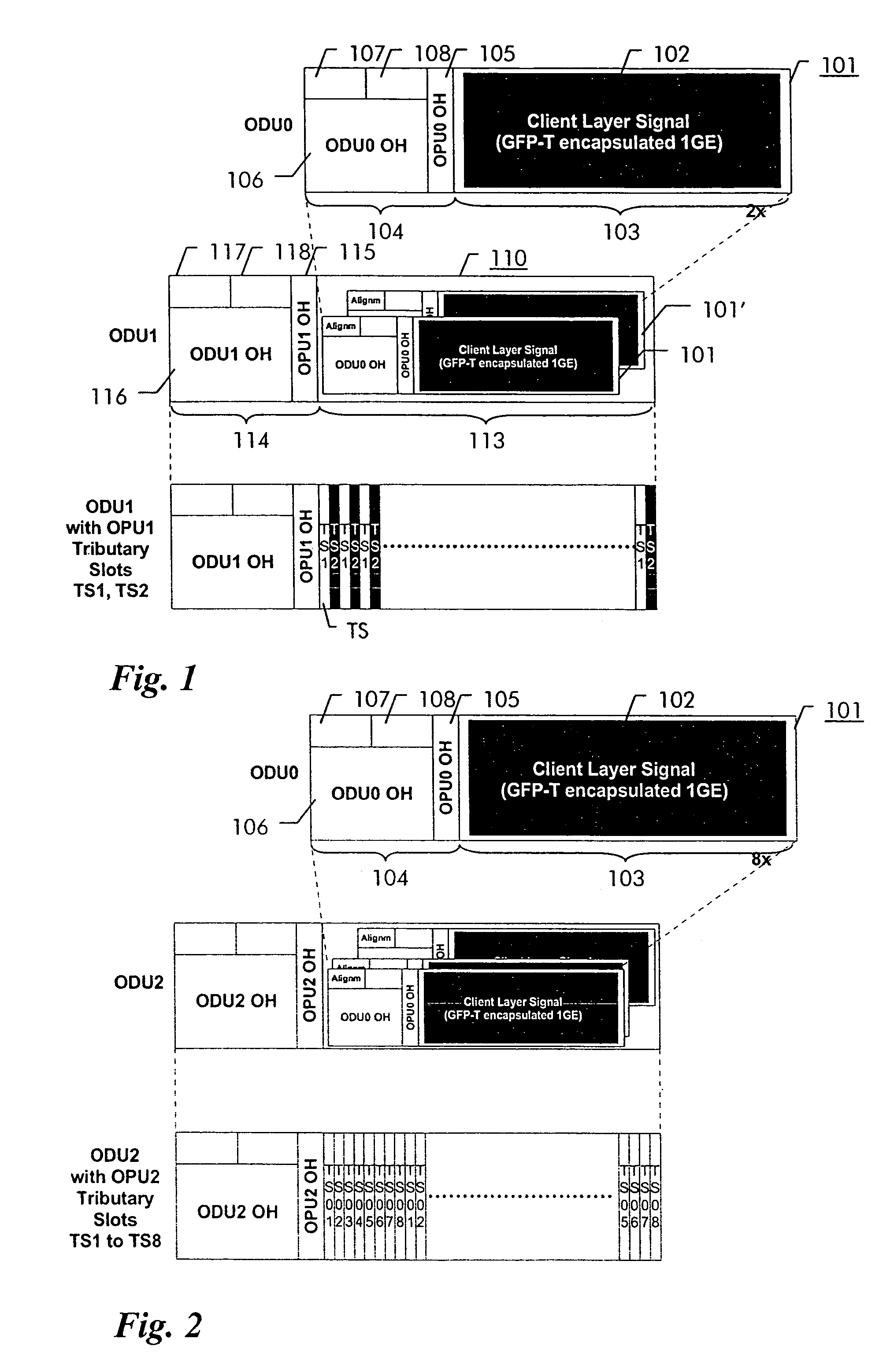
  • Figure 2
    Figure 2
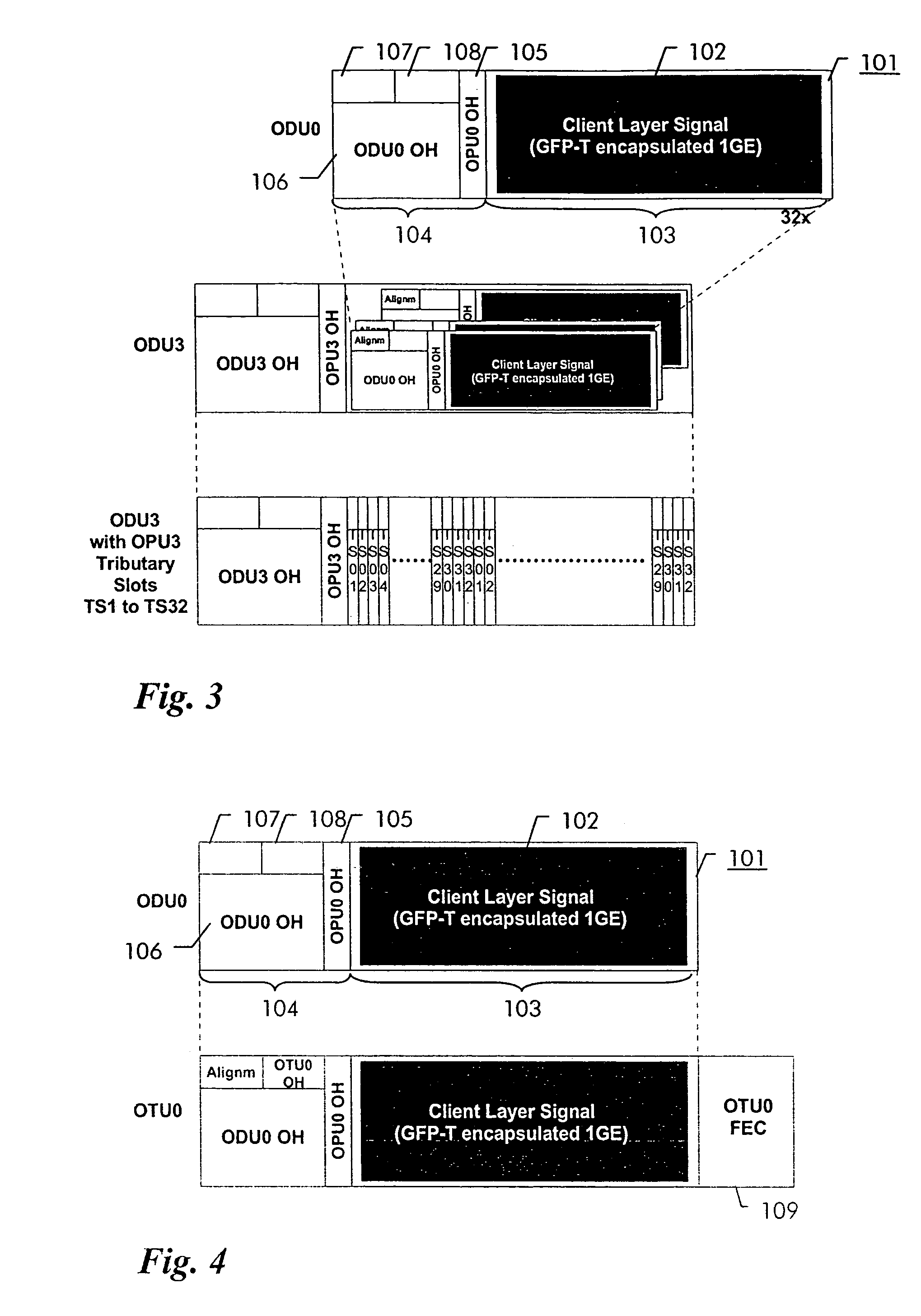
  • Figure 3
    Figure 3
Patent Text Reader

Abstract

In order to facilitate the transport of 1 Gbit / s Ethernet signals over an Optical Transport Network using the Optical Transport Hierarchy as specified by ITU-T G.709, a new OTH entity referred to as Optical Channel Data Unit-0 (ODU0, 101) with a capacity of approximately 1.22 Gbit / s is defined. This new entity fits perfectly into the existing OTH multiplexing structure, allowing the transport of two times a 1 Gbit / s Ethernet client layer signal within the capacity of one ODU1 (110), while being individually switchable. A 1 Gbit / s Ethernet signal (102) can be mapped into the ODU0 payload (103) using the Transparent Generic Framing Procedure (GFP-T) encapsulation technique as specified in Rec. G.7041.
Need to check novelty before this filing date? Find Prior Art

Description

[0001] The invention is based on a priority application EP 04026902.9 which is hereby incorporated by reference.FIELD OF THE INVENTION

[0002] The present invention relates to the field of telecommunications and more particularly to a method and apparatus for transporting a client layer signal over an Optical Transport Network (OTN).BACKGROUND OF THE INVENTION

[0003] Current transmission networks are mainly based on the Synchronous Digital Hierarchy abbreviated as SDH, see ITU-T G.707, 12 / 2003. A new hierarchy, the Optical Transport Hierarchy abbreviated as OTH has been standardized in ITU-T G.709 03 / 2003, which is incorporated by reference herein. The purpose of OTH is to deal more economically with very large bandwidths, which are termed Optical Channel Data Units and abbreviated as ODUs. Currently defined are ODU1 (˜2.7 Gbit / s), ODU2 (˜10.7 Gbit / s), and ODU3 (˜43 Gbit / s). New efficient overlay networks can be defined, build and used by network operators based on this hierarchy. The arc...

Examples

Embodiment Construction

[0021]The basic multiplex entity in an Optical Transport Network (OTN) as specified in ITU-T Rec. G.872 is the Optical Channel Data Unit-k (ODUk) with k=1, 2, or 3. An ODUk when represented in the form of a table composed of columns and rows has an overhead area and a payload area. The Overhead area of an ODUk is composed of 16 columns by 4 rows, where columns 1 to 7 of row 1 are reserved for frame alignment purposes, columns 8 to 14 of row 1 are reserved for OTU-specific overhead (Optical Channel Transport Unit) and columns 15 and 16 are reserved for OPU-specific overhead (OPU: Optical Channel Payload Unit), while the remainder of the overhead area is available for the ODU overhead. The payload area, on the other hand, has 3808 columns by 4 rows. Either a client layer signal can be mapped into the payload area or a number of ODUs of a lower layer which are interleaved to what is called an Optical Channel Data Tributary Unit Group (ODTUG). Transmission of an ODUk is row by row. The ...