
Ring magnet structure having a coded magnet pattern
a magnet pattern and ring magnet technology, applied in the field of field emission system and method, to achieve the effect of improving and extending the operation of existing magnetic field devices
- Summary
- Abstract
- Description
- Claims
- Application Information
AI Technical Summary
Benefits of technology
Problems solved by technology
Method used
Image

Examples
Embodiment Construction
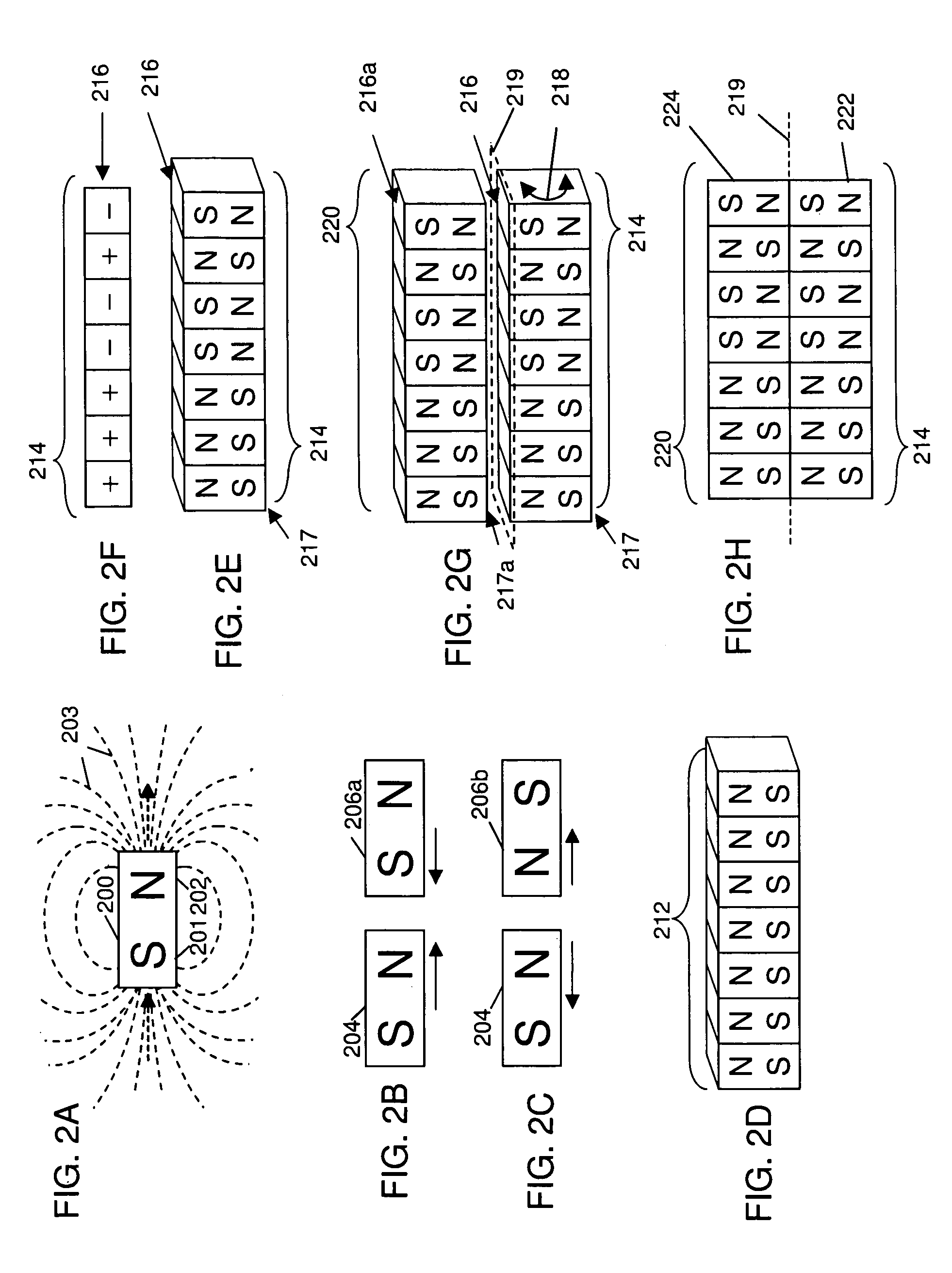
[0043]The present invention will now be described in detail, but first, a brief description of magnets and coded magnet structures will be given to clarify the notation and terminology of this disclosure.
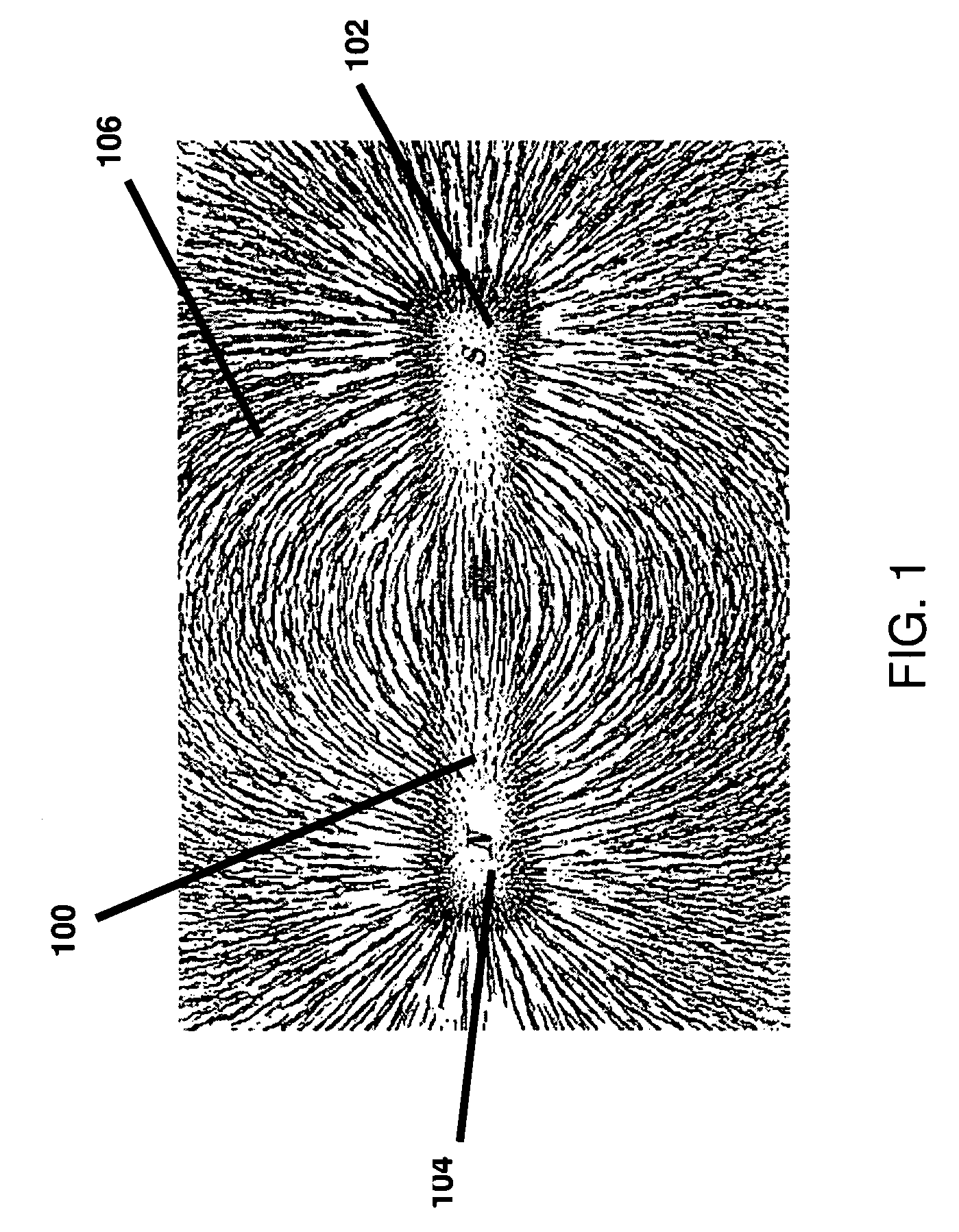
[0044]FIG. 1 depicts iron filings oriented in the magnetic field (i.e., field domain) produced by a single bar magnet. Referring to FIG. 1, a magnet 100 has a South pole 102 and a North pole 104. The iron filings 106 tend to orient in the direction of magnetic field vectors that represent the direction and magnitude of the magnet's moment. North and South poles are also referred to herein as positive (+) and negative (−) poles, respectively. In accordance with the invention, magnets can be permanent magnets, impermanent magnets, electromagnets, involve hard or soft material, and can be superconductive. In some applications, magnets can be replaced by electrets.
Coded Magnet Structures
[0045]Coded magnet structures were first fully disclosed in U.S. Provisional Patent Application 61 / 12...
PUM
| Property | Measurement | Unit |
|---|---|---|
| total magnetic force | aaaaa | aaaaa |
| angle | aaaaa | aaaaa |
| angles | aaaaa | aaaaa |
Abstract
Description
Claims
Application Information
 Login to View More