Relating to brain computer interfaces

a brain computer and computer interface technology, applied in the field of brain computer interfaces, can solve the problems of insufficient relative slow change of some eeg signals, high risk, and different from subject to subject, and achieve the effect of speed and accuracy

Active Publication Date: 2014-10-14
KONINK PHILIPS ELECTRONICS NV
View PDF11 Cites 3 Cited by
  • Summary
  • Abstract
  • Description
  • Claims
  • Application Information

AI Technical Summary

Benefits of technology

[0015]Owing to the invention, it is possible to overcome the problems associated with the conventional usage of brain computer interfaces, which require extensive training, which takes a considerable amount of time and is boring, annoying and cumbersome. The invention provides a solution via the separation of the training and usage of a BCI into two parts: a generic training, and the usage. The training may involve a competitive element to motivate the user, and may focus of speed and accuracy. The measured brain signals are mapped onto mental task descriptions, and stored in a database. In the usage of the BCI, this database is used to map the mental task descriptions and related brain signals onto specific features of functions of the application. In this way the generic training only has to be performed once, and different applications can be controlled without individually learning / training them extensively. This constitutes a clear usability improvement for BCIs.
[0016]The principal advantage delivered by the invention is that there is no longer any need for the user to repeat training tasks for different applications. A user can participate in a single training session and this will be used to generate a user profile. This profile may contain, for example, details that the user can perform three different tasks in a steady and repeatable manner, and that these are then defined in the user profile. When a user is to be setup to use a new application, then a mapping occurs from the functions of that application to the content of the user profile. In the example above, then the mapping will take three of the functions of the new application and map these to the three contained in the user profile for the specific user. The user profile can also include a set of user preferences, for example, the user prefers certain mental tasks for accomplishing certain activities, and / or the user gets tired easily.
[0018]Advantageously, the training further comprises measuring a user's fatigue during the training exercise, and further comprising recording information relating to the measured fatigue in the user profile. Recording information about the user's fatigue improves the ultimate performance of the brain computer interface, as the mapping of the user profile to the new application can take into account the levels of fatigue that are associated with the specific tasks recorded in the user profile that the user can perform. For example, a user may be able to perform task A very accurately, but rapidly becomes fatigued and the performance deteriorates, whereas task B may be performed with a margin of error of 10%, but the user is able to maintain this level of performance over a longer period. When the mapping of the new application takes place, these fatigue levels can be used to determine which functions of the new application are matched to which task. For example, an application may indicate that function X is not so common in the application, but requires a high degree of accuracy, so this can be mapped to task A. Similarly, a high frequency function Y can be mapped to task B for which the user is less likely to suffer fatigue.

Problems solved by technology

For precise control functions, such as rapid motion of physical devices, the relatively slow changes of some EEG signals may be inadequate, whereas the more rapid dynamics of neuronal spike trains may suffice.
However, such a choice forces another trade-off: surface electrodes are convenient and involve little risk whereas implantation of electrodes in the brain is invasive and, therefore, involves more risk.
However, electroencephalogram (EEG) signals are naturally non-stationary, different from subject to subject and usually very noisy since they are contaminated with various artifacts such as electromyogram (EMG) and electrooculogram (EOG) signals.
Both the signal variability and the noises may considerably distort the performance of an EEG classifier.
Therefore, for many BCI systems, a tedious and time-consuming training process is usually needed for learning the specific characteristic of the brain signals; see for example X. Liao, D. Y., C. Li, “Transductive SVM for reducing the training effort in BCI” Journal of Neural Engineering, 2007 4(3), pages 246 to 254.
In general the subject experiences the training for a BCI as taking too much time, boring and annoying.
Especially for disabled or elderly people the training is very much a significant burden.

Method used

the structure of the environmentally friendly knitted fabric provided by the present invention; figure 2 Flow chart of the yarn wrapping machine for environmentally friendly knitted fabrics and storage devices; image 3 Is the parameter map of the yarn covering machine
View more

Image

Smart Image Click on the blue labels to locate them in the text.
Viewing Examples
Smart Image
  • Relating to brain computer interfaces
  • Relating to brain computer interfaces
  • Relating to brain computer interfaces

Examples

Experimental program
Comparison scheme
Effect test

Embodiment Construction

[0030]The invention is based on the recognition that training and usage of a brain computer interface can be two activities that are completely separated in time. The following description consists of two parts: the first relates to the training and the second relates to the usage of a brain computer interface. In both cases, the purpose is to reduce the required training time that a user must undergo and as a consequence reduce boredom and improve convenience for the subject.

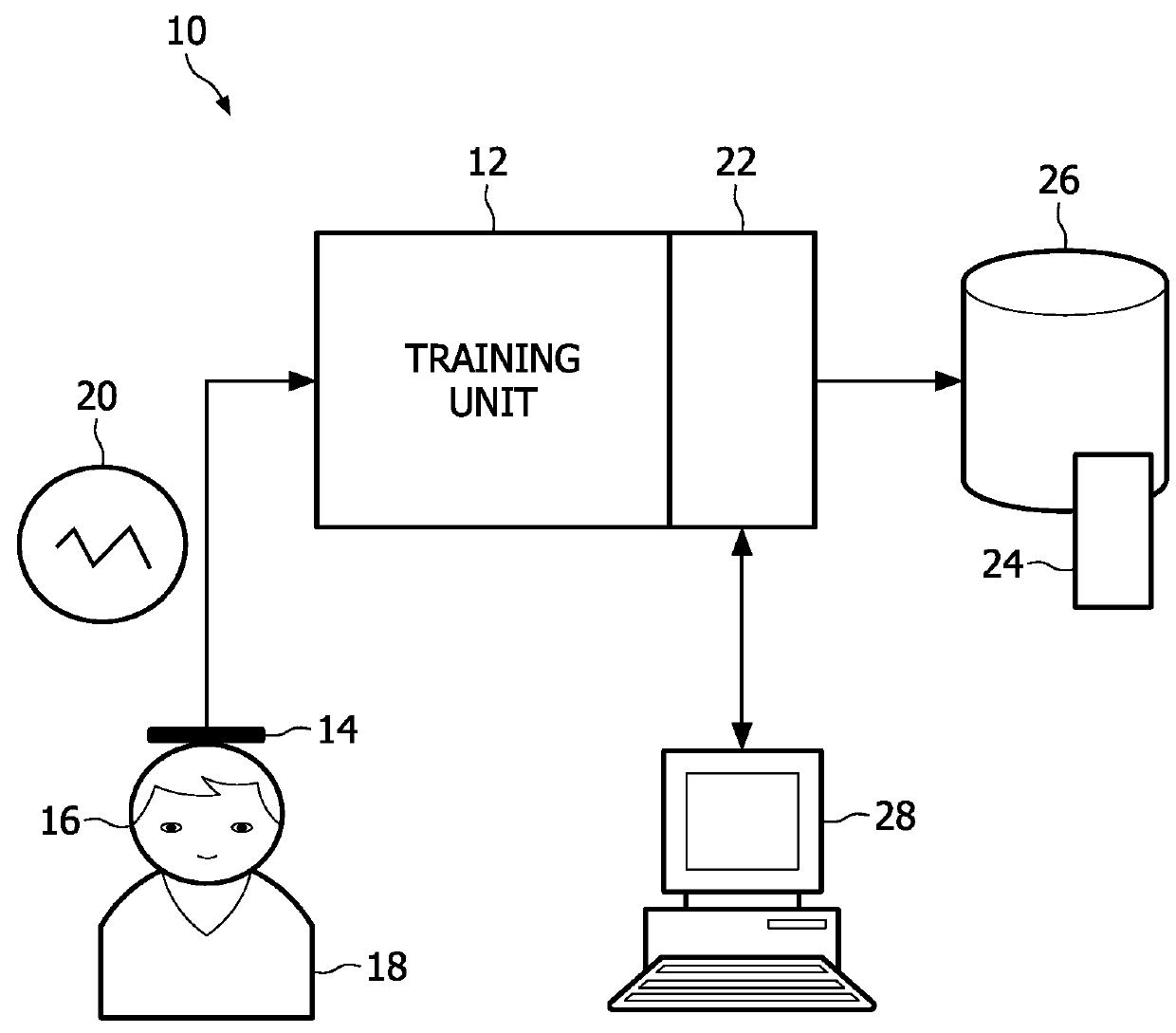
[0031]FIG. 1 shows the basic scheme for training a user in relation to the creating of a brain computer interface. This Fig. shows a system 10 for creating a user profile for use in a brain computer interface. A training unit 12 is connected to a head unit 14. The head unit 14 comprises electrodes that are in contact with the scalp 16 of a subject 18, for example, by means of a cap with multiple electrodes, to measure brain signals 20 from specific parts of the brain of the user 18. In addition, the training un...

the structure of the environmentally friendly knitted fabric provided by the present invention; figure 2 Flow chart of the yarn wrapping machine for environmentally friendly knitted fabrics and storage devices; image 3 Is the parameter map of the yarn covering machine
Login to View More

PUM

No PUM Login to View More

Abstract

A method of creating a user profile for use in a brain computer interface includes performing a training exercise, measuring a user's brain signals during the training exercise, mapping specific signals of the user's brain signals to predefined mental task descriptions, and creating a user profile including the user's brain signals mapped to the mental task descriptions. The user profile so created can be used in a method of creating a brain computer interface for a user for an application. This method includes accessing a user profile including the user's brain signals mapped to mental task descriptions, accessing an application profile including a plurality of properties of the application, matching one or more mental task descriptions from the user profile to a respective property from the application profile, and creating a brain computer interface accordingly.

Description

FIELD OF THE INVENTION[0001]This invention relates to a method of and system for creating a user profile for use in a brain computer interface and to a method of and system for creating a brain computer interface for a user for an application.BACKGROUND OF THE INVENTION[0002]For many years people have speculated that electroencephalographic activity or other electrophysiological measures of brain function might provide a new non-muscular channel for sending messages and commands to the external world, commonly referred to as a brain computer interface (BCI). Over the past 20 years, productive BCI research programs have arisen. Encouraged by an improved understanding of brain functions, by the advent of powerful low-cost computer equipment, and by the growing recognition of the needs and potentials of people with disabilities, these programs concentrate on developing new communication and control technologies.[0003]The most popular brain computer interfaces use electro-encephalograph...

Claims

the structure of the environmentally friendly knitted fabric provided by the present invention; figure 2 Flow chart of the yarn wrapping machine for environmentally friendly knitted fabrics and storage devices; image 3 Is the parameter map of the yarn covering machine
Login to View More

Application Information

Patent Timeline
no application Login to View More
Patent Type & AuthorityPatents(United States)
IPC IPC(8): A61B5/04A61B5/0476G06F3/01G16H10/60
CPCG06F3/015A61B5/0476G06Q50/24G16H20/00A61B5/369A61B5/372
InventorGARCIA MOLINA, GARY NELSONBRUEKERS, ALPHONS ANTONIUS MARIA LAMBERTUSDAMSTRA, MARIJN CHRISTIANWEDA, JOHANNES
OwnerKONINK PHILIPS ELECTRONICS NV