
Connection assembly having multi-contact connectors with a polarizing system using keys
a multi-contact connector and polarizing system technology, which is applied in the direction of coupling base/case, coupling device connection, incorrect coupling prevention, etc., can solve the problems of not being completely satisfactory, and being unable to provide polarizing at the lateral end using screws as provided in the commercially available assembly, so as to improve the mechanical strength of the keys and improve the mechanical guidance
- Summary
- Abstract
- Description
- Claims
- Application Information
AI Technical Summary
Benefits of technology
Problems solved by technology
Method used
Image

Examples
first embodiment
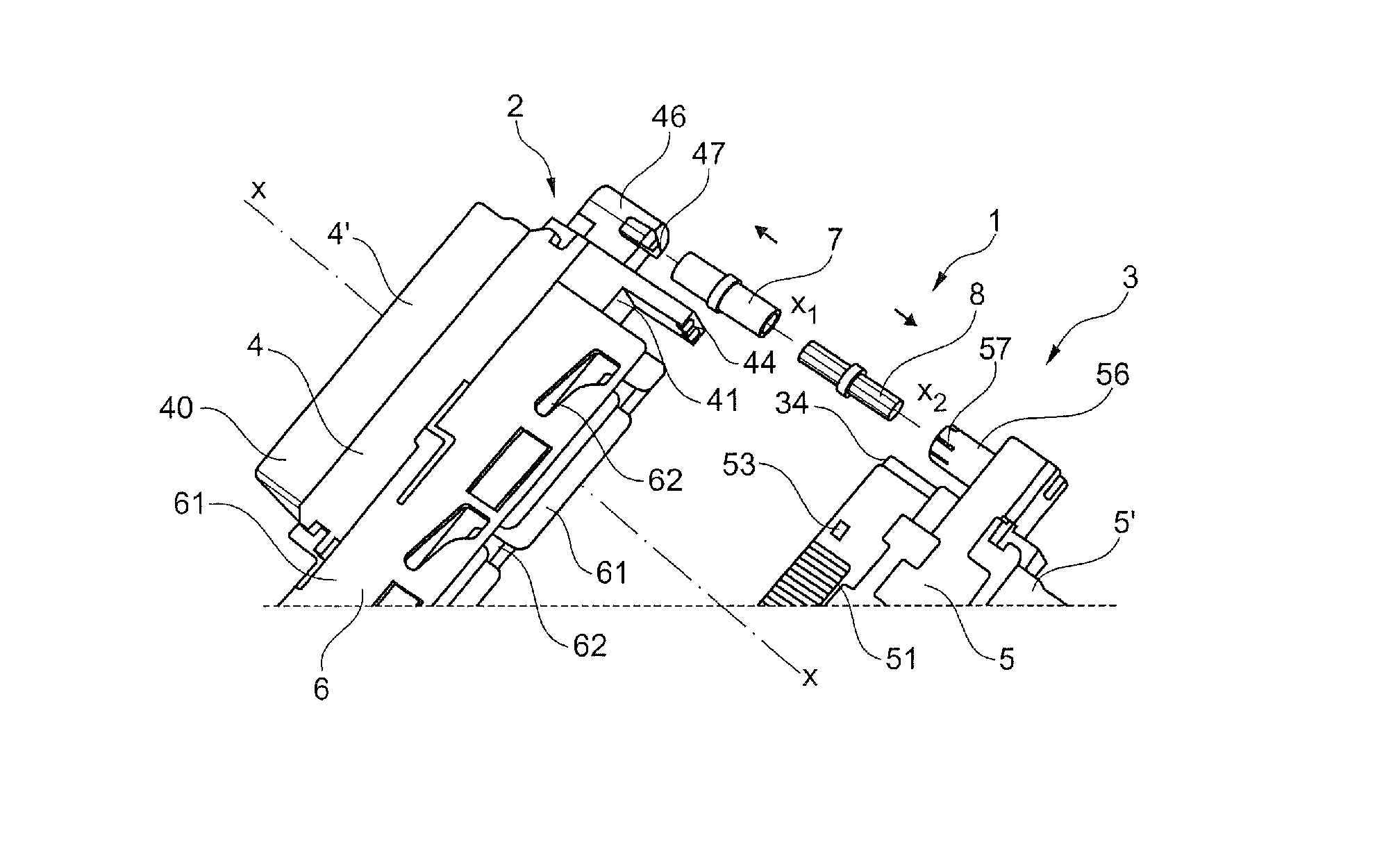
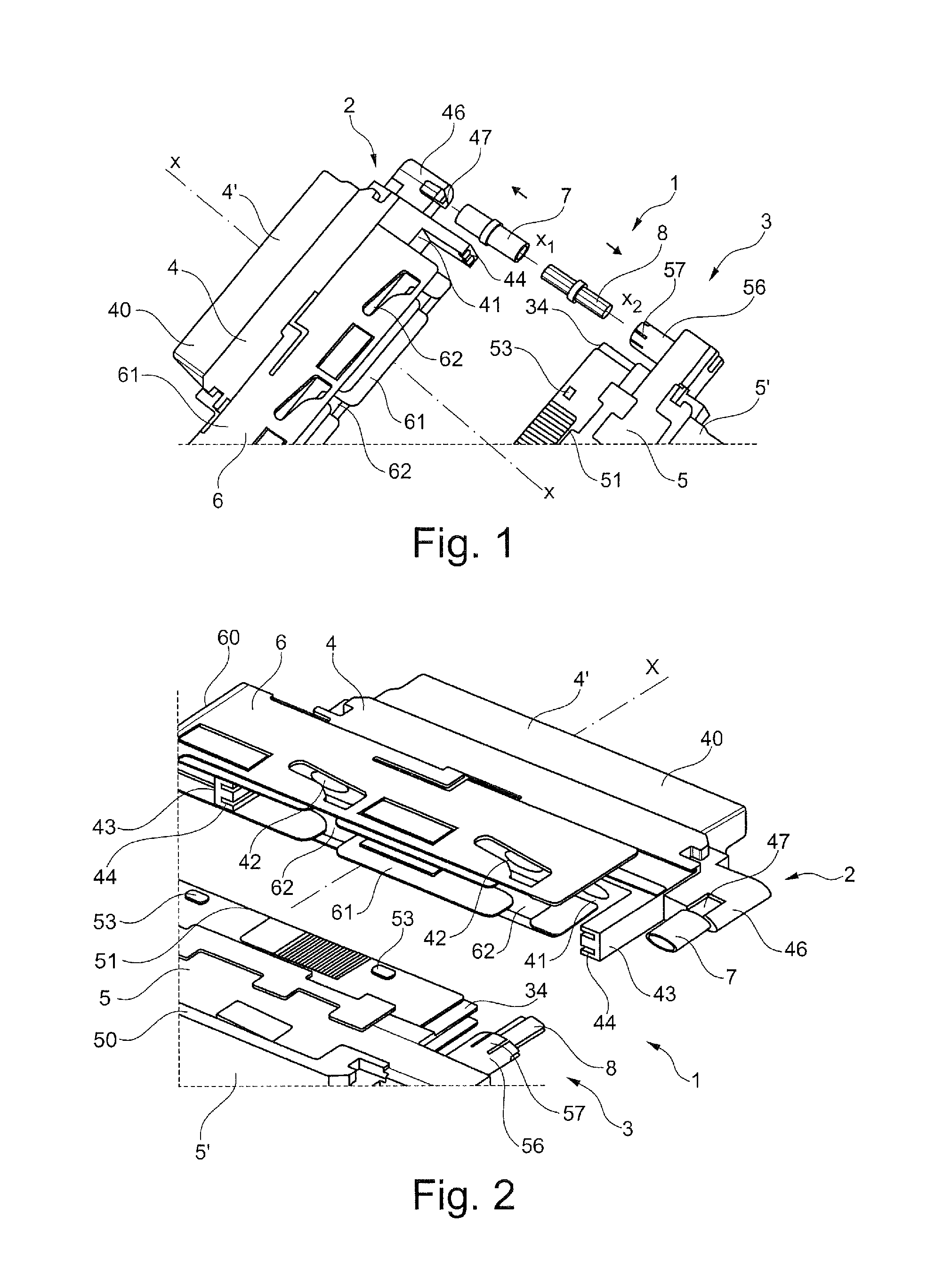
[0049]FIGS. 1, 2, 7, and 8 show a connection assembly given overall reference 1 in the invention. This connection assembly 1 comprises a first multi-contact connector given overall reference 2 and a second multi-contact connector given overall reference 3. The multi-contact connectors 2 and 3 are of complementary type, it being possible, by way of example, for the first connector 2 to be of the male type and in particular to be a plug, while the second connector 3 is of the female type, being in particular a socket.
[0050]However, in all of the figures described, the first connector 2 is a female plug and the second connector 3 is a male socket.
[0051]Each multi-contact connector 2, 3 conveys optical signals, electrical signals, or power. In a variant, signals or power of different types may be conveyed by each of the multi-contact connectors, in which case contacts of different sizes and different types are arranged simultaneously in the connectors.
[0052]The contacts may be single or...
second embodiment
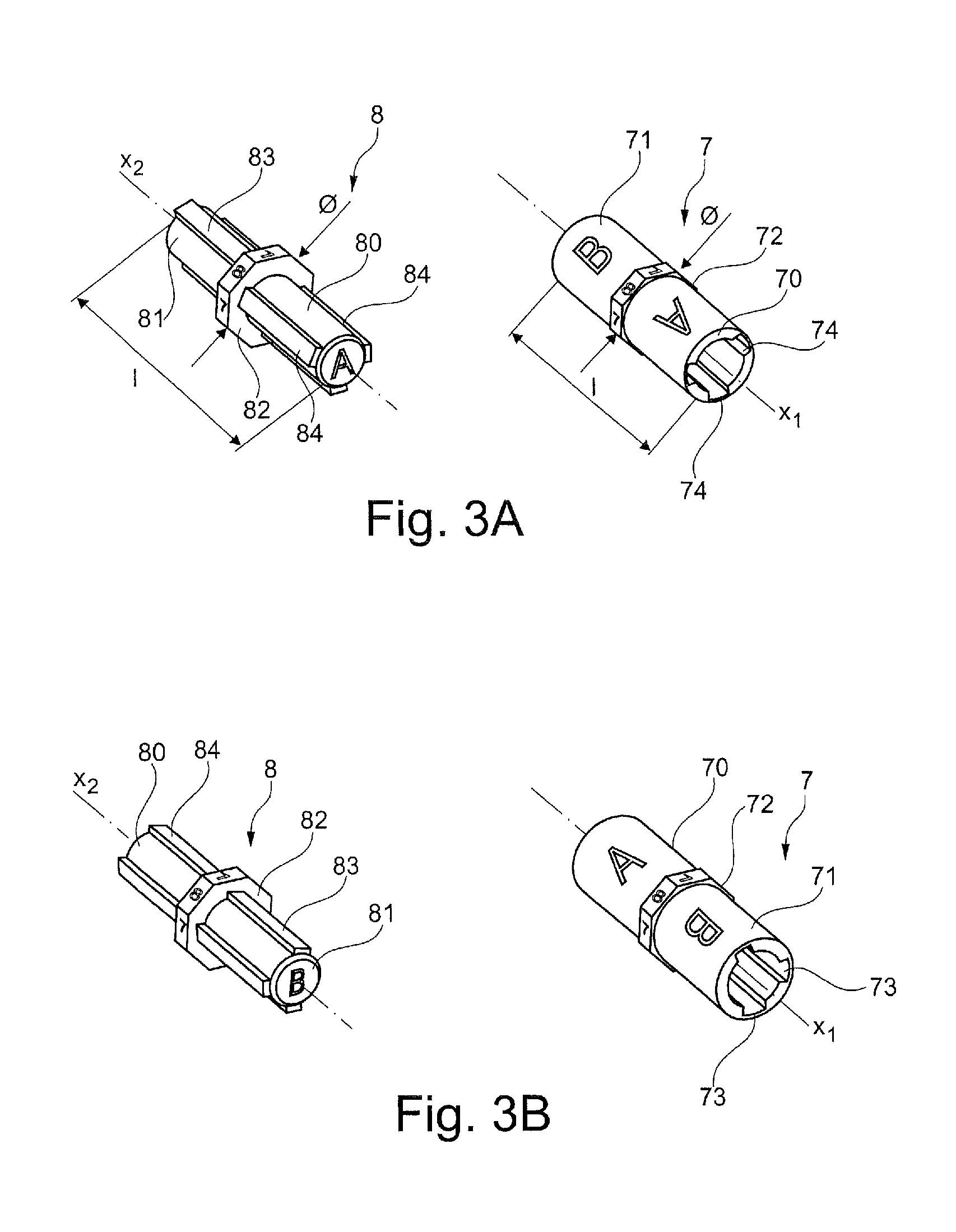
[0120]Also in this second embodiment, the end wall of the recess 46 in the housing 4 is adapted solely to receiving the female key 7 and is fitted with a solid cylinder 9. When the female key 7 is inserted into the recess 46, the solid cylinder 9 penetrates into the inside of one of the end portions 70, 71 without that leading to any problem of assembly. If an attempt is made to insert the male key 8 in the recess 46, the solid cylinder 9 comes into abutment against the male key 8 and thus prevents it from being snap-fastened. The mechanical interference between the solid cylinder 9 and the male key 8 is shown in FIG. 10. In this figure, it can clearly be seen that the male key 8 comes into abutment against the solid cylinder 9.
[0121]Naturally, although FIGS. 8 to 10 show a configuration in which it is impossible to insert the female key 7 in the second connector 3 (socket) or the male key 8 in the first connector 2 (plug), it is naturally possible to provide the inverse configurati...
PUM
 Login to View More
 Abstract
Description
Claims
Application Information
 Login to View More