
Vulcanization accelerator- and sulfur-free elastomer rubber glove for clean rooms
a vulcanization accelerator and rubber glove technology, applied in the field of thin film rubber gloves, can solve the problems of vulcanization accelerators, crosslinking agents, iv type hypersensitivity, and the development of gloves using rubbers which do not use sulfur or sulfur compositions, and the difficulty of vulcanization accelerators, etc., and achieves easy elongation, easy slipping, and easy breaking
- Summary
- Abstract
- Description
- Claims
- Application Information
AI Technical Summary
Benefits of technology
Problems solved by technology
Method used
Image

Examples
example 1
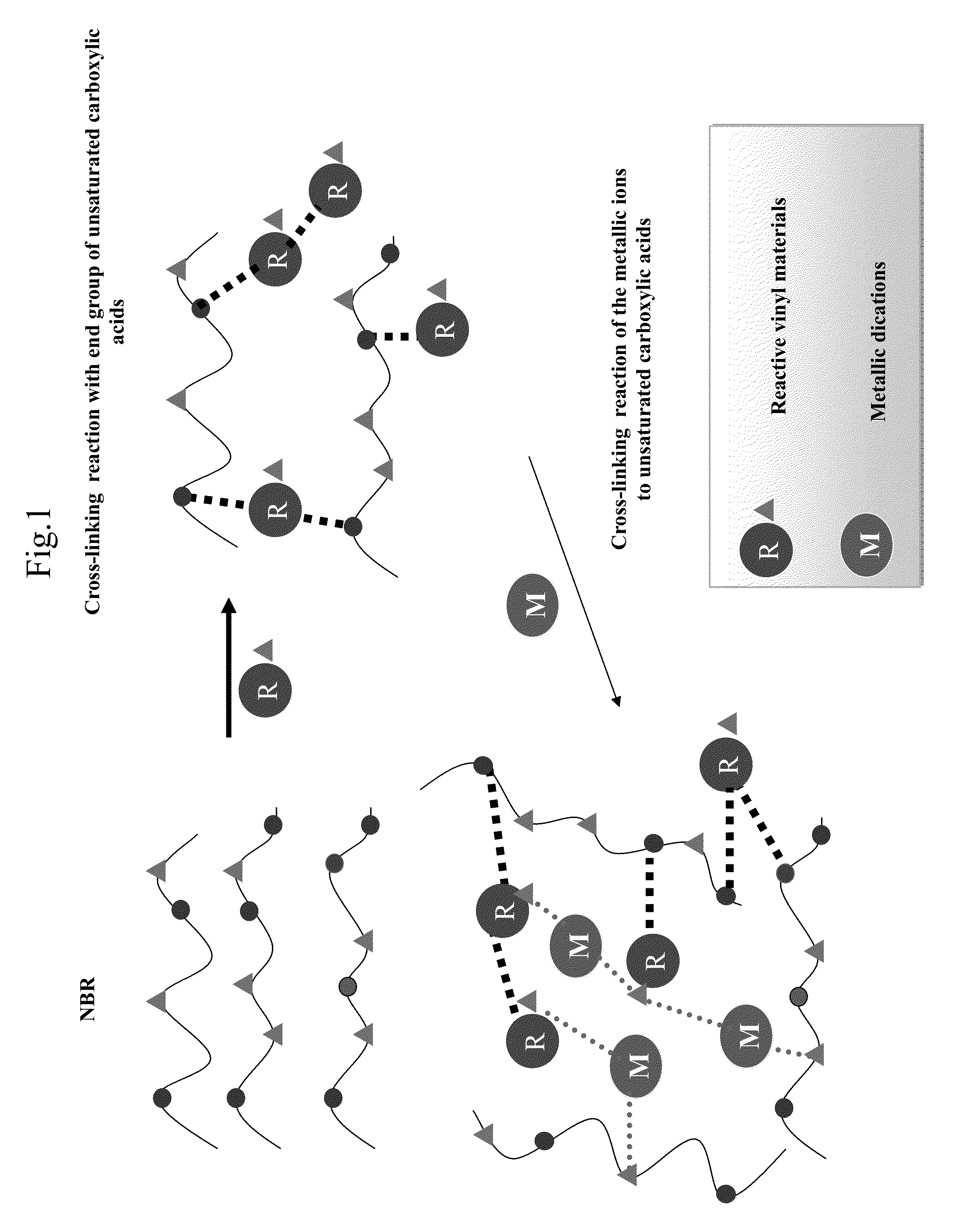
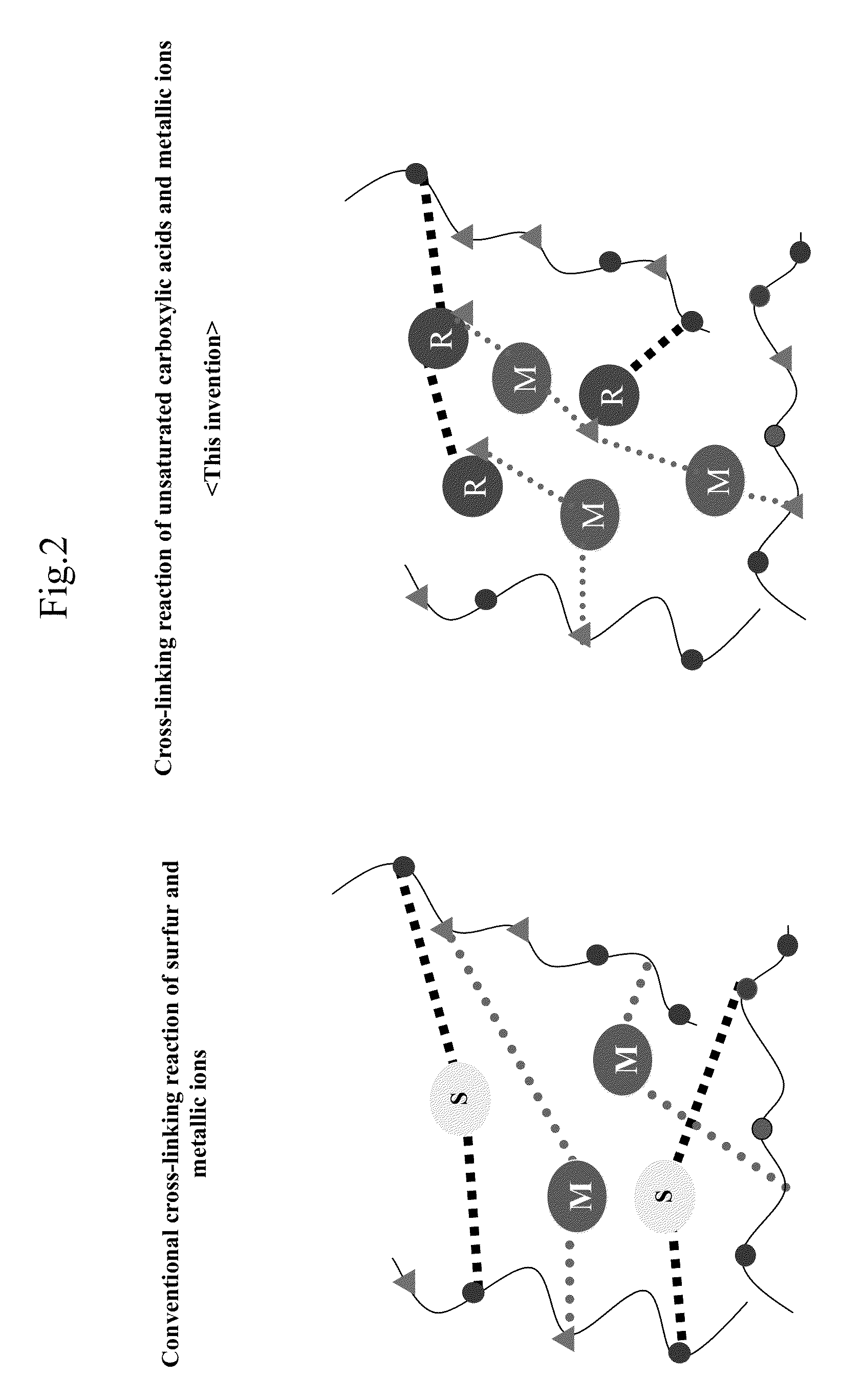
[0175]Mixture of methacrylic acid added to acrylonitrile-butadiene prepared by adding methacrylic acid to acrylonitrile-butadiene to which previously mathacrylic acid is added or not added (product of Syntomer Co., Ltd.: product name is Syntomer 746-SXL) is mixed with potassium hydroxide, zinc oxide, titanium dioxide, a dispersing agent, an anti oxidant, a coloring agent and water and a composition of concentration indicated in Table 2 is prepared. Using this composition an elastomer thin film which does not contain sulfur as a crosslinking agent and a vulcanizing accelerator is prepared.
[0176]
TABLE 4agentsphr746SXL elastomer emulsion of Syntomer Co., Ltd. on which100first step crosslinking treatment is performedKOH1.35zinc oxide1.2titanium dioxide0.75dispersing agent1.5anti oxidant0.25coloring agent0.05water to bring solid phase to 18-30 weight %voluntarily
example 2
[0177]Using a composition composed of a mixture obtained according to Table 4, a gloves made of elastomer thin film by dipping method mentioned below.
(a) process to wash a mold or former by washing water so as to remove stains, then wash with cold water and to dry.
[0178]Dried mold or former is treated by direct dipping method or coagulation agent dipping method. Selection of these methods is depending on a kind of product. Direct dipping method is to dip dried mold or former into a mixture prepared by a recipe of the present invention.
(b) process to dip the mold or former into solution of coagulant containing 8-17 weight % of Ca2+ ion.
The coagulant is prepared as aqueous solution which contains 10 weight % of Ca2+. The mold or former is dipped in said solution. Consequently, coagulant is stuck on the surface of the mold or the former. Time for dipping is 10-20 seconds. A wetting agent or an anti adherence agent can be added. Concretely, zinc stearate and calcium stearate.
(c) process...
example 3
Comparative Example is Mentioned
[0180]Mixture of methacrylic acid added to acrylonitrile-butadiene prepared by adding methacrylic acid to acrylonitrile-butadiene to which previously mathacrylic acid is added or not added (product of Syntomer Co., Ltd.: product name is Syntomer 746-SXL) is mixed with potassium hydroxide, zinc oxide, titanium dioxide, a dispersing agent, an anti oxidant, a coloring agent and water and a composition of concentration indicated in Table 2 is prepared. In the comparative Example, composition containing carboxylated acrylonitrile-butadiene latex (product of Synthomer Co., Ltd. product name is Synthomer 6322), ZnO (1.5 weight %) and sulfur (1.0 weight %) is used and a gloves is prepared, and these two gloves are compared. Regarding zinc oxide, a dispersing agent, a pH adjusting agent and an anti oxidant are same as mentioned in Examples. Weight of solid phase is 30 weight %. According to the processes mentioned in Example 2, gloves product (product name is ...
PUM
| Property | Measurement | Unit |
|---|---|---|
| weight % | aaaaa | aaaaa |
| weight % | aaaaa | aaaaa |
| weight % | aaaaa | aaaaa |
Abstract
Description
Claims
Application Information
 Login to View More