
Halogen-free fire resistance resin composite and application thereof
A resin composition, flame retardant technology, applied in chemical instruments and methods, printed circuits, printed circuit manufacturing, etc., can solve problems such as the inability to meet halogen-free environmental protection requirements, achieve excellent heat resistance, good heat resistance, The effect of excellent heat resistance
Patent Information
- Authority / Receiving Office
- CN · China
- Current Assignee / Owner
- Publication Date
- 2011-04-20
- Estimated Expiration
- Not applicable · inactive patent
Smart Images
Figure 1 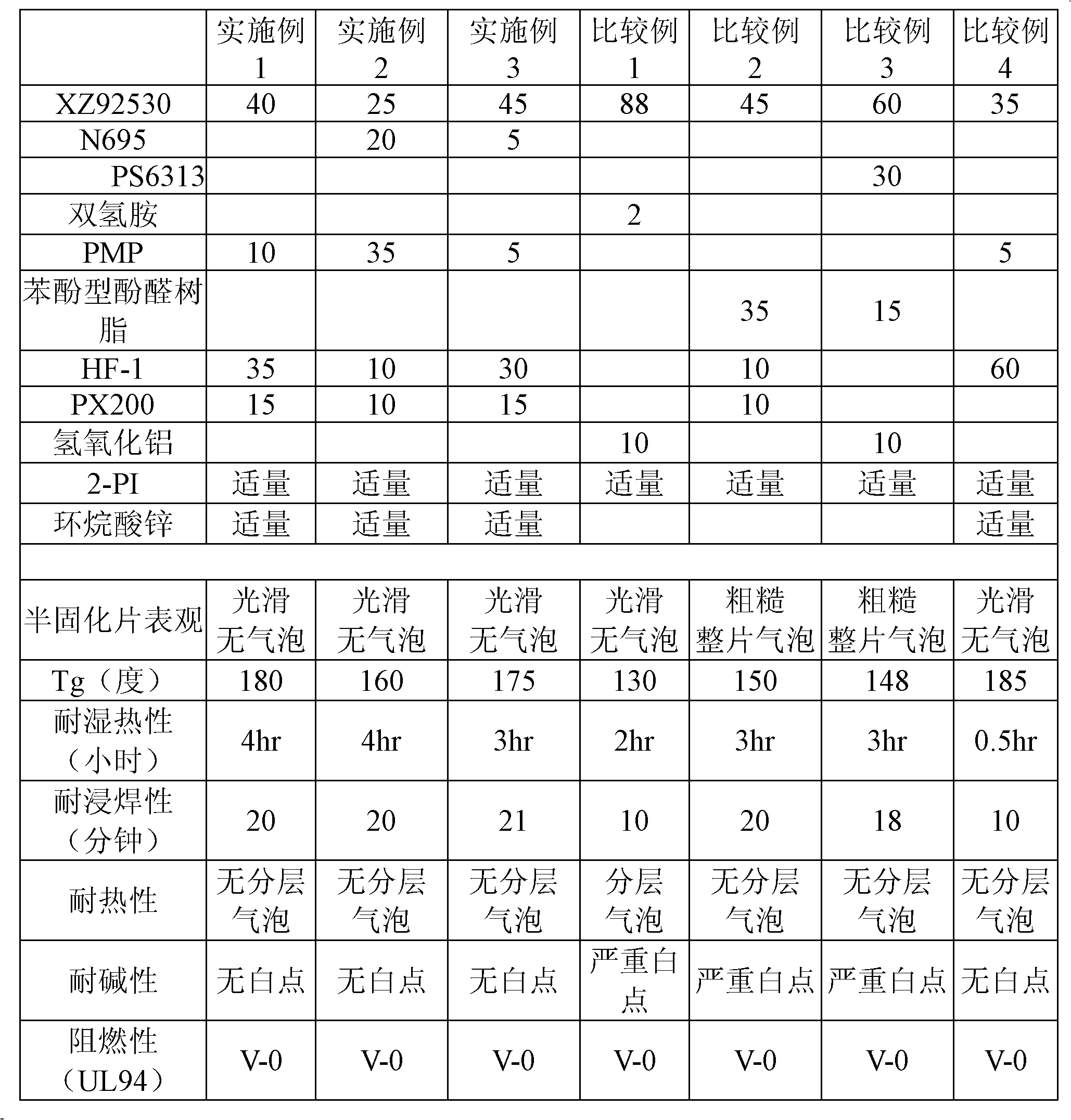
Figure 2 
Figure 3
Abstract
Description
technical field
[0001] The invention relates to a resin composition, in particular to a halogen-free flame-retardant resin composition and its application. Background technique
[0002] With the rapid development of electronic and electrical products in the world, the environmental hazards of electronic and electrical product waste and toxic substances in electronic and electrical products are becoming more and more serious. In order to achieve excellent flame retardancy, existing electronic materials usually use bromine-containing epoxy resin or bromine-containing flame retardants. However, they will dissociate to form hydrogen bromide and bromine under high temperature and long-term use, and have Wire corrosion may cause danger; in addition, a large amount of suffocating smoke will be produced during the combustion process, and carcinogens such as dioxin and dibenzofuran will also be produced during the combustion process. In addition, it is quite difficult to dispose or ...
Examples
Embodiment 1
[0033] Use 40 parts of XZ92530, 10 parts of PMP, 35 parts of HF-1, 15 parts of PX200 supplemented with catalyst 2-PI and zinc naphthenate, use 80 parts of MEK to dissolve the above compounds, and prepare a glue with a suitable viscosity. Use 2116-type electronic grade glass cloth to soak the glue, and bake it in an oven at 155 degrees to remove the solvent to obtain a B-stage prepreg.
[0034] Laminate eight prepregs and two one-ounce electrolytic copper foils together, and laminate them with a hot press to obtain a double-sided copper-clad laminate (a laminate for printed circuits). The lamination conditions are as follows: 1. When the material temperature is 80-120 degrees, the heating rate is controlled at 1.0-3.0 degrees / minute; 2. The pressure is set to 20kg / cm 2 ; 3, curing temperature at 190 degrees, and maintain this temperature for 90 minutes. The corresponding properties are shown in Table 1.
Embodiment 2
[0036] Use 25 parts of XZ92530, 20 parts of N695, 35 parts of PMP, 10 parts of HF-1, 10 parts of PX200 supplemented with catalyst 2-PI and zinc naphthenate, use 80 parts of MEK to dissolve the above compounds, and adjust to a suitable viscosity glue. Use 2116-type electronic grade glass cloth to soak the glue, and bake it in an oven at 155 degrees to remove the solvent to obtain a B-stage prepreg.
[0037] Laminate eight prepregs and two one-ounce electrolytic copper foils together, and laminate them with a hot press to obtain a double-sided copper-clad laminate. The lamination conditions are as follows: 1. When the material temperature is 80-120 degrees, the heating rate is controlled at 1.0-3.0 degrees / minute; 2. The pressure is set to 20kg / cm2; 3. The curing temperature is 190 degrees, and keep this temperature for 90 minutes . The corresponding properties are shown in Table 1.
Embodiment 3
[0039] Use 45 parts of XZ92530, 5 parts of N695, 5 parts of PMP, 30 parts of HF-1, 15 parts of PX200 supplemented with catalyst 2-PI, zinc naphthenate, use 100 parts of MEK to dissolve the above compounds, and adjust to a suitable viscosity glue. Use 2116-type electronic grade glass cloth to soak the glue, and bake it in an oven at 155 degrees to remove the solvent to obtain a B-stage prepreg.
[0040] Laminate eight prepregs and two one-ounce electrolytic copper foils together, and laminate them with a hot press to obtain a double-sided copper-clad laminate. The lamination conditions are the same as in Example 1, and the corresponding properties are shown in Table 1.