
Traditional Chinese medicine composition preventing stalk penicillium digitatum and sclerotinia sclerotiorum, preparation method and application thereof
A technology for Sclerotinia sclerotiorum and Sclerotinia sclerotiorum, which is applied in the directions of botanical equipment and methods, applications, fungicides, etc., can solve the problems of Sclerotinia sclerotiorum and Sclerotinia sclerotiorum that are not yet available in Chinese herbal medicines, and achieves overcoming the resistance of pathogenic bacteria that are easy to cause. Sexuality, no toxic side effects, strong stability effect
Patent Information
- Authority / Receiving Office
- CN · China
- Patent Type
- Applications(China)
- Current Assignee / Owner
- Publication Date
- 2012-03-21
- Estimated Expiration
- Not applicable · inactive patent
Smart Images
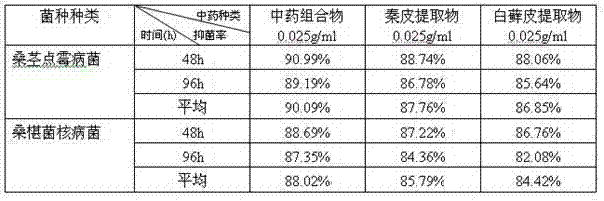
Figure 1 
Figure 2 
Figure 3
Abstract
Description
technical field
[0001] The invention relates to the technical field of biopesticides, in particular to a traditional Chinese medicine composition for resisting Phomomyces sclerotiorum and Sclerotinia sclerotiorum, and its application in the preparation of biological preparations against Phoma sclerotiorum and Sclerotinia sclerotiorum. Background technique
[0002] Phoma fungi ( phoma ) belongs to Deuteromycetes, Shell Mycetes. It is widely distributed and can infect a variety of plants. It is the main pathogenic fungus that causes many plant spot diseases and blights. Zhang Jianbin et al. found that Phomomyces is one of the pathogenic bacteria of juniper red blight; G. Bohar et al. found that Phomomyces is the pathogen that causes ragweed leaf spot; A. Garibaldi et al. V. Gavrilovic et al. reported that Phomomyces was the cause of European sour cherry disease; S. G. Bobev et al. reported for the first time that Phoma was the pathogen of medicinal stachyus plants; C. R. Hol...
Examples
Embodiment 1
[0052] Mix the bark extract and moss bark extract at a volume ratio of 3:7, for example, take 3 mL of bark bark extract and 7 mL of bark bark extract, and dilute to 200 mL with water to obtain the quality described in the present invention Servings: Antibacterial agent of traditional Chinese medicine composition with 30% of Qin bark extract and 70% of white moss bark extract. The average inhibitory rates of the traditional Chinese medicine composition preparation to the two bacteria are respectively: Phomophora mulberry 88.81%; Sclerotinia mulberry 88.35%.
Embodiment 2
[0054] Mix the bark extract and moss bark extract at a volume ratio of 5:5, for example, take 5 mL of bark bark extract and 5 mL of bark bark extract, and dilute to 200 mL with water to obtain the quality described in the present invention Servings: Antibacterial agent of traditional Chinese medicine composition with 50% Qin bark extract and 50% white moss bark extract. The average inhibitory rates of the traditional Chinese medicine composition preparation to the two bacteria are respectively: 89.37% for Phomophora mulberry and 88.64% for Sclerotinia mulberry.
Embodiment 3
[0056] Mix the bark extract and the bark extract of Moss bark in a volume ratio of 7:3, for example, take 7 mL of bark bark extract and 3 mL of bark bark extract, and dilute to 200 mL with water to obtain the comparative extract of the present invention. Optimum parts by mass: the antibacterial agent of traditional Chinese medicine composition with 70% of bark of Qin bark extract and 30% of bark of moss bark extract. The average inhibitory rates of the traditional Chinese medicine composition preparation to the two bacteria are respectively: Phomora mulberry 90.34%; Sclerotinia mulberry 89.57%.