
Lithium manganese phosphate nanoparticles and preparation method thereof
A nanoparticle, lithium manganese phosphate technology, applied in nanotechnology, nanotechnology, chemical instruments and methods, etc.
Patent Information
- Authority / Receiving Office
- CN · China
- Patent Type
- Applications(China)
- Current Assignee / Owner
- Publication Date
- 2014-12-03
- Estimated Expiration
- Not applicable · inactive patent
Smart Images
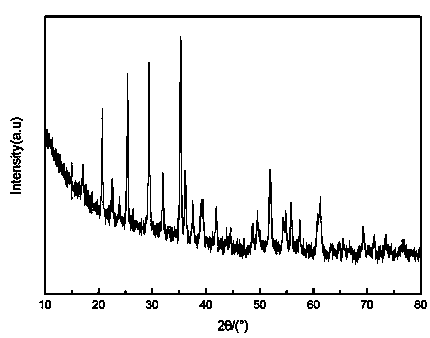
Figure 1 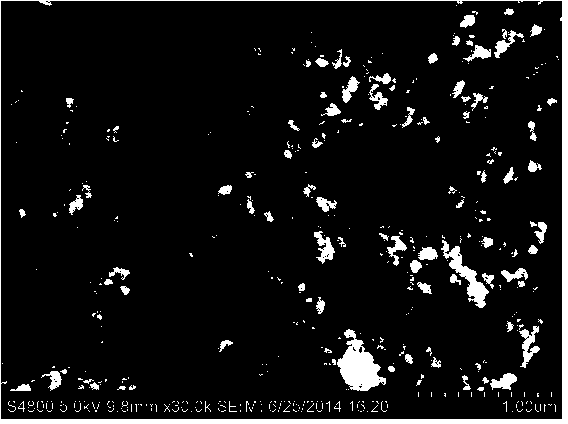
Figure 2
Abstract
Description
technical field
[0001] The invention relates to a lithium manganese phosphate nanometer material and a preparation method thereof, in particular to a lithium manganese phosphate nanometer particle and a preparation method thereof. Background technique
[0002] Lithium-ion battery, as a high-performance rechargeable green power source, has been widely used in various portable electronic products and communication tools in recent years, and has been gradually developed as a power source for electric vehicles, thereby promoting its development towards safety, environmental protection, Development in the direction of low cost and high specific energy. Among them, the development of new electrode materials, especially positive electrode materials, is extremely critical. At present, the widely studied cathode materials for lithium-ion batteries focus on transition metal oxides of lithium such as LiMO with a layered structure. 2 (M=Co, Ni, Mn) and LiMn with spinel structure 2 o ...
Examples
example 1
[0021] 1) Dissolve 2.000 g of P123 in 15 ml of deionized water, stir for 240 minutes, then add 1.470 g of manganese acetate tetrahydrate and 0.200 g of ascorbic acid, and stir until fully dissolved to obtain a manganese acetate concentration of 0.4 mol / L, ascorbic acid Solution A with a concentration of 0.076 mol / L and a P123 concentration of 0.13 g / mL;
[0022] 2) Dissolve 0.588g of phosphoric acid and 0.612g of lithium acetate dihydrate in 15 ml of ethylene glycol and stir for 30 minutes to form a suspension with a phosphoric acid concentration of 0.4 mol / L and a lithium acetate concentration of 0.4 mol / L B;
[0023] 3) Add the suspension B prepared in step 2) dropwise to the solution A prepared in step 1) under stirring to form emulsion C. The molar ratio of Li, Mn, and P in emulsion C is 1:1:1.
[0024] 4) Transfer the emulsion C in step 3) to a 60ml autoclave, add 5 ml of ethylene glycol solution containing 0.112 g KOH, stir well, and then adjust its volume to 40ml with...
example 2
[0028] 1) Dissolve 3.000 g P123 in 15 ml of deionized water, stir for 300 minutes, then add 2.45 g of manganese acetate tetrahydrate and 0.400 g of ascorbic acid, and stir until fully dissolved to obtain a manganese acetate concentration of 0.67 mol / L, ascorbic acid Solution A with a concentration of 0.152 mol / L and a P123 concentration of 0.20 g / mL;
[0029] 2) Dissolve 0.98g of phosphoric acid and 2.04g of lithium acetate dihydrate in 15 ml of ethylene glycol and stir for 90 minutes to form a suspension with a concentration of phosphoric acid of 0.67 mol / L and a concentration of lithium acetate of 1.33 mol / L B;
[0030] 3) Add the suspension B prepared in step 2) dropwise to the solution A prepared in step 1) under stirring to form emulsion C. The molar ratio of Li, Mn, and P in emulsion C is 2:1:1.
[0031] 4) Transfer the emulsion C in step 3) to a 50ml autoclave, add 5 ml of ethylene glycol solution containing 0.224 g KOH, stir well, and then adjust its volume to 40ml w...
example 3
[0034] 1) Dissolve 3.500 g of P123 in 15 ml of deionized water, stir for 360 minutes, then add 2.94 g of manganese acetate tetrahydrate and 0.240 g of ascorbic acid, stir until fully dissolved, and obtain manganese acetate concentration of 0.80 mol / L, ascorbic acid Solution A with a concentration of 0.091 mol / L and a P123 concentration of 0.23 g / mL;
[0035] 2) Dissolve 1.176g of phosphoric acid and 1.224g of lithium acetate dihydrate in 15 ml of ethylene glycol and stir for 150 minutes to form a suspension with a phosphoric acid concentration of 0.80 mol / L and a lithium acetate concentration of 0.80 mol / L B;
[0036] 3) Add the suspension B prepared in step 2) dropwise to the solution A prepared in step 1) under stirring to form emulsion C. The molar ratio of Li, Mn, and P in emulsion C is 1:1:1.
[0037] 4) Transfer the emulsion C in step 3) to a 55ml autoclave, add 8 ml of ethylene glycol solution containing 0.336 g KOH, stir well, and then adjust its volume to 40ml with ...