
Novel summer corn SRP class group selfing line breeding method
A technology for inbred lines and summer corn, which is applied in the field of breeding of inbred lines of the SRP group of summer corn, can solve the problems of fragile cobs, slow dehydration, poor density resistance and lodging resistance, etc., and achieve good adaptability and coordination The effect of high strength and compact plant type
Patent Information
- Authority / Receiving Office
- CN · China
- Patent Type
- Applications(China)
- Current Assignee / Owner
- Publication Date
- 2015-07-29
- Estimated Expiration
- Not applicable · inactive patent
Smart Images
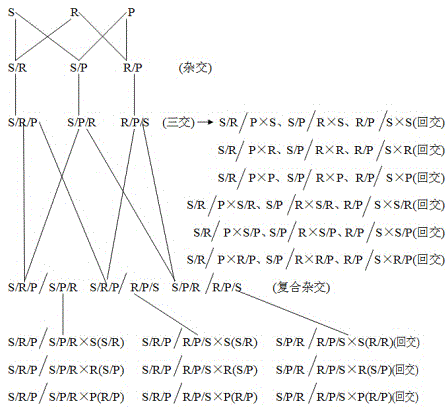
Figure 1 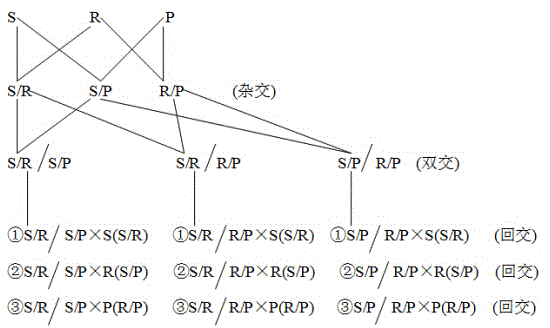
Figure 2
Abstract
Description
technical field
[0001] The invention relates to the technical field of agricultural breeding, in particular to a method for breeding a novel summer maize SRP group inbred line. Background technique
[0002] These three groups are the main breeding germplasm in Huanghuaihai and adjacent areas, and their advantages and disadvantages are as follows:
[0003] (1) P group germplasm: mainly 78599 series, Suwan (Suwan), Tuxpend tropical germplasm, inbred lines of this group germplasm: Qi 319, P138, P178, 87-1, Dan 599, 8085T, Su 37 , Double M9, etc., with semi-compact plant type and loose slope leaf type, showing good resistance to corn spot, rust, stem rot, and Curvularia leaf spot. The inbred lines of this group are sensitive to light reflection , the growth period is long, and the tightness is poor. Most of the combined hybrids are of tall stem and big panicle type, which are sensitive to planting density. The suitable planting density is 3000-3500 plants, and the planting...
Examples
Embodiment
[0016] Breeding method of inbred line 7258 and its extended varieties
[0017] Combining R×P and S inbred lines, R×P selects the 2008 summer sowing group to match 319 (P group)×Zheng 58 (R group), and the summer sowing in 2011 has reached the F6 generation, and the line code is C3958. The C3958 group was used to match Chang 7-2 (group S), after continuous self-crossing and Hainan breeding, after the mating in Hainan from October 2013 to April 2014, the hybrid combination identification was carried out from June to October 2014, the parental inbred line Has reached the F6 generation. From November 2014 to April 2015, the hybrid combination Hainan was identified, and the F7 generations of the parental inbred lines were all stable. The selected inbred line is named 7258. The plant height of the 7258 inbred line is 160cm, the ear height is 60-70cm, and the leaves are 19-20 pieces. 8-12 branches, males yellow-green, anthers light purple, filaments light red. Ear tube type, ear l...