

Method for synthesizing 1-cyclohexene-1, 2-dicarboximide
A technology of dicarboximide and phthalimide, applied in the field of synthesis of 1-cyclohexene-1,2-dicarboximide, which can solve the problem of low product quality, difficult separation and difficult application For problems in the fields of biology and materials science, achieve high conversion rate, high selectivity, and avoid polymerization side reactions
Patent Information
- Authority / Receiving Office
- CN · China
- Current Assignee / Owner
- Publication Date
- 2018-10-23
Smart Images
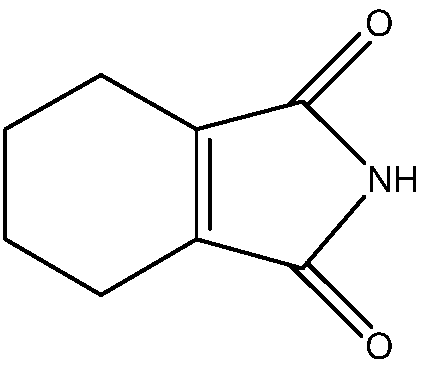
Figure 1 
Figure 2 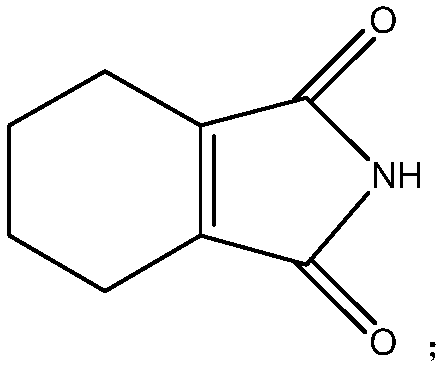
Figure 3
Abstract
Description
technical field
[0001] The invention belongs to the improvement of the synthesis method of 1-cyclohexene-1,2-dicarboximide. Background technique
[0002] 1-cyclohexene-1,2-dicarboximide, the molecular structure is:
[0003]
[0004] 1-Cyclohexene-1,2-dicarboximide, also known as 3,4,5,6-tetrahydrophthalimide, or tetrahydrophthalimide, the pure product is white flakes crystalline powder. As an intermediate, it is widely used in various fields of organic synthesis, such as biomedicine, new unsaturated resin materials, modification of composite materials, pesticides, etc. It has broad application prospects.
[0005] At present, it is reported in open literature that its synthetic method is mostly to use maleic anhydride and 1,4-butadiene to carry out conjugate addition first to obtain 1,2,3,6-tetrahydrophthalic anhydride, and then in pentoxide Under the catalysis of diphosphorus, 3,4,5,6-tetrahydrophthalic anhydride is obtained through isomerization reaction by heating a...
Examples
example 1
[0036] Add 14.7g (0.1mol) of phthalimide, 500ml of N,N-dimethylformamide and 1g of 60% palladium carbon (5%) on a dry basis in a 1L stainless steel magnetically stirred autoclave, and close the reaction kettle . After the air in the kettle was replaced with nitrogen, stirring was started to raise the temperature.
[0037] When the temperature rises to 90°C, the gauge pressure is 0MPa. At this time, hydrogen gas was introduced, and the temperature in the kettle was ensured to be between 85-95°C. After 15 minutes, the pointer of the pressure gauge was raised, the hydrogen inlet valve was closed, and the heat preservation and stirring were continued for 2.5 hours, and the pressure gauge returned to zero.
[0038] Open the hydrogen inlet valve again, and after 40 minutes, the pointer of the pressure gauge rises, close the hydrogen inlet valve, continue to keep warm and stir for 2 hours, and the pressure gauge returns to zero.
[0039] In this way, whenever the pressure gauge ha...
example 2
[0043] Add 55g (0.37mol) of phthalimide, 700ml of N,N-dimethylformamide and 5.5g of 60% palladium carbon (5%) on a dry basis in a 1L stainless steel magnetically stirred autoclave, and close the reaction kettle . After the air in the kettle was replaced with nitrogen, stirring was started to raise the temperature.
[0044] When the temperature rises to 80°C, the gauge pressure is 0MPa. At this time, hydrogen gas was introduced, and the temperature in the kettle was ensured to be between 75-90°C. After 35 minutes, the pointer of the pressure gauge was raised, the hydrogen inlet valve was closed, and the heat preservation and stirring were continued for 3 hours, and the pressure gauge returned to zero.
[0045] Open the hydrogen inlet valve again, and after 40 minutes, the pointer of the pressure gauge rises, close the hydrogen inlet valve, continue to keep warm and stir for 2 hours, and the pressure gauge returns to zero.
[0046]In this way, whenever the pressure gauge has ...
example 3、4、5
[0050] Except catalyzer, repeat example 2 operation, obtain the result shown in the following table. The catalyst filtered out in Example 2 was only dried (vacuum oven, 100° C., 5 hours), and no new catalyst was added, and was directly used in Examples 3, 4, and 5.
[0051]
[0052] As can be seen from the above table, the catalyst can be recycled and used mechanically. But when it is applied to the third time, the content of the product drops significantly, the melting range of the product is long, and there are many impurities.