

Synthesis method of lenvatinib and new intermediate
A synthetic method, the technology of lenvatinib, applied in the direction of organic chemistry, can solve the problems of separation and purification of intermediates, and achieve the effect of simple and easy operation and cheap and easy-to-obtain starting materials
Patent Information
- Authority / Receiving Office
- CN · China
- Patent Type
- Applications(China)
- Current Assignee / Owner
- Publication Date
- 2020-06-30
- Estimated Expiration
- Not applicable · inactive patent
Smart Images
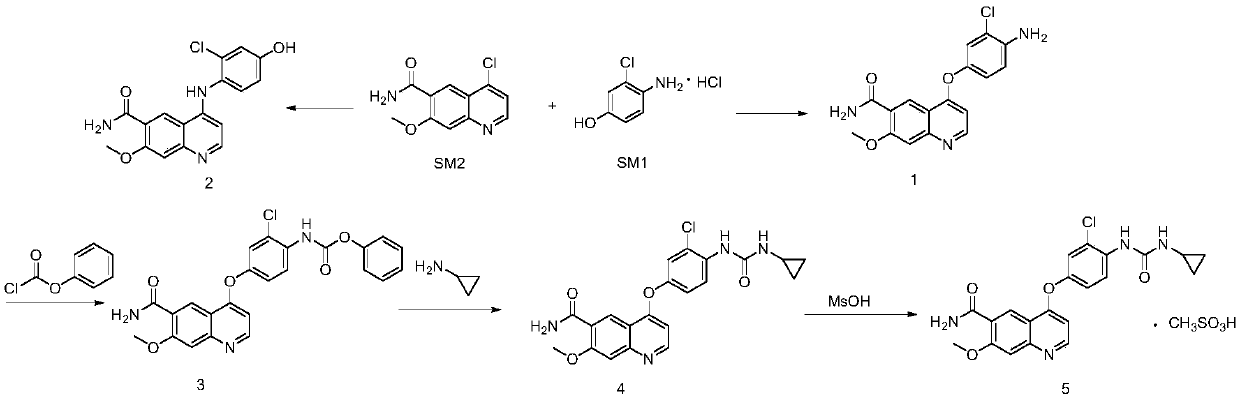
Figure 1 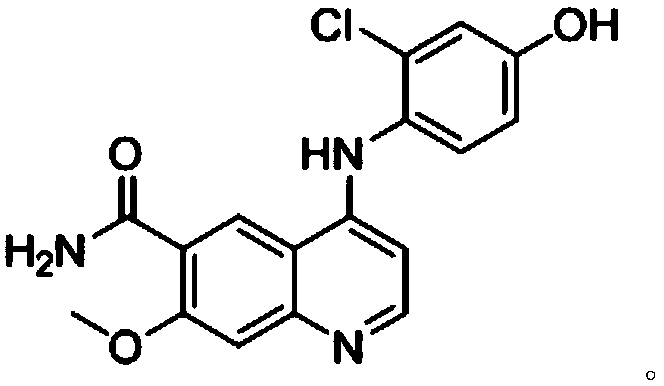
Figure 2 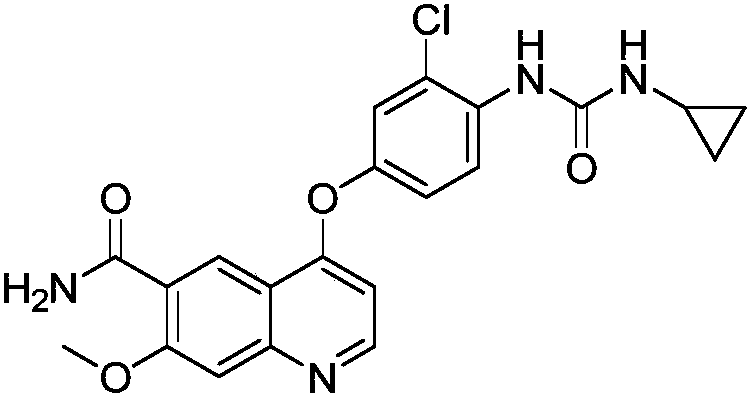
Figure 3
Abstract
Description
technical field
[0001] The invention belongs to the field of medicinal chemistry, and specifically relates to a synthesis method, a process route, and a new intermediate found in the synthesis process of lenvatinib. Background technique
[0002] Lenvatinib is a variety of tyrosine kinase RTKs inhibitors developed by Japan's Eisai Company. It has inhibitory effect on VEGFR1, VEGFR2, VEGFR3, FGFR, PDGFRKIT, RET, and can inhibit tumor progression. For thyroid cancer and unresectable hepatocellular carcinoma.
[0003] The chemical name of lenvatinib is 4-(4-(cyclopropylaminocarbonyl)amino-3-chloro-phenoxy)-7-methoxy-6-carboxamidoquinoline, molecular formula: C 21 h 19 ClN 4 o 4 , CAS number: 417716-92-8, the structural formula is as follows:
[0004]
[0005] The synthesis route and preparation method of lenvatinib have been reported: the route mentioned in the patent CN 104876864 A has the disadvantage of long synthesis process route and involves Boc protection and dep...
Examples
Embodiment 1
[0050] Preparation of compound 1:
[0051]
[0052] Weigh compound SM2 (2.00g, 8.45mmol), SM1 (2.13g, 11.83mmol) into a 100mL three-neck flask, add 18mL DMSO, and stir well. Weigh potassium hydroxide (1.19g, 21.13mmol) into a small beaker, add 2.4mL of water, stir to dissolve, and then add to the above-mentioned 100mL reaction flask. React at 80°C. After 24 hours of reaction, add a mixed solution of acetone and water until a large amount of brown solid precipitates, then filter with suction, and weigh the obtained solid after drying in a blast drying oven to obtain 2.75 g of crude product , the resulting crude product was recrystallized in DMSO to give a red solid. After drying in a blast drying oven, the compound 1 was obtained by weighing: 2.20 g, with a yield of 76%.
[0053] Preparation of compound 2:
[0054]
[0055]Weigh compound SM2 (30.00g, 126.76mmol), SM1 (27.36g, 151.97mmol) and cesium carbonate (83.34g, 255.94mmol) in a 500mL three-necked flask, and the r...