
Methods for detection of methylated DNA
a methylated dna and detection method technology, applied in biochemistry apparatus and processes, organic chemistry, sugar derivatives, etc., can solve the problems of reducing the overall affecting the efficiency of the enzyme, and requiring significantly more processing time, so as to facilitate denaturation and save significant time , the effect of increasing the overall efficiency
Patent Information
- Authority / Receiving Office
- US · United States
- Current Assignee / Owner
- Publication Date
- 2006-12-21
- Estimated Expiration
- Not applicable · inactive patent
Smart Images
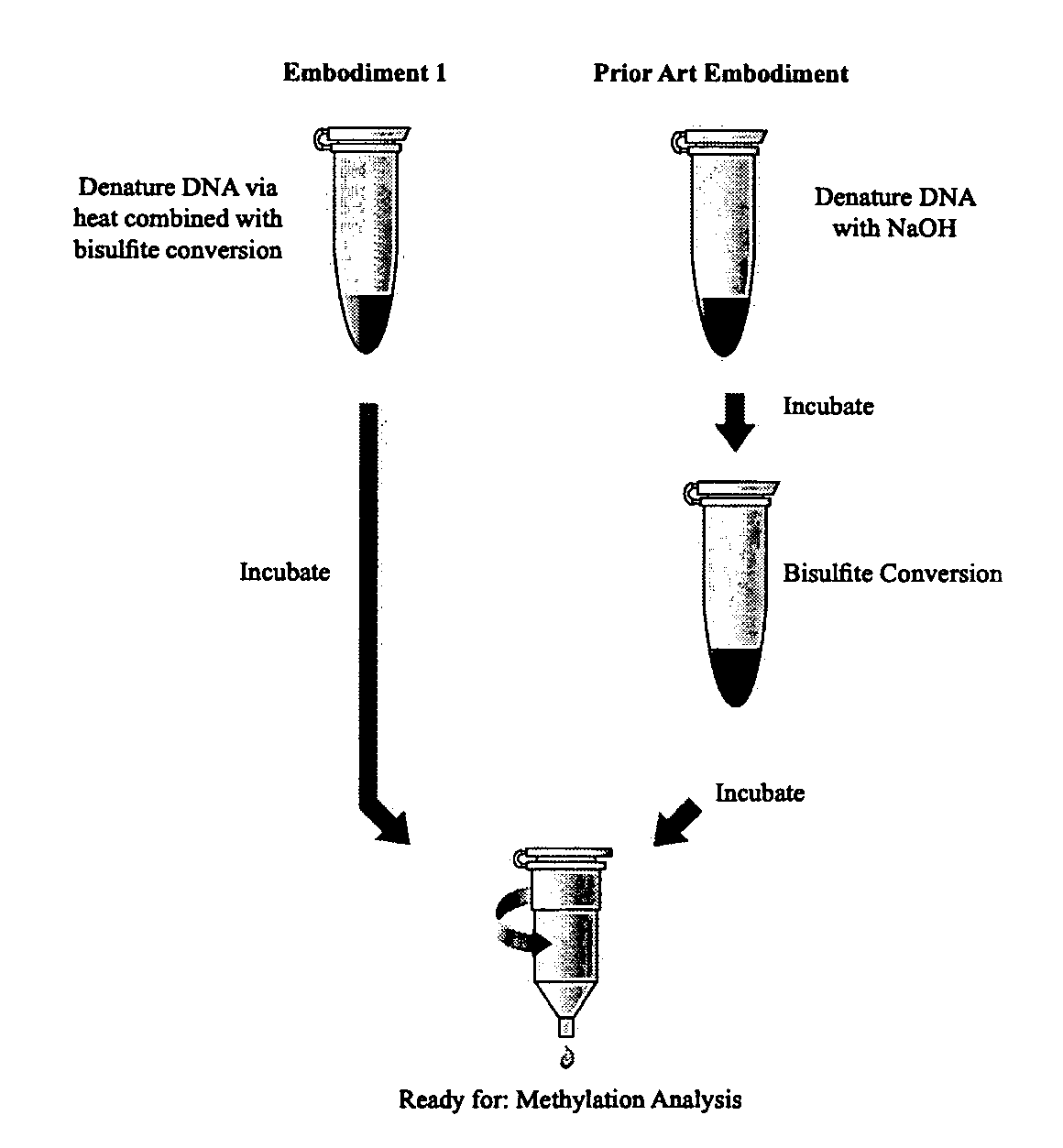
Figure 1 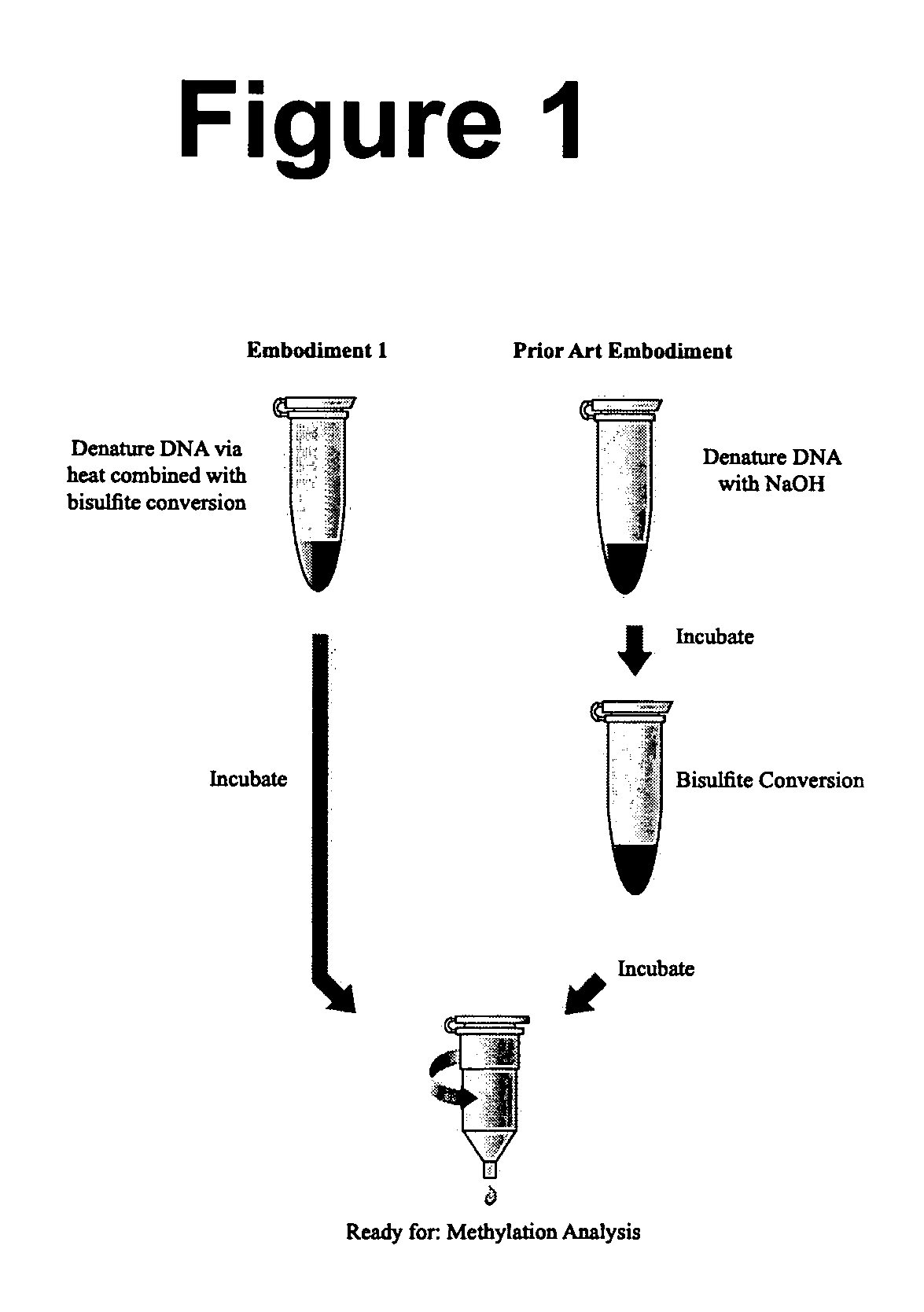
Figure 2 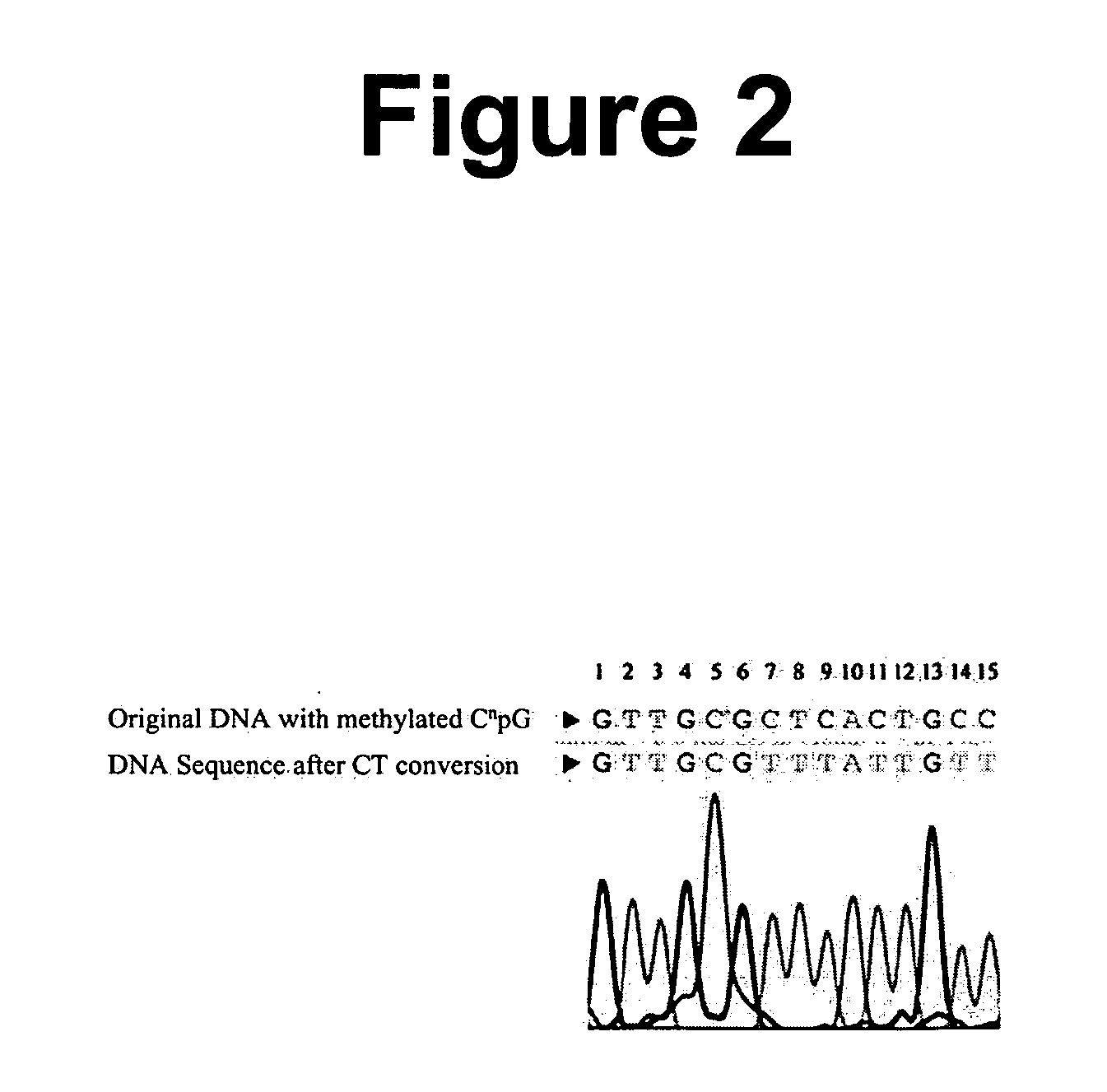
Figure 3
Abstract
Description
CLAIM OF PRIORITY
[0001] This application claims priority to U.S. Provisional Application Ser. No. 60 / 691,539, filed on Jun. 17, 2005.FIELD OF THE INVENTION
[0002] The invention relates to the regulation of gene expression and more specifically to improved methods for determining the methylation status of specific DNA templates using the bisulfite method of methylation analysis. BACKGROUND
[0003] DNA methylation is a ubiquitous process in prokaryotes and eukaryotes. In prokaryotes DNA methylation protects an organism's own DNA from restriction enzymes produced to digest foreign DNA. In higher eukaryotes DNA methylation functions in the regulation of gene expression (Costello and Plass, 2001). Aberrant methylation is widespread in cancer and may be among the earliest changes to occur during oncogenesis (Stirzaker, 1997). DNA methylation has also been shown to play a central role in gene imprinting, embryonic development, X-chromosome gene-silencing, and cell-cycle regulation. In many...
Examples
example 1
[0100] Diagnostic Primers
[0101] The primer pair A (SEQ. ID. NO: 4 and 5) are used to amplify a 470 bp DNA fragment from the pUC19 plasmid by PCR (Genbank Acession No. L09137), when unmethylated cytosine (C ) is not converted to uracil (U) (see FIG. 3).
[0102] The primer pair B (SEQ. ID. NO: 6 and 7) are used amplify a corresponding 470 bp DNA fragment from pUC19 by PCR when C is converted to U.
Set A:Seq I.D. No. 5:208-229 nt, Plus sense to amplify originalsequence.5′-gatgcgtaaggagaaaataccg-3′Seq I.D. No. 6:648-667 nt. Minus sense to amplify originalsequence.5′-cgcctctccccgcgcgttggc-3′Set B:Seq I.D. No. 7:B1: Plus sense, primers for use after C to U / Tconversion.5′-gatgtgtaaggagaaaatattg-3′Seq I.D. No. 8:B2: Minus sense, primer after C to U / T conversion5′-cacctctccccacacattaac-3′
[0103] Bisulfite conversion can be monitored using primer pair sets A and B. Primer set A detects unconverted DNA, whereas primer set B detects bisulfite-converted DNA where base C has been converted to U (...
example 2
[0104] Reagents, Solutions, and Buffers
[0105] Bisulfite Reagent (Solution): The bisulfite conversion reagent for approximately 10 reactions is a solid mixture of about 475 mg sodium metabisulfite (Na2S2O5, 1.9 M) and 0.5 mg hydroquinone (4.6 μM). It is recognized that sodium bisulfite and similar bisulfite salts may be used at concentrations from about 0.2 M to about 1.0 M, or about 1.0 M to about 2.0 M. In addition, the antioxidant hydroquinone may be omitted, or alternately used from about 3.0 μM to about 10 μM, or about 4 μM to about 5 μM. The dry chemicals are dissolved by adding 900 μl H20, 50 μl of 50% DMF, and 300 μl of 2 M NaOH. The solution is mixed until the chemicals are completely dissolved. Vortexing or shaking is recommended. Many compositions of bisulfite conversion reagent are known in the art. It is not thought that minor variations in the concentrations or inclusion of specific additional chemical components, other than bisulfite, significantly affect conversion e...
example 3
[0113] Combined Thermal Denaturation and Bisulfite Conversion: Coupled to In-Column Desulfonation.
[0114] The bisulfite conversion and desulfonaton (C-U) of DNA is accomplished using the following protocol. The Reaction volumes may be scaled as required (see embodiment 1, FIG. 1). Step 1: A sample of 130 μl of the nearly saturated bisulfite solution from Example 2 is added to about 20 μl of DNA sample in a 250 ul tube (suitable for PCR reactions). For example: 4 μl DNA sample, 16 μl H2O, and 130 μl bisulfite conversion solution constitutes a standard reaction, though modifications to account for DNA sample volume can readily be made. The DNA sample may contain from about 500 pg to about 2.0 μg of DNA template, and preferably between about 200 ng to about 500 ng. The sample may also contain about 500 ng of salmon sperm DNA or other non-interfering DNA carrier. The sample is mixed by hand by flicking the tube, or other convenient means. The sample is placed in a thermal-cycler device ...