
Seven-membered ring nucleosides
Patent Information
- Authority / Receiving Office
- US · United States
- Current Assignee / Owner
- Publication Date
- 2007-08-09
- Estimated Expiration
- Not applicable · inactive patent
Smart Images
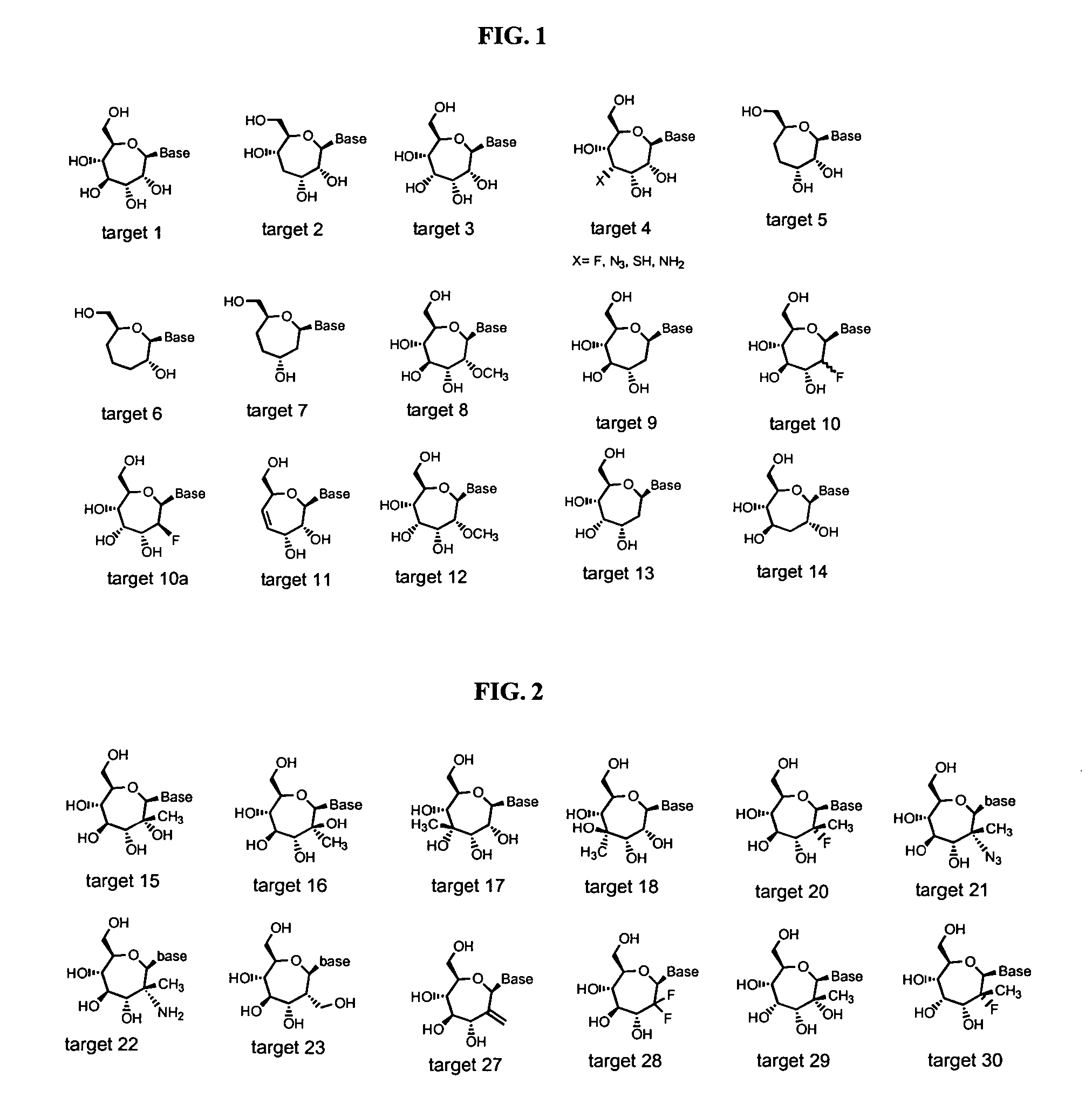
Figure 1 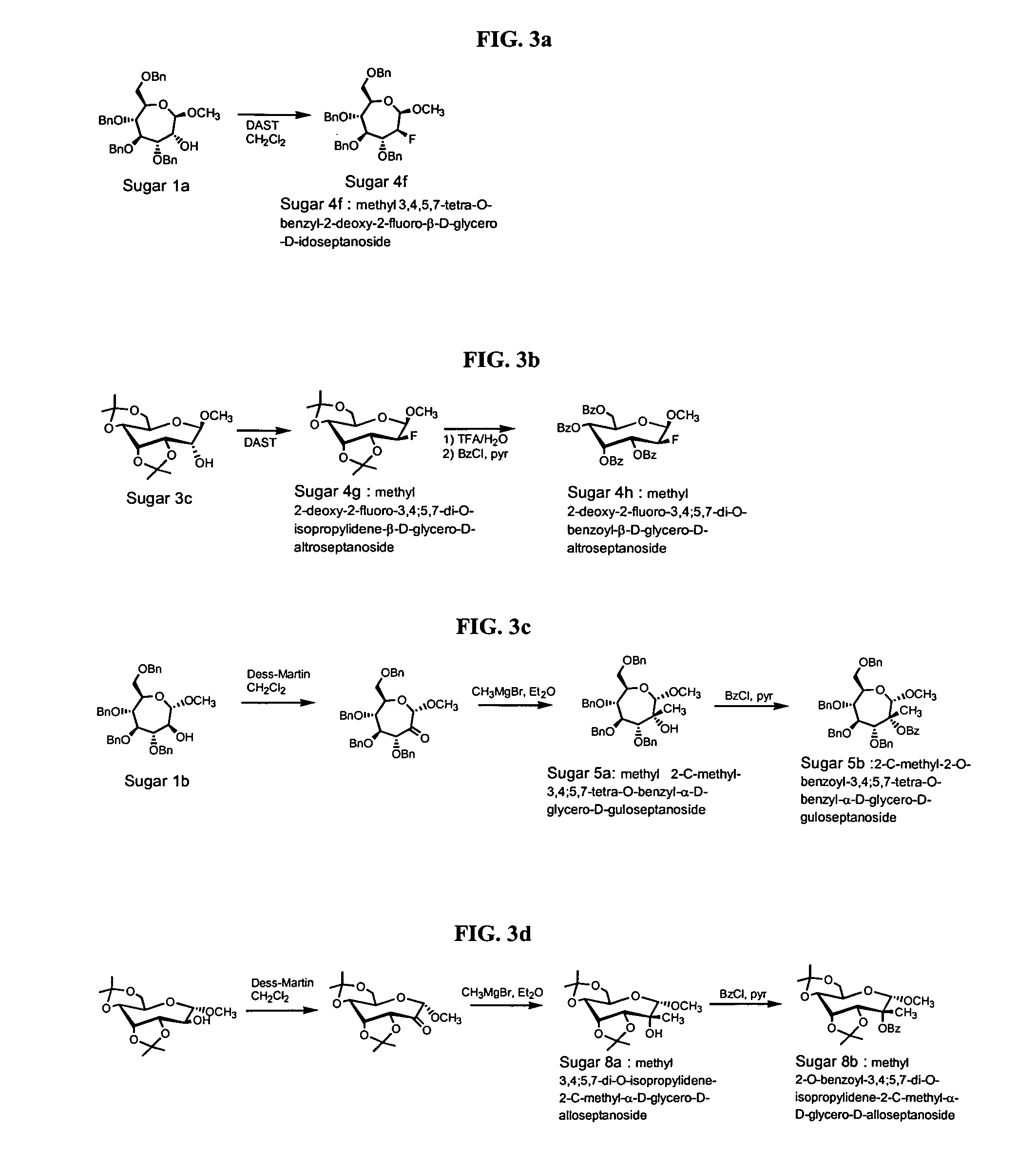
Figure 2 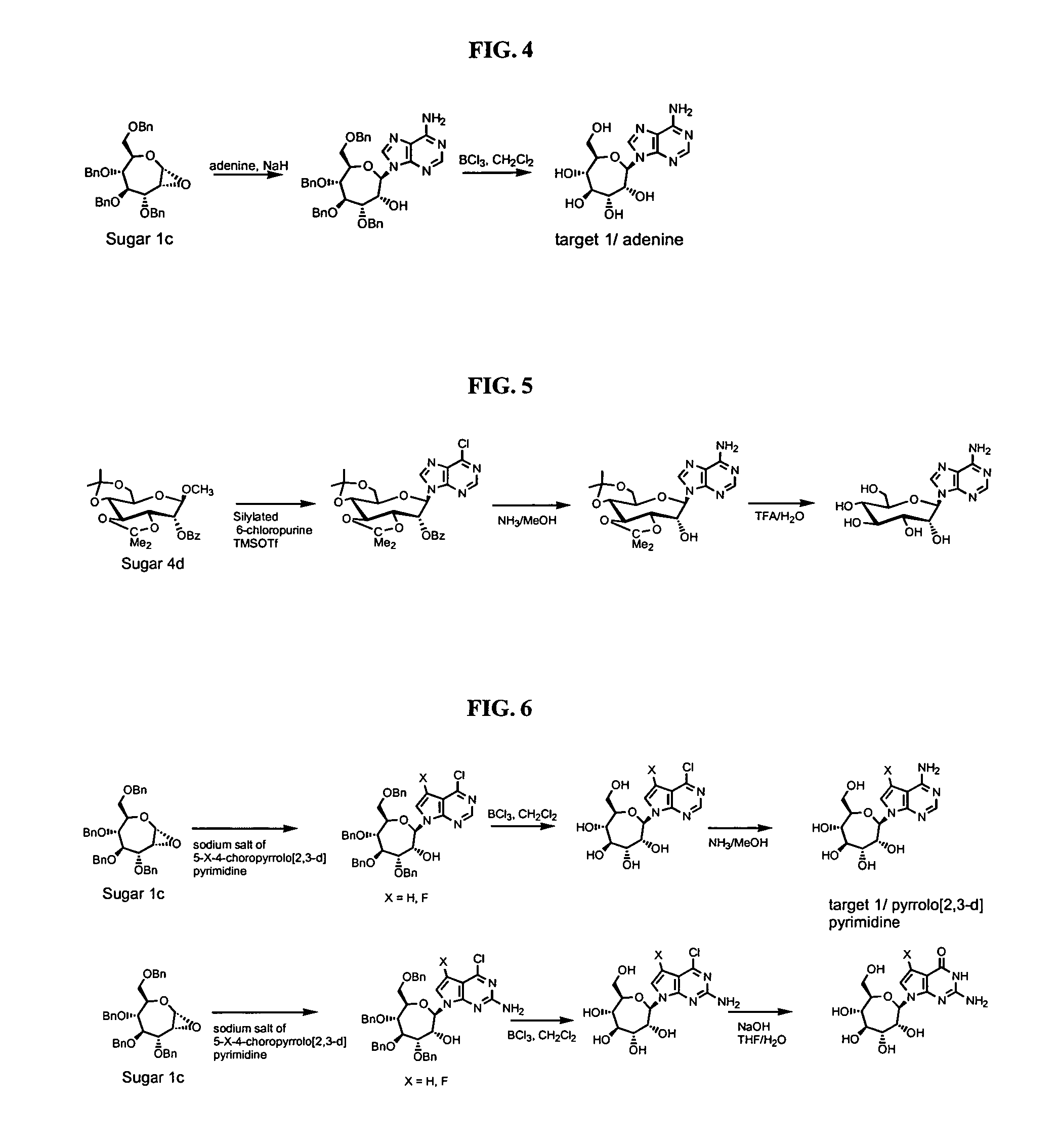
Figure 3
Abstract
Description
CROSS-REFERENCE TO RELATED APPLICATIONS
[0001] This application claims the benefit of priority to U.S. Provisional Application No. 60 / 710,771, filed Aug. 23, 2005, the disclosure of which is incorporated by reference.FIELD OF THE INVENTION
[0002] This invention is in the area of pharmaceutical chemistry and, in particular, provides nucleoside analogues that include a seven membered ring that inhibit viral replication. Included in the invention are pharmaceutically acceptable salts, esters, derivatives and prodrugs of these nucleoside analogues, as well as syntheses and uses of these compounds as anti-Flaviviridae agents in the treatment of hosts, notably humans, infected with a Flaviviridae virus, and in particular, hepatitis C virus. BACKGROUND OF THE INVENTION
[0003] Infection of a human with hepatitis C (HCV) is a major health issue that an increasing percentage of the world's population. Left untreated, HCV infection can lead to chronic liver disease, cirrhosis, hepatocellular c...
Examples
example 1
[0376]
[0377] Compound A-1: was prepared according to: Castro S., Peczuh M. W., Journal of Organic Chemistry, 2005, 70, 3312-15. Molecular Formula: C36H40O6.1H NMR (400 MHz, CDCl3) δ 7.40-7.20 (m, 20 H, 4Bn), 5.05 (d, 1H, J=10.8 Hz, H1′), 4.90-4.60 (m, 8H, 4CH2Bn), 3.90 (m, 1H), 3.80 (m, 1H), 3.70-3.60 (m, 4H), 3.40 (s, 3H, OCH3), 2.20 (dd, 1H, J1=5.6 Hz, J2=14.8 Hz, H2a′), 1.95 (m, 1H, H2b′)
[0378] Compound A-2. Silylation of N4-benzoylcytosine: a suspension of N4-benzoylcytosine (450 mg, 2.10 mmol) in 1,1,1,3,3,3-hexamethyldisilazane (HMDS, 20 ml) and a catalytic quantity of ammonium sulfate, was heated with stirring at reflux for 20 hours under argon. The resulting solution was then allowed to cool to room temperature and concentrated under vacuo under argon. Condensation step: to a solution of silylated N4-benzoylcytosine in anhydrous 1,2-dichloroethane (20 ml) was sequentially added compound A-1 (1.0 g, 1.76 mmol) and trimethylsilyltrifluoromethanesulfonate (TMSOTf, 0.51 ml, 2.6...
example 2
[0382]
[0383] Compound A-6a and A6-b. To a suspension of 6-chloropurine (1.31 g, 8.45 mmol) in anhydrous toluene (25 ml) was added N,O-bis(trimethylsilyl)acetamide (3.49 ml, 14.08 mmol). The reaction mixture was stirred at reflux during 20 min. At room temperature and under argon, to this mixture was added compound A-1 (4.0 g, 7.04 mmol) and trimethylsilyltrifluoromethanesulfonate (TMSOTf, 2.72 ml, 14.08 mmol), the reaction mixture was stirred at reflux for 2 hours, then, at room temperature was diluted with ethyl acetate, washed successively with a saturated aqueous solution of sodium bicarbonate, brine, dried over sodium sulfate and concentrated under vacuo. Purification on a silica gel column chromatography (eluent: petroleum ether / diethyl ether (1 / 1)) afforded compound A-6a (2.85 g, 58 %) and compound A-6b (1.7 g, 35%). Molecular Formula: C40H39ClN4O5. A-6a: 1H NMR (300 MHz, CDCl3): δ 8.75 (s, 1H, H8), 8.40 (s, 1H, H2), 7.40-7.00 (m, 20H, 4Bn), 6.20 (dd, 1H, J1=5.2 Hz, J2=6.5 Hz,...
example 3
[0390]
[0391] Compounds A-10 and A-11. To a suspension of N2-isobutyrylguanine (932 mg, 4.22 mmol) in anhydrous toluene (7 ml) was added N,O-bis(trimethylsilyl)acetamide (3.49 ml, 14.07 mmol). The reaction mixture was stirred at reflux during 3 hours. To the previous reaction mixture was added compound A-1 (2.0 g, 3.52 mmol) in solution in anhydrous toluene (13 ml), trimethylsilyltrifluoromethanesulfonate (TMSOTf, 2.72 ml, 14.07 mmol) and the reaction mixture was stirred at reflux for 40 min. At room temperature the reaction mixture was diluted with ethyl acetate, neutralized with a saturated aqueous solution of sodium bicarbonate and the mixture was filtrated through a pad of celite. The organic layer was washed with brine, dried over sodium sulfate (Na2SO4) and evaporated to dryness. The crude material was purified on a silica gel column chromatography (eluent: from 2 to 2.5% of ethanol in diethyl ether) to give compound A-10 (630 mg, 24%) and compound A-11 (390 mg, 15%). Molecular...