

Processes and Device for Low Temperature Separation of Air
a technology of low temperature separation and process, which is applied in the direction of refrigeration and liquid storage, lighting and heating equipment, solidification, etc., can solve the problems of turbine damage, inability to unconditionally lower the temperature at the turbine inlet, etc., and achieve the effect of low equipment cos
Patent Information
- Authority / Receiving Office
- US · United States
- Patent Type
- Applications(United States)
- Current Assignee / Owner
- Publication Date
- 2011-03-24
- Estimated Expiration
- Not applicable · inactive patent
Smart Images
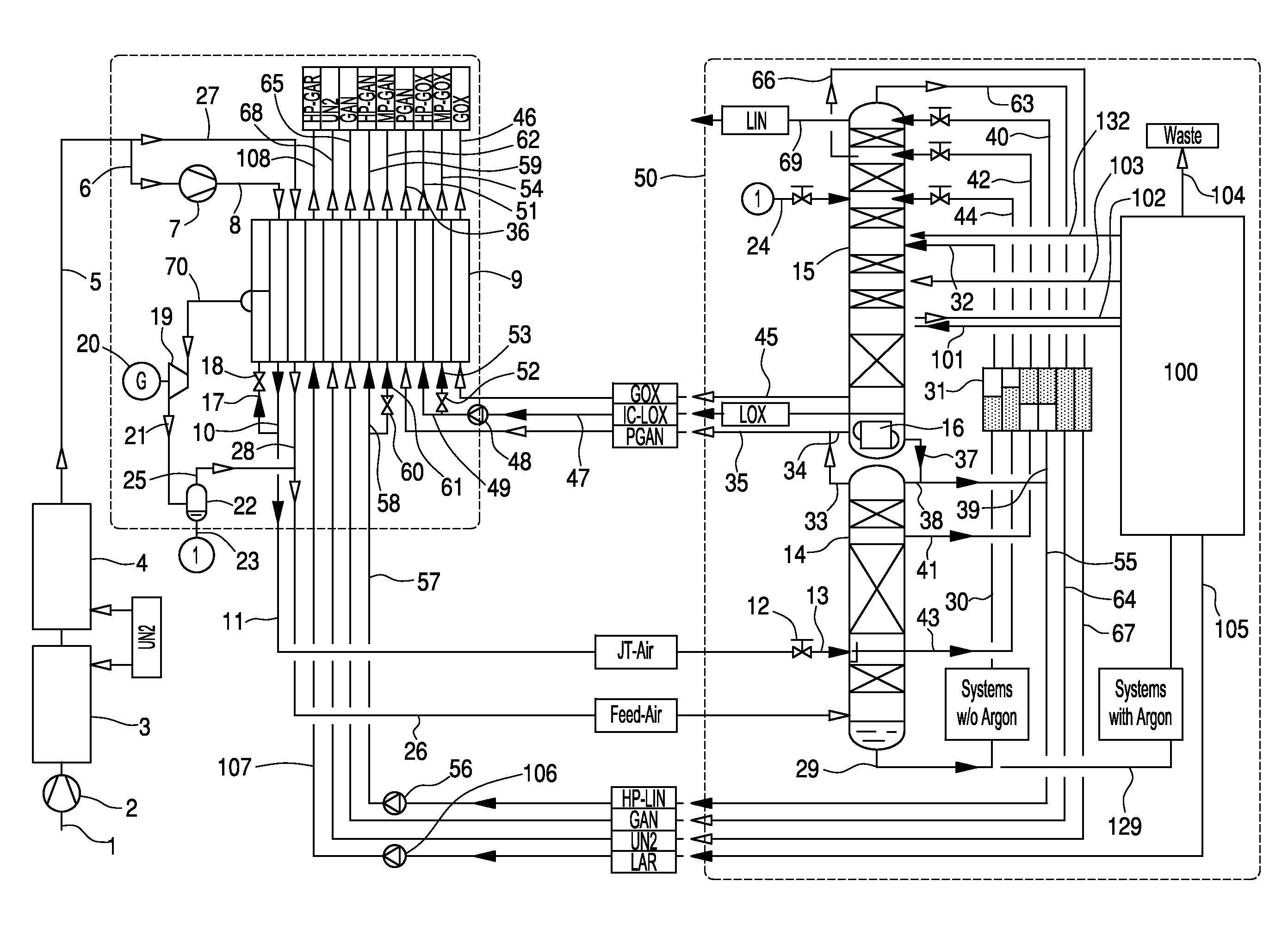
Figure 1 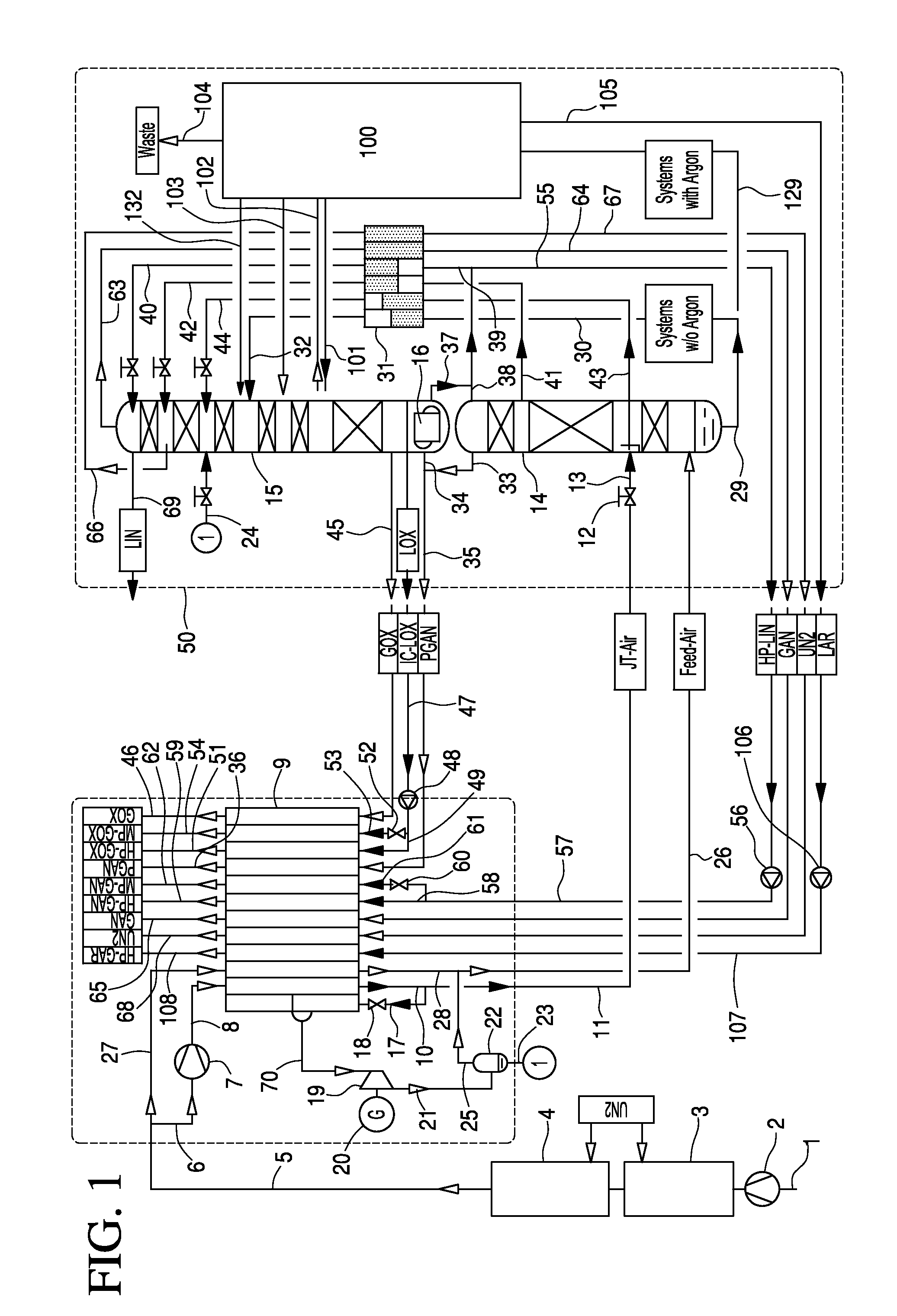
Figure 2 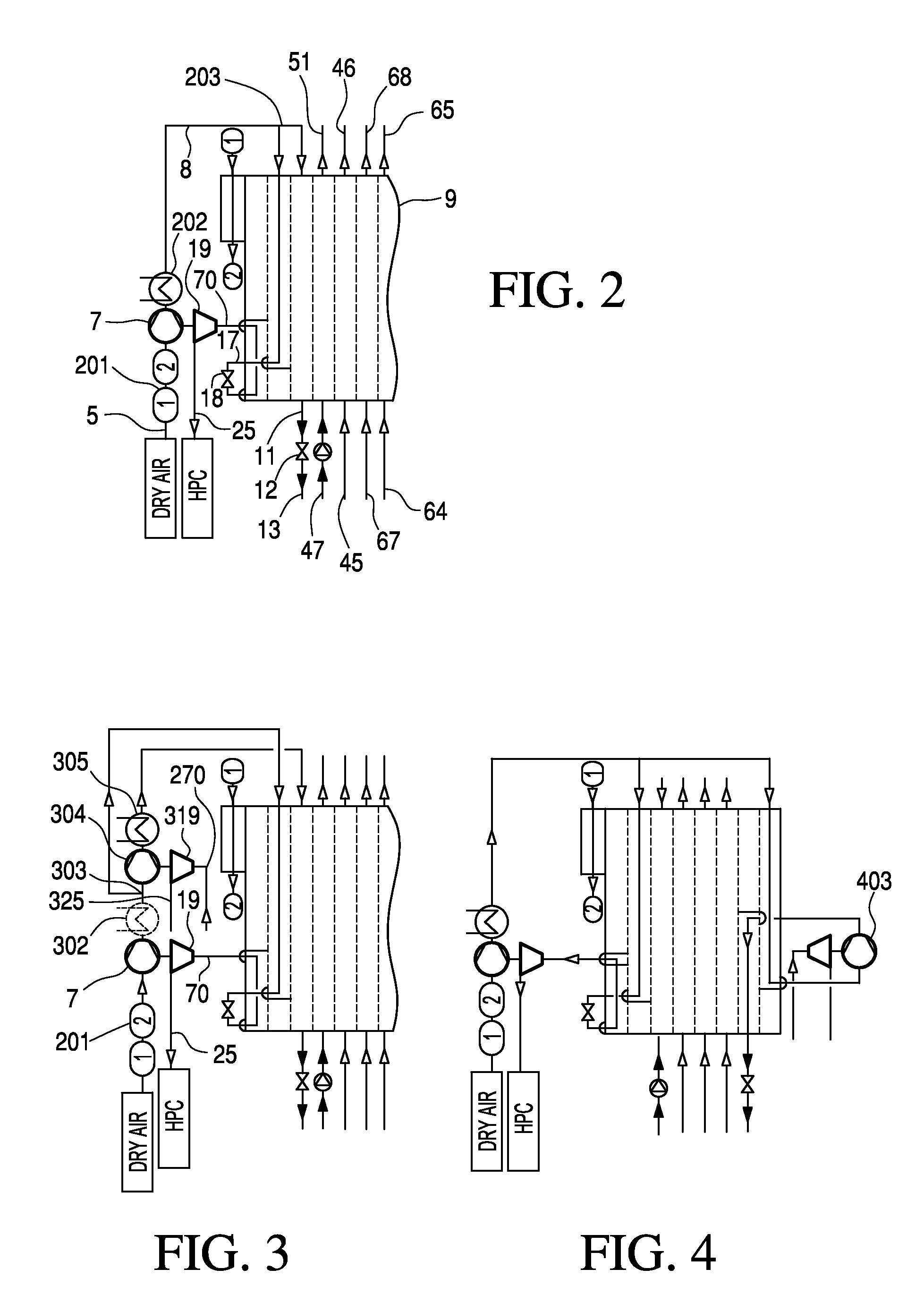
Figure 3
Abstract
Description
[0001] This U.S. patent application claims priority of German patent document DE 10 2009 042410.5 filed on Sep. 21, 2009 and German patent document DE 10 2009 0484156.6 filed on Oct. 7, 2009, the entireties of which are incorporated herein by reference.FIELD OF INVENTION
[0002] The invention is directed to a method and device for the low temperature separation of air with a distillation-column system.BACKGROUND OF INVENTION
[0003] A process in which a product flow of liquid at pressure is vaporized against a heat carrier and is finally obtained as a gaseous compressed product is also called an internal compression process. The process is particularly widespread for obtaining compressed oxygen, but can also be used to obtain compressed nitrogen or compressed argon. For the case of a supercritical pressure in a main heat exchanger, no phase transformation occurs in a real sense; the product stream is then “pseudo-vaporized”.
[0004] Compared to the (pseudo-)vaporized product stream, a heat ca...
Examples
Embodiment Construction
[0030]In the embodiment of FIG. 1, the distillation-column system 50 comprises, in the part which serves for the nitrogen-oxygen separation, a high-pressure column 14, a low-pressure column 15, and a main condenser 16 constructed as a condenser-evaporator, at which the two columns stand relative to heat exchange.
[0031]Atmospheric air is sucked in as main air stream 1 to an air compressor 2, and is brought there to a first pressure that corresponds roughly to the operating pressure of the high-pressure column 14, is cooled down in a primary cooling 3 to roughly ambient temperature, and is conducted to an adsorptive air purification 4. A first portion of the purified main air stream 5 is further compressed as a “first air stream”6 in a recompressor 7 at a second pressure of at least 50 bars, for example roughly 60 bars. The high-pressure air 8 is conducted to the hot end of a main heat exchanger 9 and is cooled down and pseudo-liquefied in the main heat exchanger. The pseudo-liquefied...