
Catalytic funneling of phenolics
Patent Information
- Authority / Receiving Office
- US · United States
- Current Assignee / Owner
- Publication Date
- 2021-04-29
Smart Images
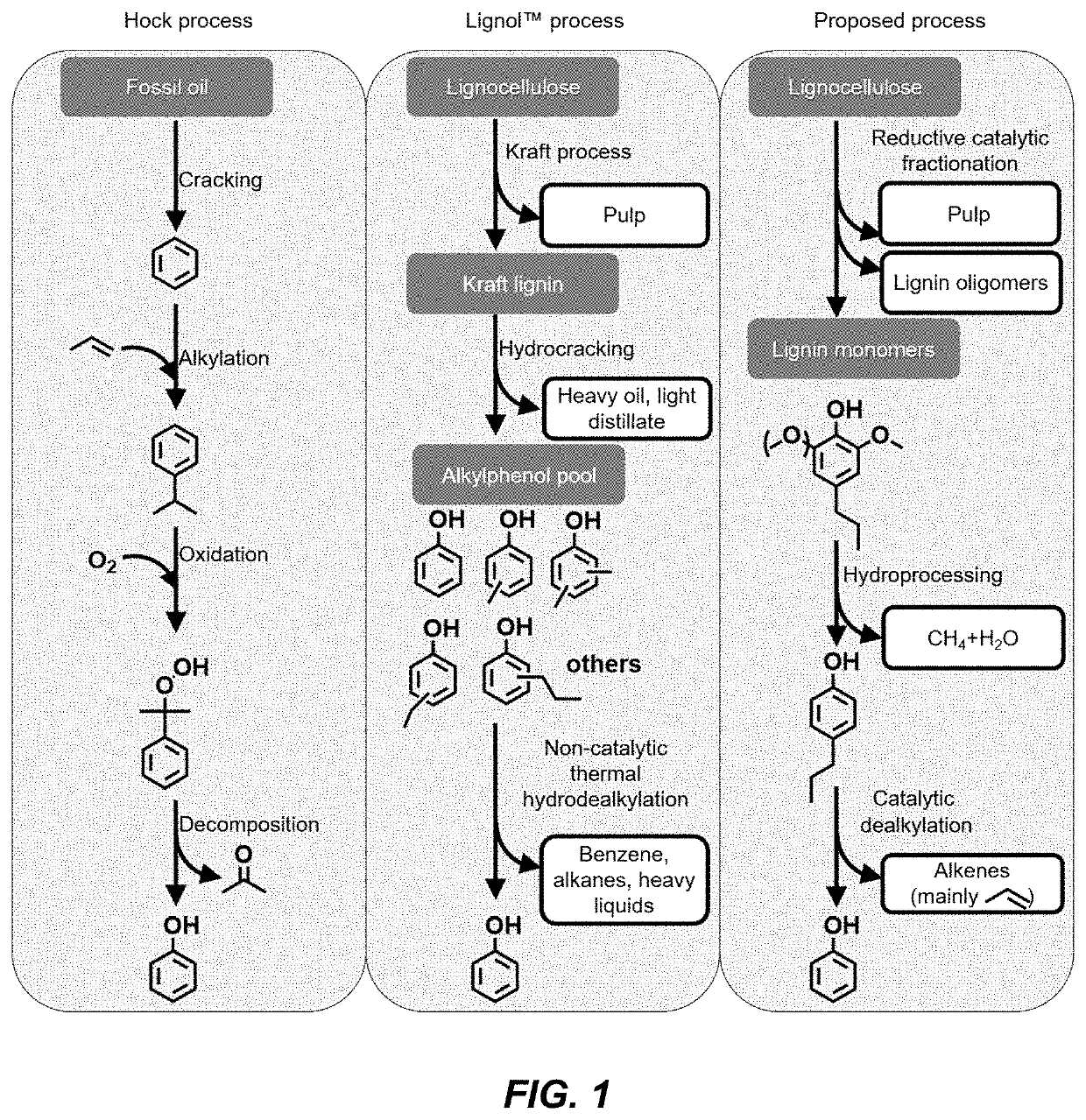
Figure 1 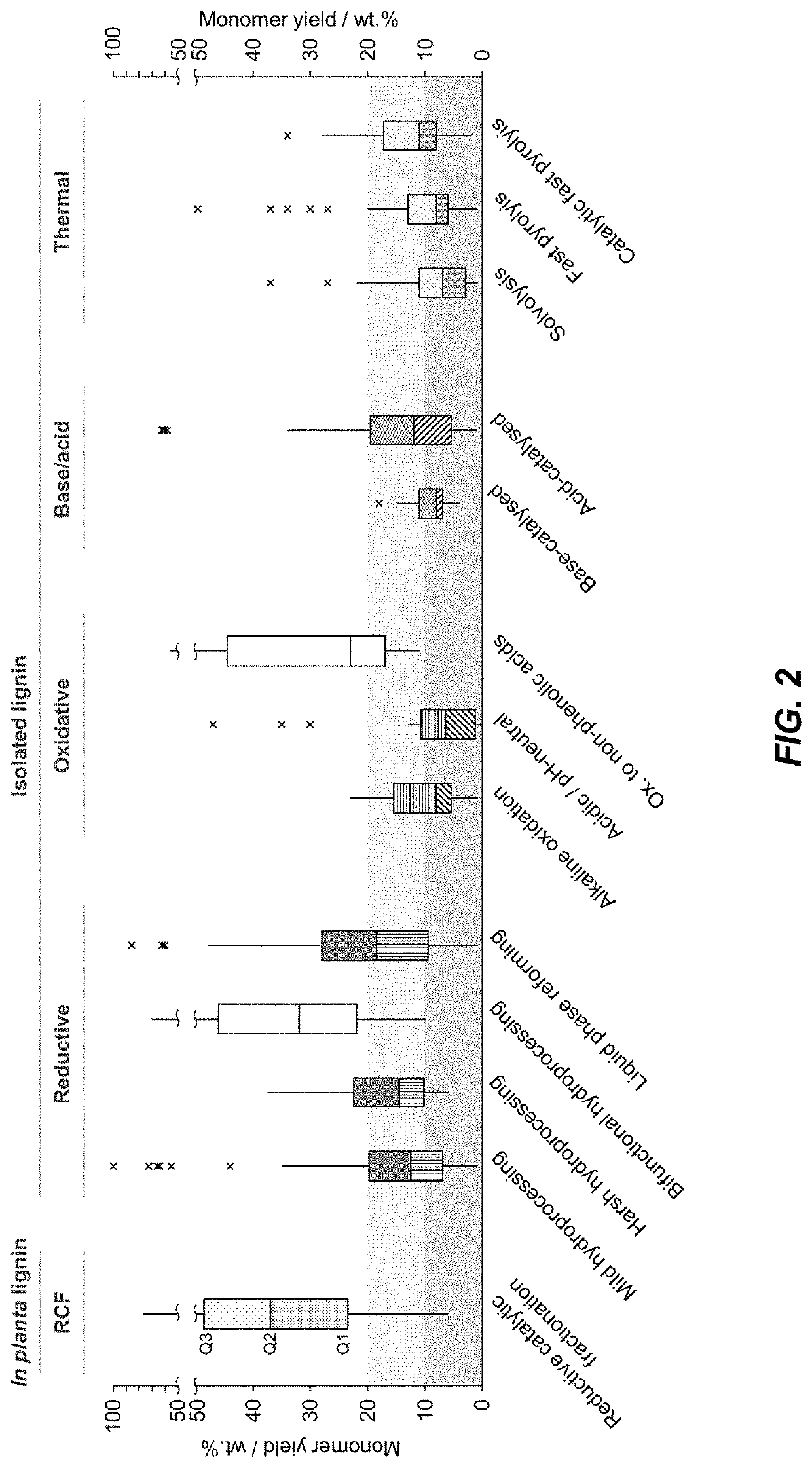
Figure 2 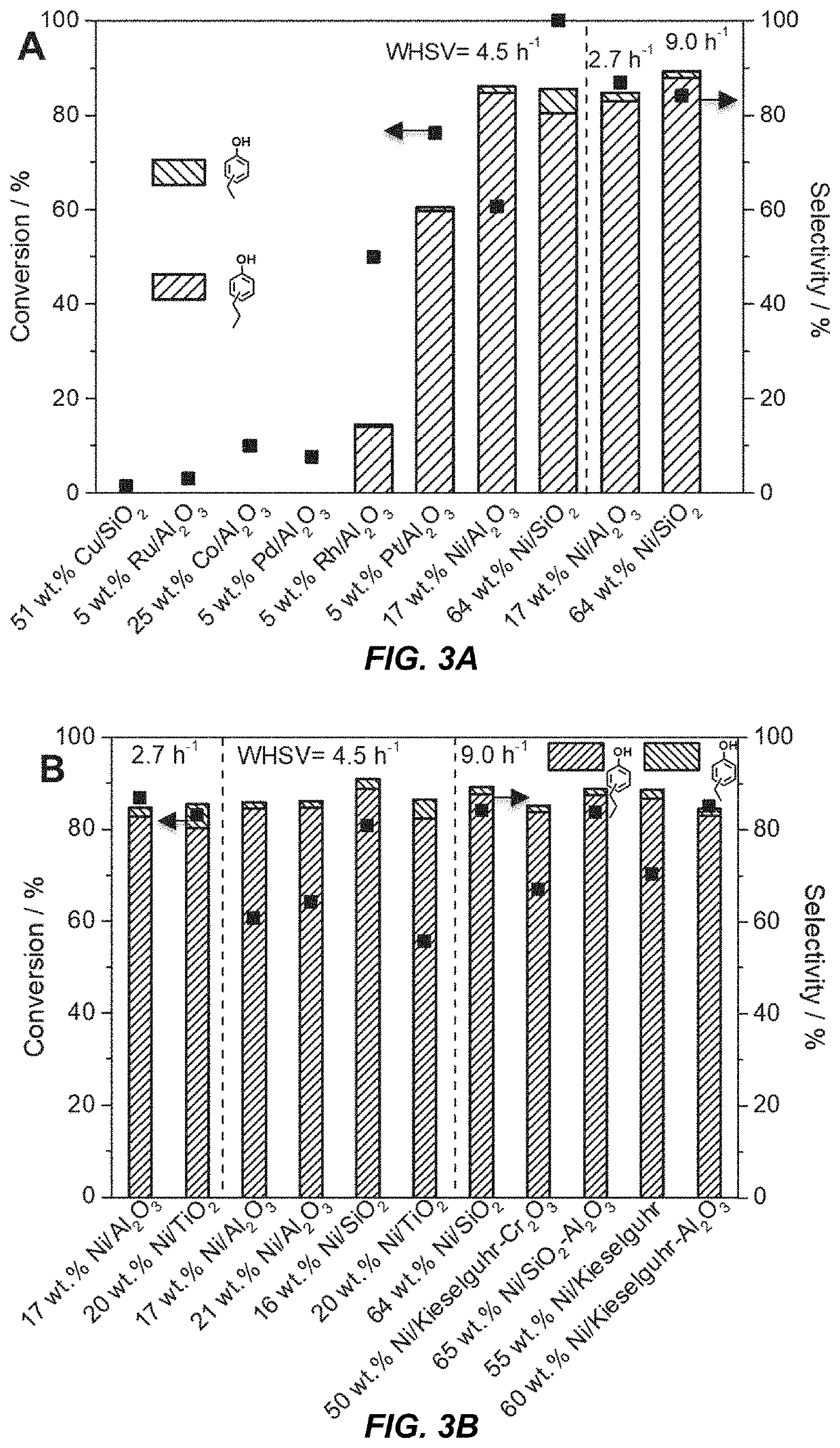
Figure 3
Abstract
Description
CROSS-REFERENCE TO RELATED APPLICATION
[0001] This application claims the benefit under 35 U.S.C. § 119(e) of U.S. Provisional Patent Application Ser. No. 62 / 926,936, filed Oct. 28, 2019, the disclosure of which is hereby incorporated herein in its entirety by this reference.TECHNICAL FIELD
[0002] In general, this present disclosure concerns an integrated lignocellulose biorefinery, enabling production of renewable phenol, phenolic oligomers, propylene, and carbohydrate pulp from lignocellulosic biomass.BACKGROUND
[0003] Production of chemicals is rapidly becoming the single largest driver of global oil consumption in the future1, 2 To reduce the oil consumption and the resulting greenhouse gas emission, a shift from non-renewable fossil to renewable carbon resources is required. Lignocellulose, as an abundant feedstock of renewable carbon, can be used for production of bio-fuels, bio-chemicals and bio-materials.3, 4 However, most of the proposed lignocellulose biorefineries cannot econom...
Examples
examples
[0128]Example 1. Reductive catalytic fractionation of birch wood. This experiment was performed according to experimental procedure I. birch wood (150 g) was used as the feedstock, 5 wt % Ru / C as a catalyst, and methanol as the solvent. The reaction was conducted at 235° C. for 3 h under 30 bar of H2 (room temperature). Conversion of lignin: 80.69%. Monomers yield (on the basis of Klason lignin): 4-propylguaiacol (9.71 wt %), isoeugenol (0.49 wt %), 4-(3-methoxypropyl)-guaiacol (<0.19 wt %), 4-n-prop-1-anolguaiacol (0.89 wt %), 4-ethylguaiacol (0.30 wt %), 4-propylsyringol (33.85 wt %), 4-prop-1-enylsyringol (0.32 wt %), 4-n-prop-1-anolsyringol (2.21 wt %), syringol (0.43 wt %), 4-methylsyringol (0.28 wt %), 4-ethylsryingol (1.03 wt %), 4-(3-methoxypropyl)-syringol (0.79 wt %), others (<0.02 wt %), total monomers (50.51 wt %). Oligomers (30.18 wt %).
[0129]Example 2. Reductive catalytic fractionation of pine wood. This experiment was performed according to experimental procedure I. p...