
Cephem compounds and pharmaceutical compositions containing the same
Patent Information
- Authority / Receiving Office
- US · United States
- Current Assignee / Owner
- Publication Date
- 2001-04-10
- Estimated Expiration
- Not applicable · inactive patent
Smart Images
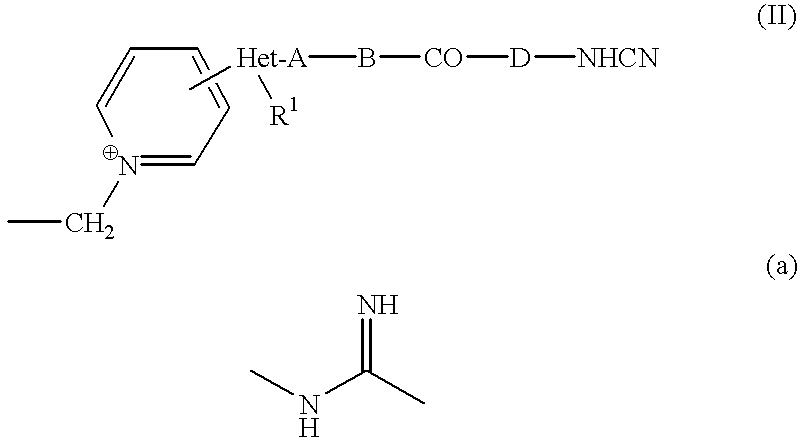
Figure 1 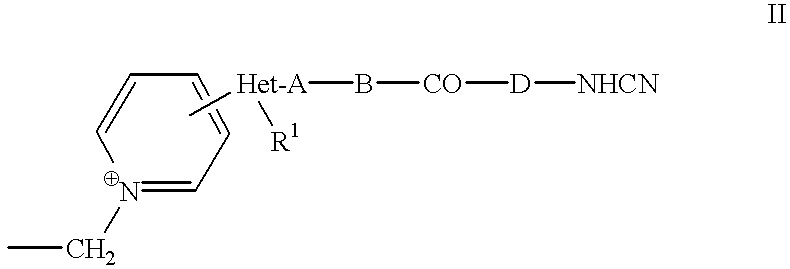
Figure 2 
Figure 3
Abstract
Description
The present invention relates to novel cephem compounds, a process for preparing the same, intermediates therefor, and pharmaceutical compositions containing the compounds.Compounds having an optionally substituted pyridiniomethyl group at the 3-position of the cephem ring have been disclosed in patent applications such as Japanese Patent Publication (KOKAI) 60-237090 (WO 8505106, EP 160969A2), Japanese Patent Publication (KOKOKU) 1-44190 and also Japanese Patent Publication (KOKOKU) 6-70068 (EP 64740B1, U.S. Pat. No. 5,071,979), Japanese Patent Publication (KOKOKU) 2-44476 (EP 159011B1, U.S. Pat. No. 4,833,242), etc. However, there have not been reported compounds wherein a pyridinium ring is substituted with a heterocyclic group having a substituent of the formula --CONHCN or its analogues.Although a huge number of antibiotics have been marketed so far, the development and characterization of compounds with higher antibiotic activity have been continuously demanded so as to cope w...
Examples
example 2 #
#STR44##
(1) Compound V-2 (0.91 g, 1.2 mmol) and 34 (254 mg, 1 mmol) were dissolved in DMSO (5 ml), and the mixture was stirred at room temperature for 2 hours. The reaction solution was poured into ethyl ether to precipitate the insoluble matter. The ether layer was removed by decantation and the insoluble materials were washed again with water, and ether, and dried to obtain 0.91 g of I-2 (yield 89.8%).
Compound I-2: NMR (d.sub.6 -DMSO) .delta.: 1.24 (3H, t, J=7 Hz), 1.51 (9H, s), 3.55, 3.70 (2H, ABq, J=10 Hz), 3.71 (3H, s), 4.17 (2H, q, J=7 Hz), 5.18.about.5.31 (3H, m), 5.44 (2H, bs), 5.97 (1H, d, J=5 Hz), 6.91 (2H, d, J=8 Hz), 7.36 (2H, d, J=8 Hz), 8.06 (1H, s), 8.15 (2H, d, J=6 Hz), 8.40 (1H, s), 8.76 (2H, d, J=6 Hz).
(2) To a solution of I-2 (0.91 g, 0.90 mmol) in a mixed solution of dichloromethane (10 ml)-nitromethane (6 ml) was added a solution of aluminum chloride (0.72 g, 5.4 mmol) in anisole (6 ml) at -20.degree. C., and the mixture was stirred at the same temperature for 1...
example 3 #
#STR45##
(1) The reaction was carried out using V-2 (910 mg, 1.2 moles) and 44 (240 mg, 0.9 mmol) as starting materials in a manner similar to that described in Example 1 to obtain 0.79 of I-3 (yield 85.4%).
(2) Compound I-3 (783 mg, 0.76 mmol) was reacted with AlCl.sub.3 in CH.sub.2 Cl.sub.2 --CH.sub.3 NO.sub.2 to obtain 30 mg of I-3' (yield 5.8%).
Compound I-3': NMR (d.sub.6 -DMSO) .delta.: 1.21 (3H, t, J=7 Hz), 3.37, 3.52 (2H, ABq, J=18.0 Hz), 3.82 (3H, s), 4.14 (2H, q, J=7 Hz), 5.19 (1H, d, J=5 Hz), 5.17, 5.38 (2H, ABq, J=15.0 Hz), 5.88 (1H, dd, J=5 Hz, 8 Hz), 6.92 (1H, s), 8.05 (1H, s), 8.15 (2H, bs), 8.28 (2H, d, J=7 Hz), 8.73 (2H, d, J=7 Hz), 9.60 (2H, d, J=8 Hz), 12.12 (1H, bs).
IR (KBr) .nu. cm.sup.-1 : 2257, 2164, 1780, 1671, 1636.
example 4 #
#STR46##
(1) To a solution of 47 (203 mg, 0.8 mmol) in DMSO (10 ml) was added V-2 (789 mg, 1.03 mmol), and the mixture was stirred for 45 minutes. The resulting solution was added dropwise to ethyl ether (500 ml) with stirring and the mother liquor was decanted to obtain an oily insoluble matter. The insoluble materials were washed with H.sub.2 O, collected by filtration, dissolved in a mixed solution of CHCl.sub.3 and acetonitrile, and dried over MgSO.sub.4 to obtain 830 mg of I-4.
Compound I-4: NMR (d.sub.6 -DMSO) .delta.: 1.24 (3H, t, J=7.0 Hz), 1.51 (9H, s), 3.53 (2H, bs), 3.73 (3H, s), 4.21 (2H, q, J=7.0 Hz), 5.22 (2H, bs), 5.22 (1H, d, J=5.2 Hz), 5.43 (2H, bs), 6.00 (1H, dd, J=5.2, 8.6 Hz), 6.93 (2H, d, J=8.6 Hz), 7.37 (2H, d, J=8.6 Hz), 8.08 (1H, bs), 8.15 (2H, d, J=6.6 Hz), 8.33 (1H, bs), 8.77 (2H, d, J=6.6 Hz), 9.04 (1H, bs), 9.69 (1H, d, J=8.6 Hz), 11.18 (1H, bs), 12.61 (1H, bs), 12.96 (1H, bs).
IR (KBr) .nu. cm.sup.-1 : 2182, 1784, 1713, 1679, 1634.
(2) To a solution of I-4 (...