
Structured programming control flow in a SIMD architecture
a programming control and structure technology, applied in the field ofgraphics processing, can solve the problem of limited use of conditional break and return instructions
Patent Information
- Authority / Receiving Office
- US · United States
- Patent Type
- Patents(United States)
- Current Assignee / Owner
- Publication Date
- 2011-01-25
Smart Images
Figure 1 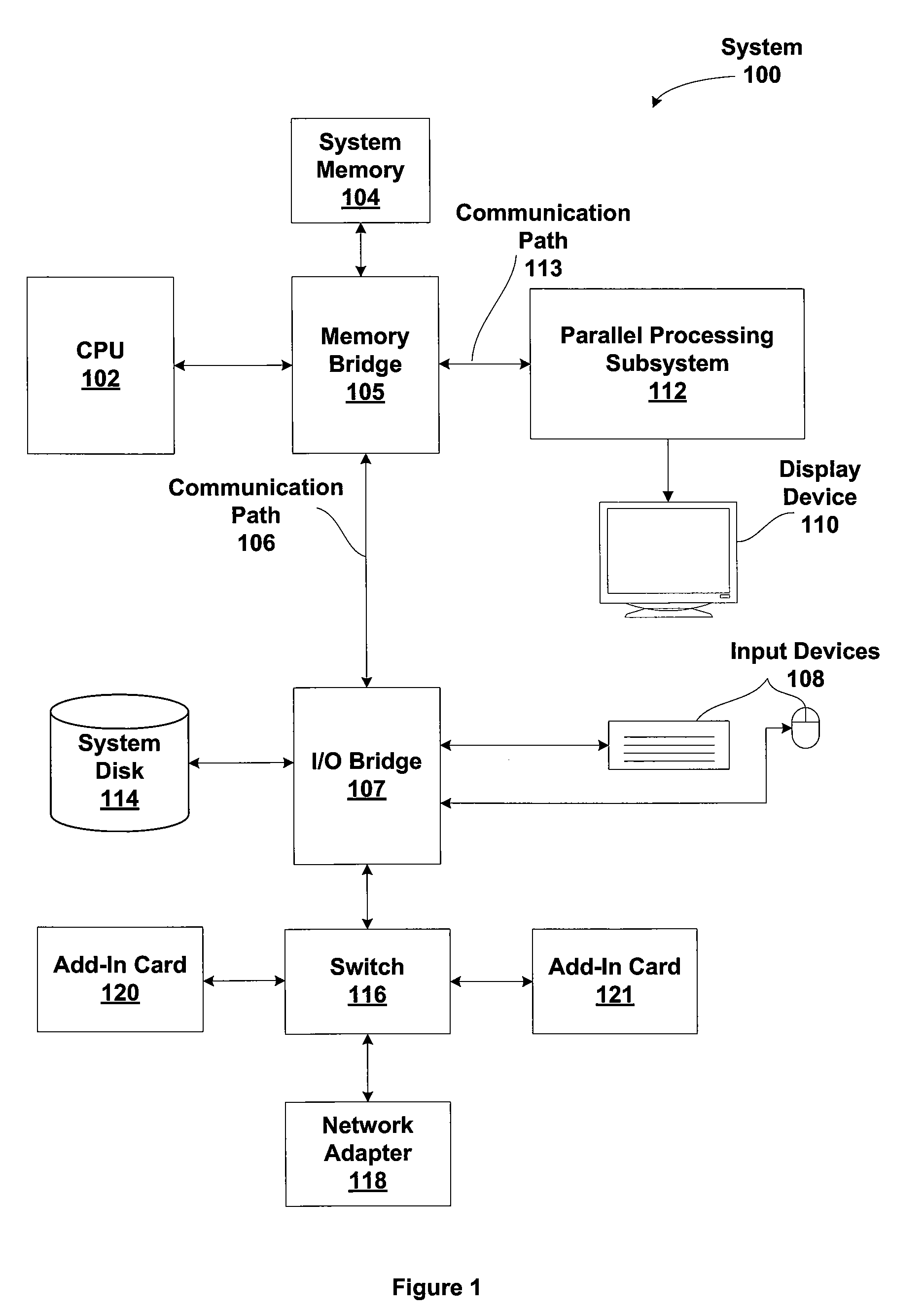
Figure 2 
Figure 3
Abstract
Description
CROSS-REFERENCE TO RELATED APPLICATIONS
[0001] This application claims benefit of U.S. provisional patent application Ser. No. 60 / 864,574, filed Nov. 6, 2006, which is herein incorporated by reference.BACKGROUND OF THE INVENTION
[0002] 1. Field of the Invention
[0003] The present invention generally relates to graphics processing and more specifically to a system and method for managing divergent threads in a single-instruction, multiple-data (“SIMD”) architecture by using control instructions to set up thread processing target addresses for synchronization, breaks, and returns.
[0004] 2. Description of the Related Art
[0005] Current graphics data processing includes systems and methods developed to perform specific operations on graphics data such as, for example, linear interpolation, tessellation, rasterization, texture mapping, depth testing, etc. Traditionally, graphics processors used fixed function computational units to process graphics data; however, more recently, portions of graphi...
Examples
Embodiment Construction
[0022]In the following description, numerous specific details are set forth to provide a more thorough understanding of the present invention. However, it will be apparent to one of skill in the art that the present invention may be practiced without one or more of these specific details. In other instances, well-known features have not been described in order to avoid obscuring the present invention.
System Overview
[0023]FIG. 1 is a block diagram illustrating a computer system configured to implement one or more aspects of the present invention. FIG. 1 is a block diagram of a computer system 100 according to an embodiment of the present invention. Computer system 100 includes a central processing unit (CPU) 102 and a system memory 104 communicating via a bus path that may include a memory bridge 105. Memory bridge 105, which may be, e.g., a Northbridge chip, is connected via a bus or other communication path 106 (e.g., a HyperTransport link) to an I / O (input / output) bridge 107. I / O ...