
Photochemical activation of surfaces for attaching biomaterial
a biomaterial and photochemical activation technology, applied in the field of surface modification, can solve the problems of limiting the level of transgene expression, ad cell entry and processing within cells via non-receptor endocytosis is a far less efficient means of vector processing, and the effect of ad cell entry and processing
Patent Information
- Authority / Receiving Office
- US · United States
- Patent Type
- Applications(United States)
- Current Assignee / Owner
- Publication Date
- 2006-07-06
Smart Images
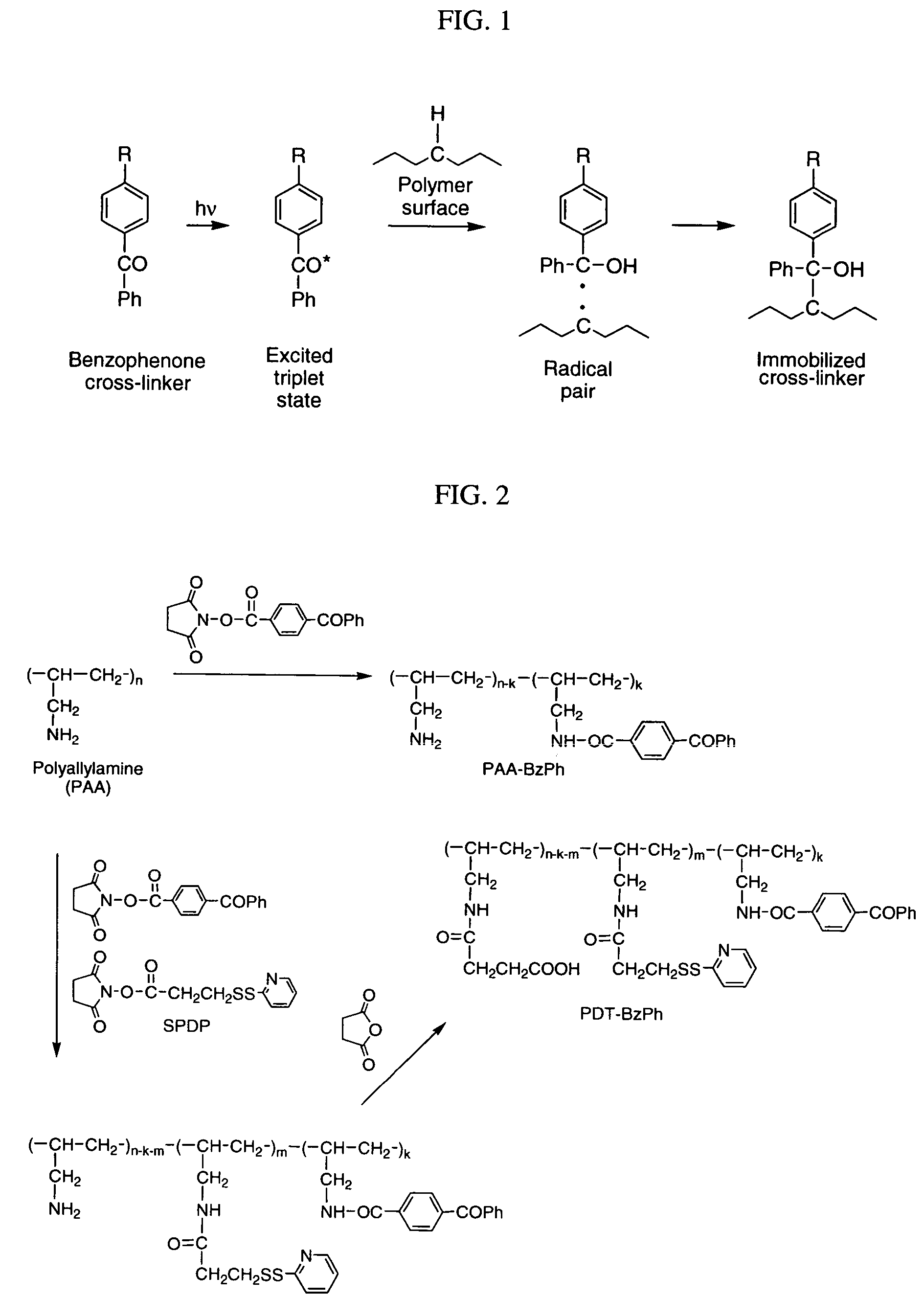
Figure 1 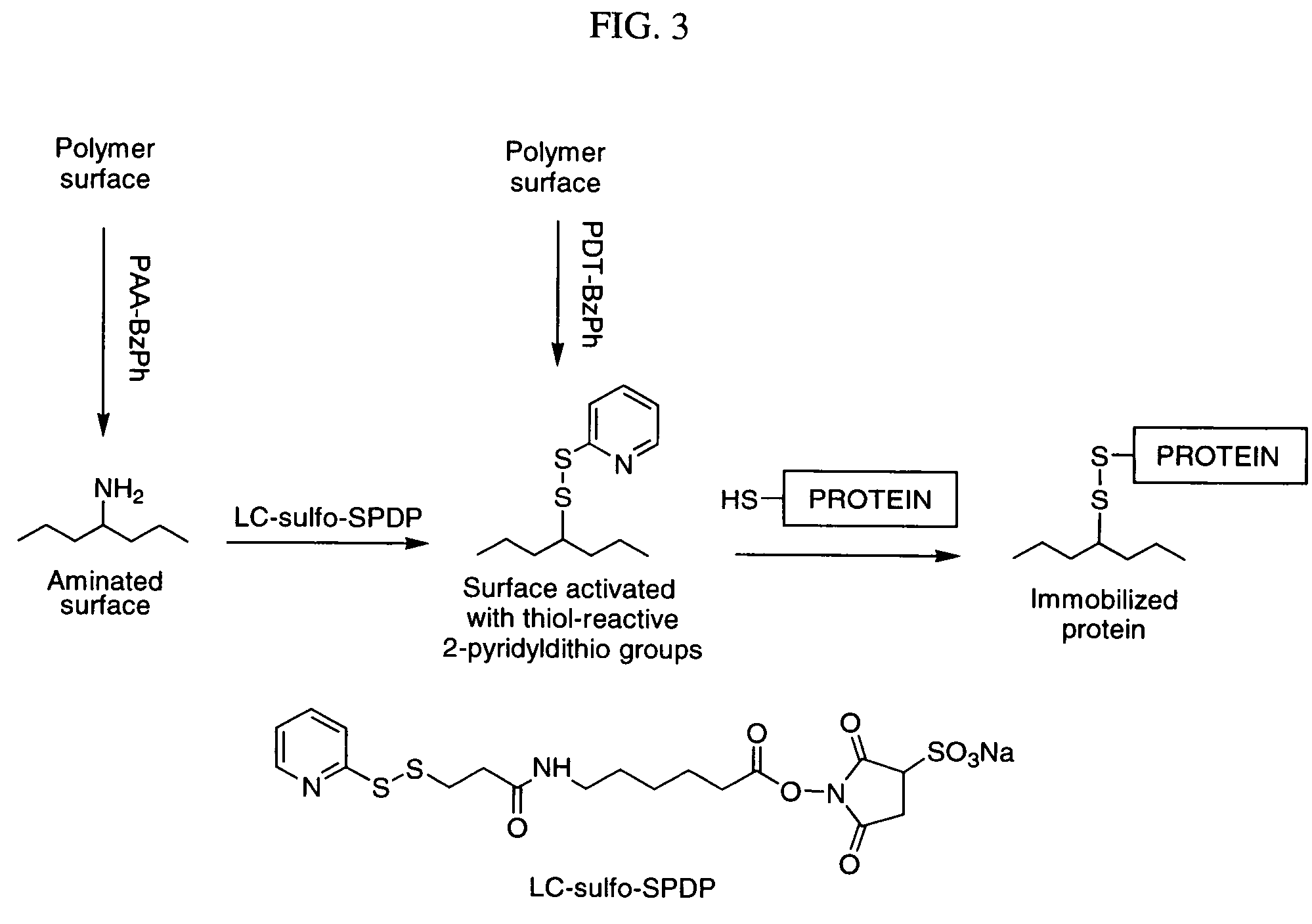
Figure 2 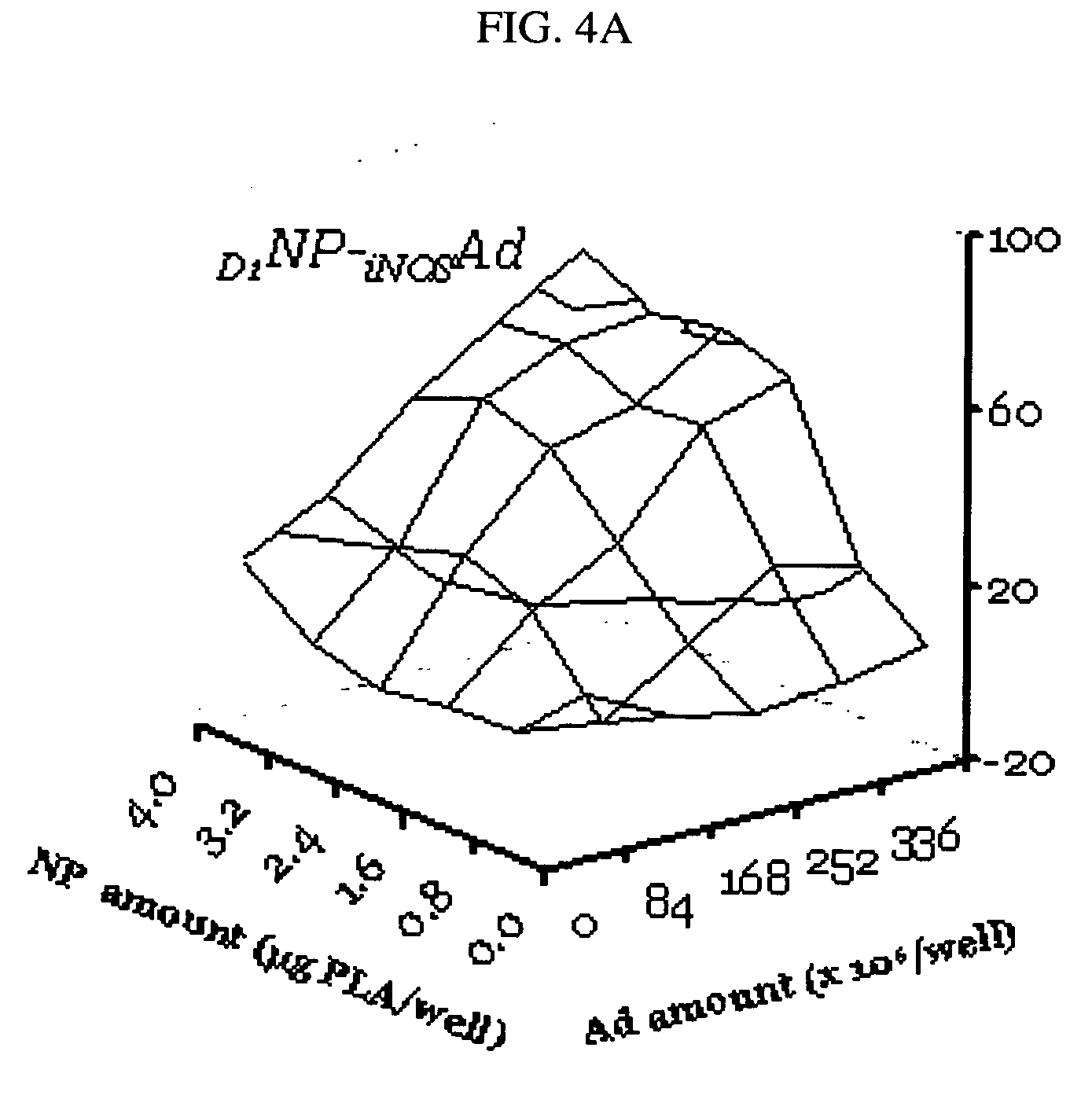
Figure 3
Abstract
Description
BACKGROUND OF THE INVENTION
[0001] 1. Field of Invention
[0002] This invention relates to surface modifications and more particularly to immobilization of molecules to surfaces by photochemical coupling.
[0003] 2. Description of Related Art
[0004] A common shortcoming of implantable medical devices or surfaces is recognition of these devices by an organism as foreign objects followed by inflammation or even a rejection of such devices. Surface modification science concentrates on finding a better interface between a living tissue and a solid matrix. It is known to use various coatings to impart desirable properties to implantable surfaces. Such coatings are based on polymers and may include biologically active materials. Challenges in preparing such coatings include attaching biologically active materials to inert surfaces.
[0005] One of the techniques for derivatizing inert surfaces is photochemical coupling (see reference [1]). Photo-cross-linking chemistry based on organic solven...
Examples
example 1
Preparation of Water-Soluble Photo-Activatable Polymers Based on poly(allylamine) Synthesis of PAA-BzPh
[0201] Synthesis of PAA-BzPh is demonstrated in FIG. 2. Poly(allylamine) (PAA) base was prepared from PAA hydrochloride (Sigma-Aldrich St. Louis, Mo., MW=70 KDa) by treatment in aqueous medium with a strong anionite Dowex G-55 followed by replacement of water by 2-propanol. A 5.1% solution of PAA base in 2-propanol (4.06 g, containing 3.65 mmol of amino groups) was diluted with CH2Cl2 (7 ml) and cooled on an ice bath. Succinoyl 4-benzoylbenzoate (Sigma-Aldrich, 236 mg, 0.73 mmol) in CH2Cl2 (12 ml) was added over a 10-min period. The mixture was stirred near 0° C. for 10 min, then warmed to room temperature and acidified with concentrated HCl (0.24 ml, 2.9 mmol). The resulting suspension was dried in vacuo, resuspended in CH2Cl2, and the precipitate was filtered off. After washing with CH2Cl2 and pentane, 0.544 g of PAA-BzPh hydrochloride were obtained. A 1H NMR study of this polym...
example 2
Preparation of Water-Soluble Photo-Activatable Polymers Based on Polyacrylic Acid
[0203] Polyacrylic acid can be coupled in aqueous solutions simultaneously with amino-derivatized benzophenone compound and a compound (also amino-derivatized) containing one of the reactive groups described above, particularly 2-(2-pyridyldithio)ethylamine. Water-soluble carbodiimide (EDC) can be used for such coupling (see Scheme below).
example 3
Photo-Immobilization of Polymeric Modifiers onto Matrix
Surface amination of polymeric matrix with PAA-BzPh.
[0204] An aqueous solution (2 mg / ml) of PAA-BzPh or its FITC-labeled variant was mixed with an equal volume of a buffer containing 0.1M NH4OAc and 0.05M NH3. PU Tecothane TT-1074A films or polyester (PE) fibers were immersed into the mixture for 5-60 min, rinsed with a 1% solution of NH3 and dried on a filter paper. The polymers were irradiated under an UV-lamp (UVGL-25, long wave) for 15-30 min to achieve the covalent binding of modifiers to the polymer surface. Finally, the surface modified polymers were thoroughly washed with diluted (2%) HCl and water.
Modification of polymeric matrix with PDT-BzPh.
[0205] PDT-BzPh (30 mg) was dissolved in water (30 ml) by addition of KHCO3 (20 mg) and acidified with a 20% solution of KH2PO4 (1 ml). PU films and PE fibers were soaked in the resulting mixture for 5-40 min., rinsed with 0.1% acetic acid, dried and irradiated as above. Fin...