
Lubricating oil compositions containing sterically hindered amines as ashless TBN sources
a technology of amines and lubricating oil, which is applied in the field of new sterically hindered amines, can solve the problems of oxidation catalyst poisoning, reduced effectiveness, and claim that such lubricants will provide sufficient tbn, and achieve the effect of increasing the tbn of lubricating oil compositions and reducing the content of sash
Patent Information
- Authority / Receiving Office
- US · United States
- Patent Type
- Patents(United States)
- Current Assignee / Owner
- Publication Date
- 2015-09-29
Smart Images
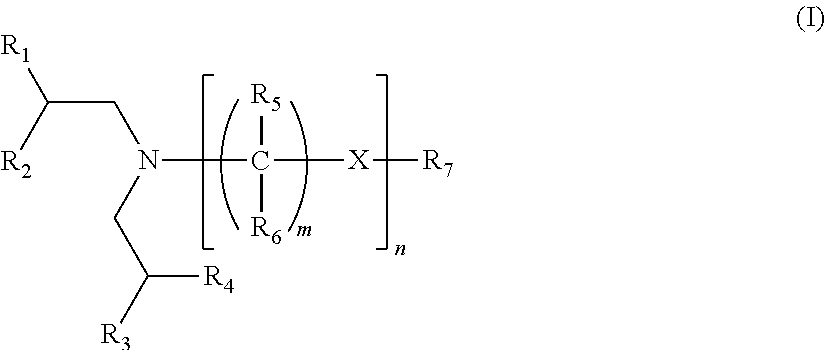
Figure 1 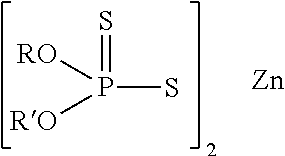
Figure 2 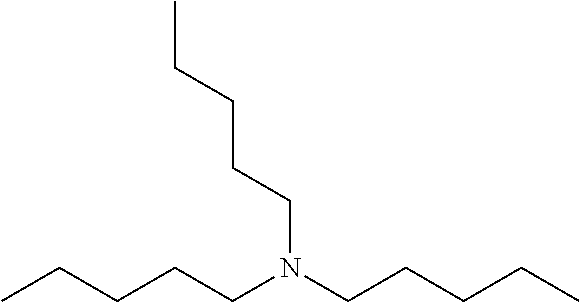
Figure 3
Abstract
Description
FIELD OF THE INVENTION
[0001] This invention relates to a novel class of sterically hindered amines useful as ashless TBN (Total Base Number) boosters lubricating oil compositions, particularly crankcase lubricating oil compositions having reduced levels of sulfated ash (SASH), containing sterically hindered amine ashless TBN (Total Base Number) boosters.BACKGROUND OF THE INVENTION
[0002] Environmental concerns have led to continued efforts to reduce the CO, hydrocarbon and nitrogen oxide (NOx) emissions of compression ignited (diesel-fueled) and spark ignited (gasoline-fueled) light duty internal combustion engines. Further, there have been continued efforts to reduce the particulate emissions of compression ignited internal combustion engines. To meet the upcoming emission standards for heavy duty diesel vehicles, original equipment manufacturers (OEMs) will rely on the use of additional exhaust gas after-treatment devices. Such exhaust gas after-treatment devices may include catalyti...
Examples
synthesis examples
Amine 1: Linear Amine—Tri-n-pentylamine (Comparative)
[0076]
[0077]Commercially available material; available from Tokyo Chemical Industry, Tokyo, Japan and TCI America, Portland Oreg., USA at 98% purity.
Amine 2: Linear Amine—Tri-n-octylamine (Comparative)
[0078]
[0079]Commercially available material; available from Alfa Aesar, a Johnson Matthey Company, Ward Hill, Mass., USA at 95% purity.
synthesis example 1
Amine 3: N,N-bis(2-ethylhexyl)dodecan-1-amine (Comparative)
[0080]
[0081]A 1 L metal reactor was charged with dodecan-1-amine (50 g, 270 mmol), 2-ethylhexanal (78 g, 582 mmol), Palladium on carbon (3 g, 1% of the amine), and ethanol (500 mL). While stirring at 600 rpm, the flow of hydrogen was set to 5.0 bars at room temperature (hydrogen was charged four times; a total of 16.8 bars of hydrogen were consumed by the reaction). The solution was then filtered over Celite and concentrated. The reaction yielded 102 g of yellow oil containing mono- and di-alkylated product. The di-alkylated product was purified and isolated by column chromatography [heptane / ethyl acetate 99.8 / 0.2], which resulted in a pale yellow oil (47 g, 43.4% yield). GC-MS confirmed the product purity to be 100.00%. 1H NMR (300 MHz, CDCl3) δ 0.86 (m, 15H), 1.26 (m, 38H), 2.08 (d, 4H), 2.26 (t, 2H).
synthesis example 2
Amine 4: 2-Ethyl-N-(2-ethylhexyl)-N-(2-methoxyethyl)hexan-1-amine (Inventive)
[0082]
[0083]2-Methoxyethanamine (10 g, 133 mmol), 2-ethylhexanal (37.6 g, 293 mmol) and dichloromethane (DCM, 40 g) were stirred at room temperature in a 250 mL 4-neck round bottom flask equipped with a reflux condenser, thermocouple, overhead stirrer and nitrogen blanket. The mixture was left to stir 3 hours. Sodium triacetoxyborohydride (STAB, 62.1 g, 293 mmol) was slowly added portion-wise to the flask. 1H NMR showed the reaction reached completion and was quenched with saturated aqueous sodium bicarbonate solution. The organic layer was washed with saturated aqueous sodium bicarbonate and brine. This layer was then dried over magnesium sulphate, filtered, and concentrated yielding a cloudy orange oil. Product was purified by column chromatography [heptane / ethyl acetate 95 / 5] resulting in a colourless oil (30.4 g, 76% yield). GC-MS confirmed the product purity to be 97%. 1H NMR (300 MHz, CDCl3) δ 0.81-0....