Integrated valve block

An integrated valve block and valve body technology, applied in the hydraulic field, can solve problems such as small boost ratio

CN103452940BActive Publication Date: 2014-08-20SHANDONG UNIV OF SCI & TECH
1 Cites 0 Cited by

Patent Information

Authority / Receiving Office
CN · China
Patent Type
Patents(China)
Current Assignee / Owner
Publication Date
2014-08-20

Smart Images

  • Figure 1
    Figure 1
  • Figure 2
    Figure 2
  • Figure 3
    Figure 3
Patent Text Reader

Abstract

The invention discloses an integrated valve block and belongs to the field of hydraulic technology. The integrated valve block comprises a valve body (200) provided with an inner cavity (201). Through holes are formed at two ends of the inner cavity (201) of the valve body (200). Five annular through holes are radially formed between the outer wall face of the valve body (200) and the inner cavity. A valve element (220) is nested into the inner cavity (201). Four coaxial cylinders with the same cross section are disposed at intervals in the axial direction of the valve element (220). The four cylinders of the valve element (220) are matched with the inner cavity (201) to form a zero-openness two-position four-way reversing valve. Compared with the prior art, the integrated valve block is free of an electric control system and simple in system.
Need to check novelty before this filing date? Find Prior Art

Description

technical field

[0001] The invention belongs to the technical field of hydraulic pressure and relates to a supercharging device, in particular to a supercharging cylinder, an integrated valve block and a supercharging device thereof. Background technique

[0002] The principle of the pressurized cylinder in the general sense is to increase the proportional output of the input hydraulic oil according to the difference in the effective area of ​​the piston and the plunger. The boost ratio is equal to the inverse ratio of the piston area. This booster cylinder only performs one-stage booster conversion, and the booster ratio is a linear proportional relationship between the radial area of ​​the piston and the plunger, and does not fully utilize the space volume of the booster cylinder for boosting. In order to achieve two-way continuous supercharging, the following double-acting reciprocating superchargers have emerged, such as electromagnetic reversing valves, etc. However, ...

Examples

Embodiment Construction

[0048] The invention will be described in detail below in conjunction with the accompanying drawings.

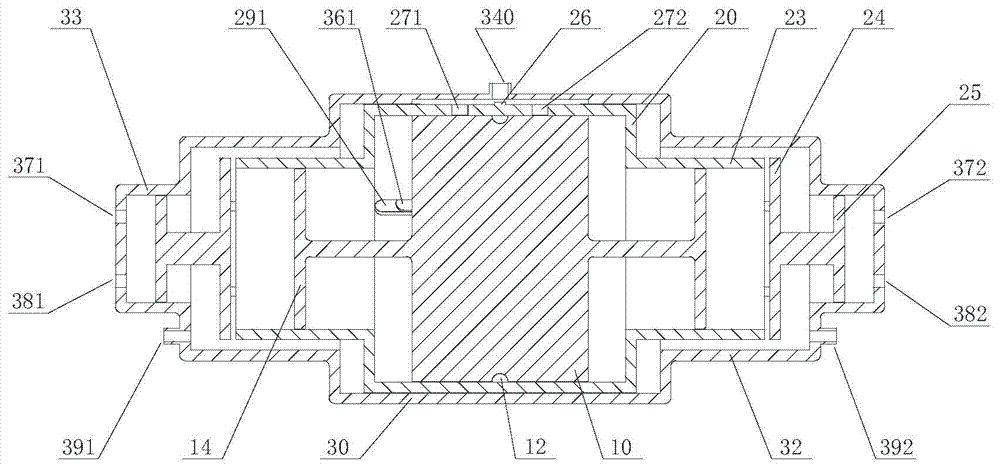
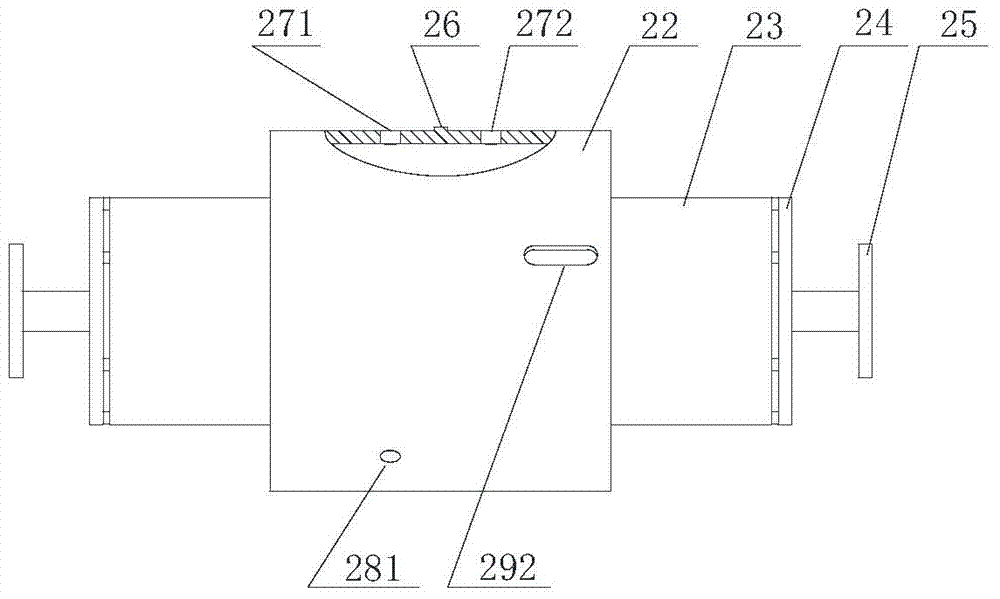
[0049] Such as figure 1 As shown, a booster cylinder includes three parts: a primary piston 10, a secondary piston 20 and a cylinder barrel 30. The primary piston 10 is set in the inner cavity of the secondary piston 20, and the secondary piston 20 is set in the cylinder barrel 30. The inner chamber of the first stage piston 10 and the second stage piston 20 move with each other to complete the first pressurization of the hydraulic oil; the relative movement of the second stage piston 20 and the cylinder barrel 30 completes the second pressurization of the hydraulic oil.

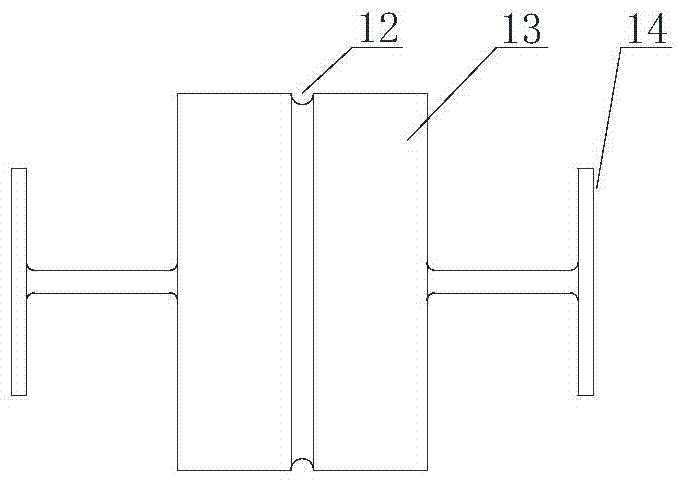
[0050] Such as figure 2 As shown, the primary piston 10 includes a main body, the main body is a cylinder 13 with an annular groove 12 on the circumferential surface, and a disc 14 is respectively formed on the two ends of the cylinder 13, the circle Area A of disc 14 14 less than the cross-sectional a...