
Horizontal water flow vertical mud discharging sedimentation and separation device
A sedimentation separation and vertical discharge technology, applied in the sedimentation tank and other directions, can solve the problems of the complex structure of the sedimentation separation device, the sediment is easy to accumulate on the slope, and the mud discharge port is easy to block, so as to achieve the rapid and effective sedimentation effect and solve the deformation of the inclined plate. Or collapse, avoid the effect of short flow of water
- Summary
- Abstract
- Description
- Claims
- Application Information
AI Technical Summary
Problems solved by technology
Method used
Image


Examples
Embodiment 1
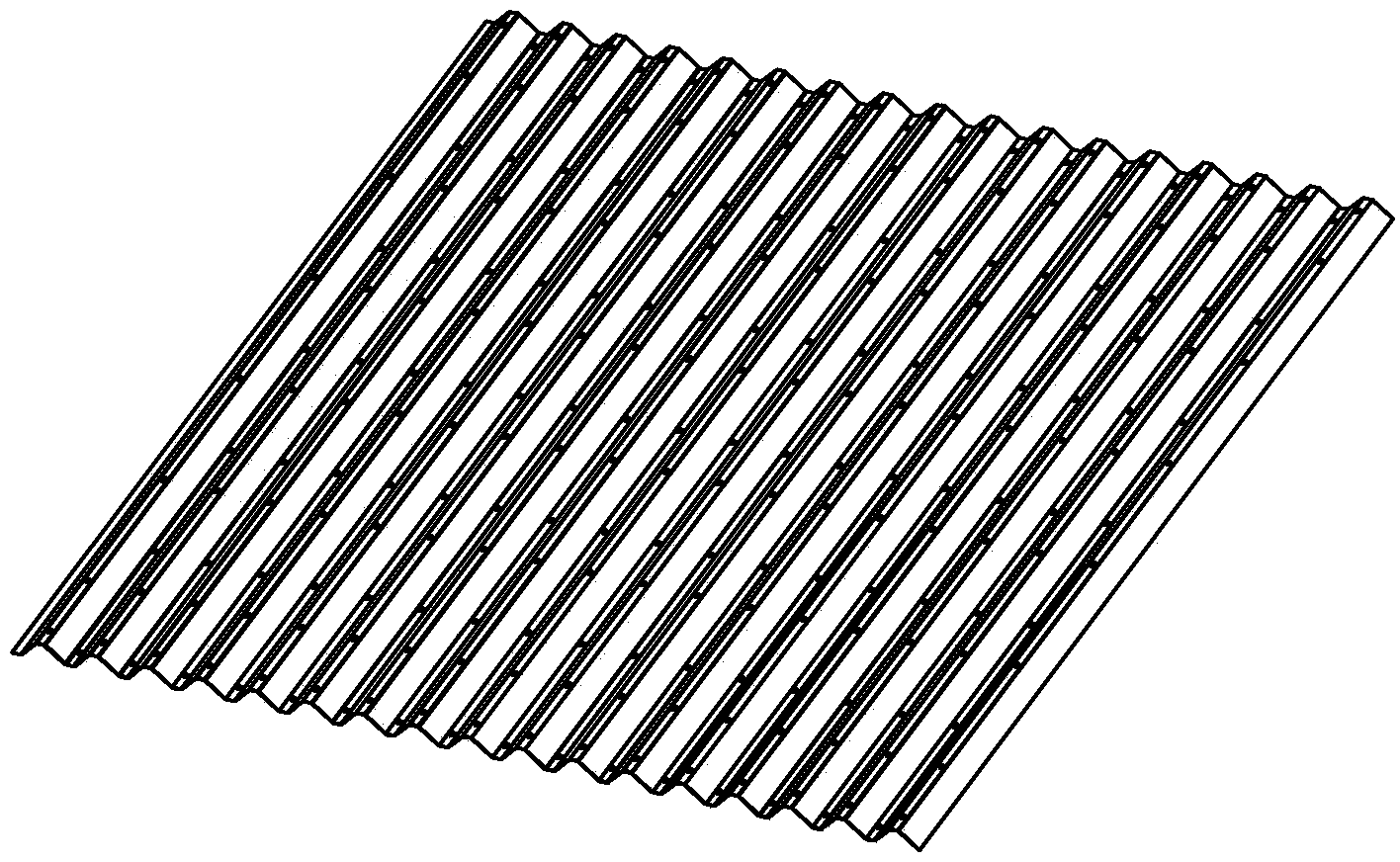
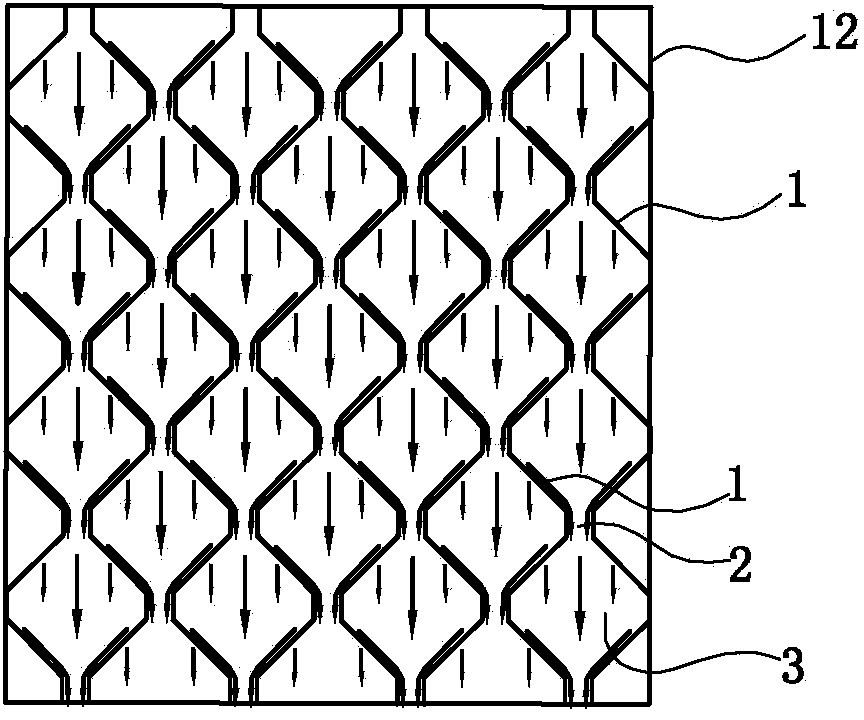
[0036] Such as Figure 1 to Figure 5 As shown, the horizontal flow vertical sludge discharge sedimentation separation device is installed in the sedimentation tank 12, which includes:
[0037] There are multiple corrugated plates 1, and these corrugated plates are arranged vertically relative to the horizontal plane, and the cross-section of the corrugated plates has a trapezoidal wave structure. The trapezoidal wave in this embodiment is an isosceles trapezoid, and the included angle α between the two waists and the corresponding valley bottom is 45°, and the width of the valley bottom is 1 cm. The width of the valley bottom can also select other sizes according to needs, usually Between 0.5 and 2 cm. The length of the two waists is 3 centimeters; the length of the waist can also be selected for other sizes as required, such as 2 to 3.5 centimeters.
[0038]In this embodiment, the surface of each corrugated pipe has a hydrophobic layer, thereby effectively reducing the resi...
Embodiment 2
[0045] Such as Figure 6 to Figure 8 As shown, the horizontal flow vertical sludge discharge and sedimentation separation device includes:
[0046] There are multiple corrugated plates 1, and these corrugated plates are arranged vertically relative to the horizontal plane, and the cross-section of the corrugated plates has a trapezoidal wave structure. The trapezoidal wave in this embodiment is an isosceles trapezoid, and the included angle α between the two waists and the corresponding valley bottom is 45°, and the width of the valley bottom is 1 cm. The width of the valley bottom can also select other sizes according to needs, usually Between 0.5 and 2 cm. The length of the two waists is 3 centimeters; the length of the waist can also be selected for other sizes as required, such as 2 to 3.5 centimeters.
[0047] In this embodiment, the surface of each corrugated pipe has a hydrophobic layer, thereby effectively reducing the resistance of the surface of the corrugated plat...
Embodiment 3
[0053] as above Figure 9 to Figure 13 As shown, the waveform of the cross section of the corrugated plate 14 in this embodiment is a triangular wave, such as Figure 10 As shown, a plurality of clamping holes 15 are arranged at intervals at sharp corners of the corrugated plate. In this embodiment, the distance between adjacent locking holes is 9 cm.
[0054] In the gap between adjacent corrugated plates 14, a plurality of partitions 16 are arranged at intervals, and these partitions run longitudinally between adjacent corrugated plates; The space between them is suitable, and it is also a zigzag structure to facilitate the positioning of the partition and the corrugated board when they are assembled; the rest of the partition is a linear plate structure, and the width of this partition is larger than that of the adjacent partition. The minimum distance between the plates is smaller than the maximum distance between adjacent partitions, that is, part of the edge of the part...
PUM
 Login to View More
 Abstract
Description
Claims
Application Information
 Login to View More