
A method of correcting SOC based on charging curves at different temperatures and rates
A charging curve and multiplier technology, which is applied in the field of SOC correction, can solve problems such as breakdown, and achieve the effect of less correction data, lower cost, and simple and fast calculation
- Summary
- Abstract
- Description
- Claims
- Application Information
AI Technical Summary
Problems solved by technology
Method used
Image

Examples
Embodiment Construction
[0023] In order to allow those skilled in the art to better understand the technical solutions of the present invention, the present invention will be further described below in conjunction with the accompanying drawings.
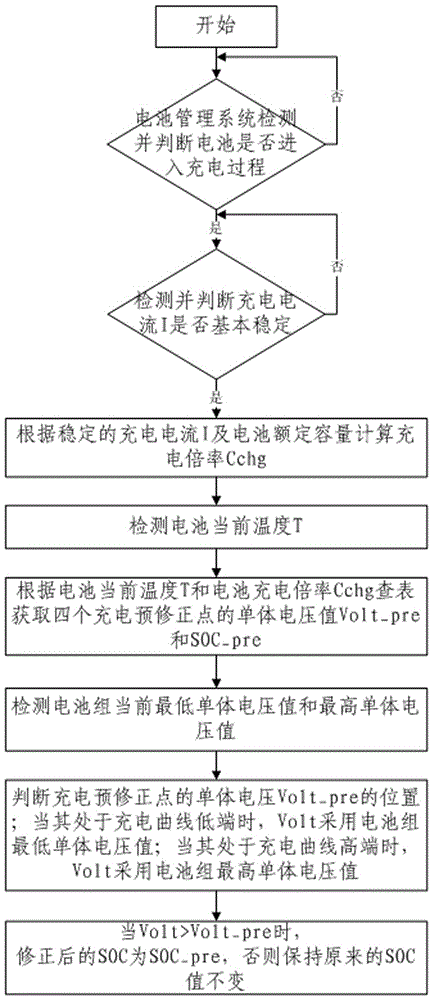
[0024] The specific embodiment of the present invention is as figure 1 As shown, a method of correcting SOC based on different temperature and rate charging curves is:
[0025] S1: The battery management system detects and judges whether the battery is in the charging process, if yes, executes the next step; if not, loops step S1.
[0026] S2: Detect and judge whether the charging current I is basically stable, if so, execute the next step; if not, then loop step S2;
[0027] In this embodiment, the criterion for judging that the charging current is basically stable is: the current change within 5s is less than 3A. The specific judgment criteria can be appropriately modified according to the battery type and the curve measured by the battery.
[0028] S3...
PUM
 Login to View More
 Abstract
Description
Claims
Application Information
 Login to View More