
Water quality in-situ improving device capable of automatically switching between full-layer mixing and isothermal layer aeration
An automatic switching and isothermal layer technology, applied in water aeration, chemical instruments and methods, water/sludge/sewage treatment, etc., to improve the effective utilization rate, enhance the aeration and oxygenation function of the isothermal layer, and reduce the number of water mixing Effect
- Summary
- Abstract
- Description
- Claims
- Application Information
AI Technical Summary
Problems solved by technology
Method used
Image

Examples
Embodiment Construction
[0022] The present invention will be described in further detail below in conjunction with the accompanying drawings.
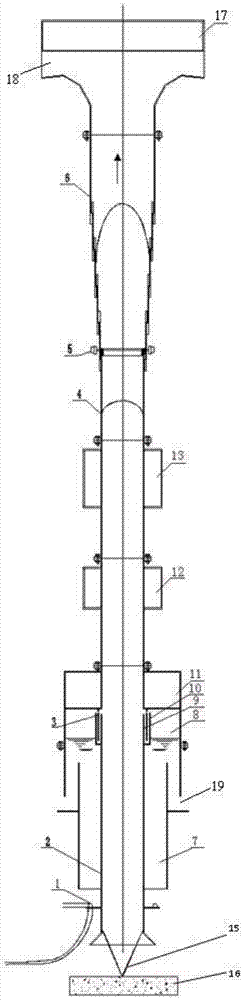
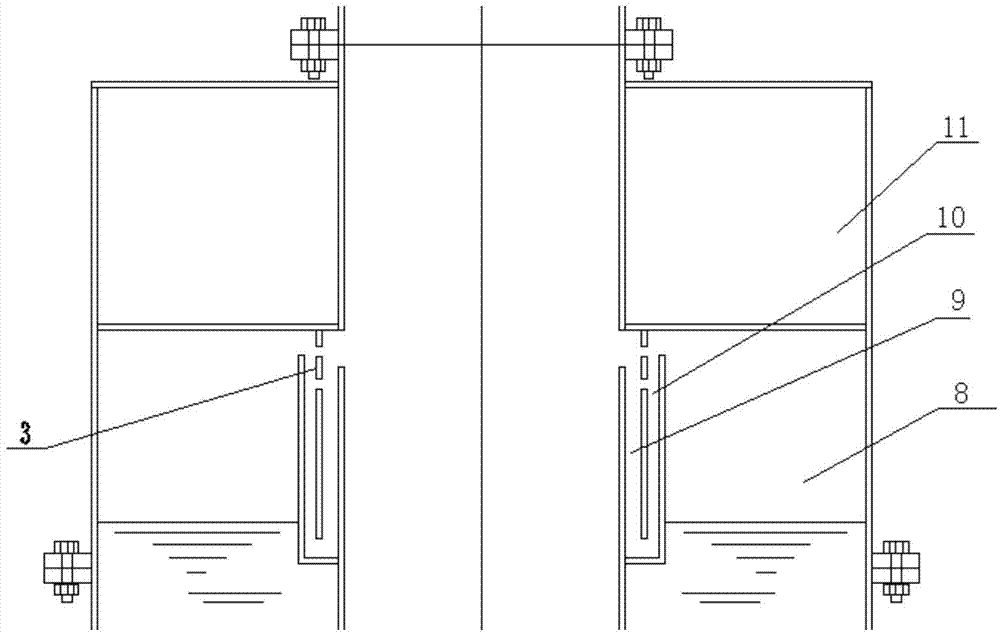
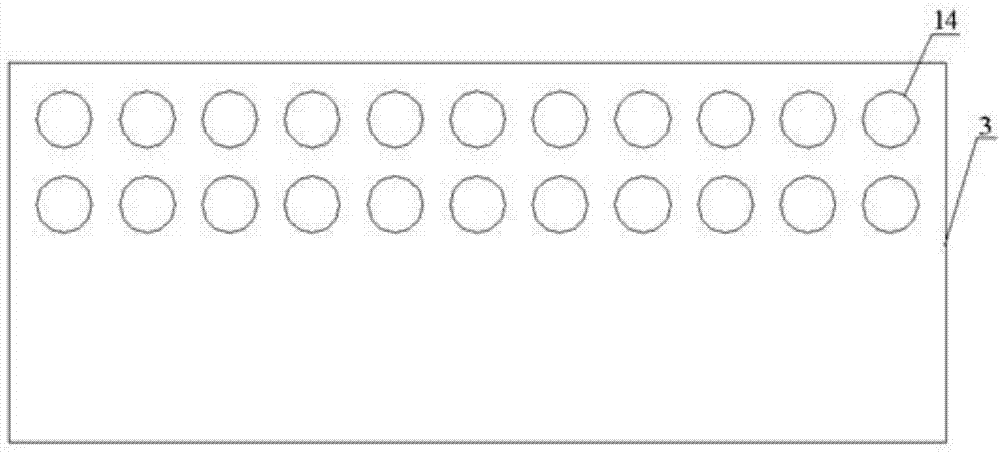
[0023] see Figure 1 to Figure 3 , the present invention is an in-situ water quality improvement device for automatic switching between full-layer mixing and isothermal layer aeration, comprising a flow guide device connected sequentially from top to bottom, an upper rising cylinder 6, a middle rising cylinder 4 and a lower rising cylinder 2; wherein , the deflector is connected to the upper ascending cylinder 6 through a flange, the top of the deflector is provided with a first watertight chamber 17 for providing buoyancy, and a first outlet 18 is provided on its circumference;
[0024] The upper rising cylinder 6 is a conical structure with an opening at the upper end larger than the opening at the lower end. It is formed by splicing several straight cylinders whose diameters increase sequentially from bottom to top, and the two connected straight cylinders...
PUM
 Login to View More
 Abstract
Description
Claims
Application Information
 Login to View More