Series excitation motor and its stator core, stator and stator manufacturing method

A technology for series motors and stator cores, applied in the manufacture of stator/rotor bodies, winding insulation shapes/styles/structures, magnetic circuit shapes/styles/structures, etc., can solve the problem of low winding efficiency and cost of series motors High, large size and other issues, to achieve the effect of miniaturization design, improve utilization rate, and reduce space restrictions

CN105024464BActive Publication Date: 2017-07-04FOSHAN WEILING WASHER MOTOR MFG
5 Cites 0 Cited by

Patent Information

Authority / Receiving Office
CN · China
Patent Type
Patents(China)
Current Assignee / Owner
Publication Date
2017-07-04

Smart Images

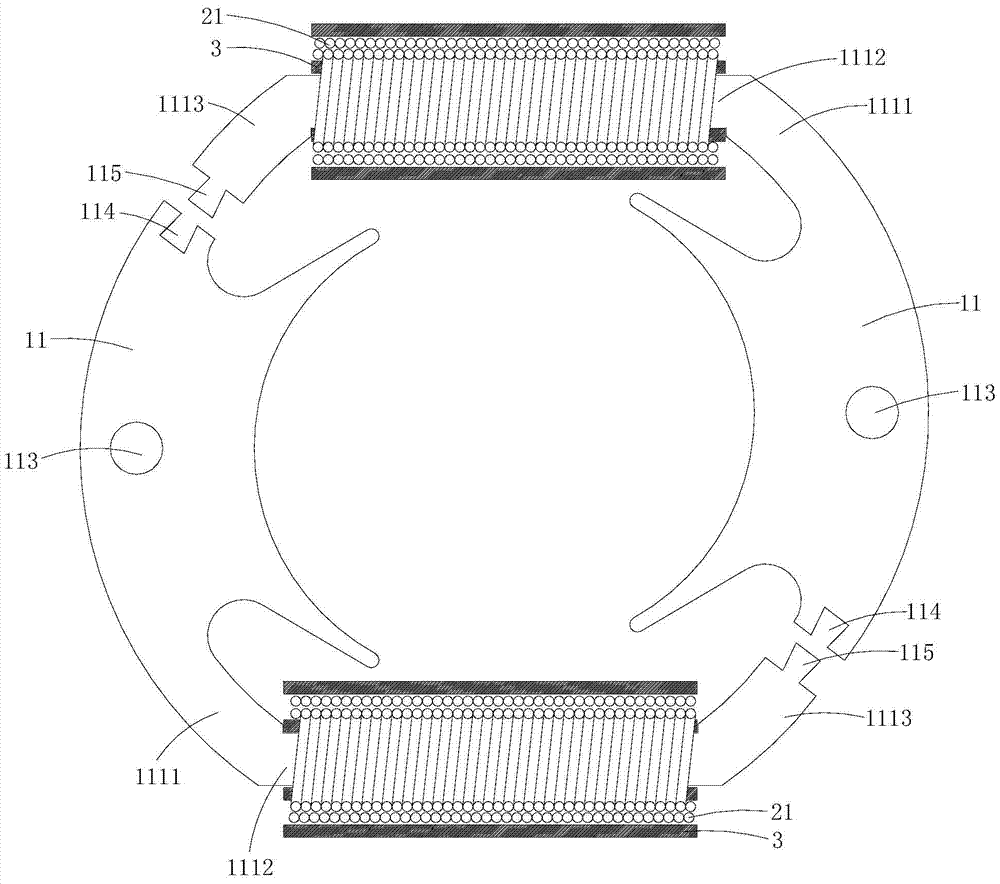
  • Figure 1
    Figure 1
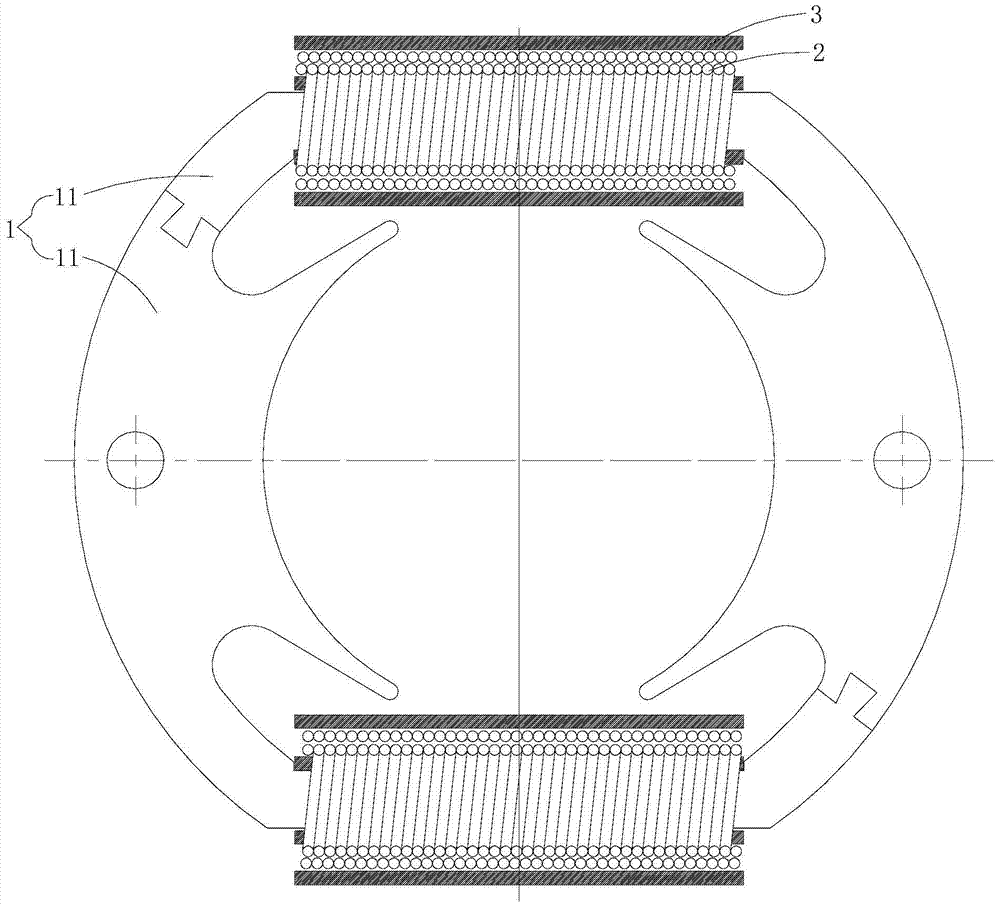
  • Figure 2
    Figure 2
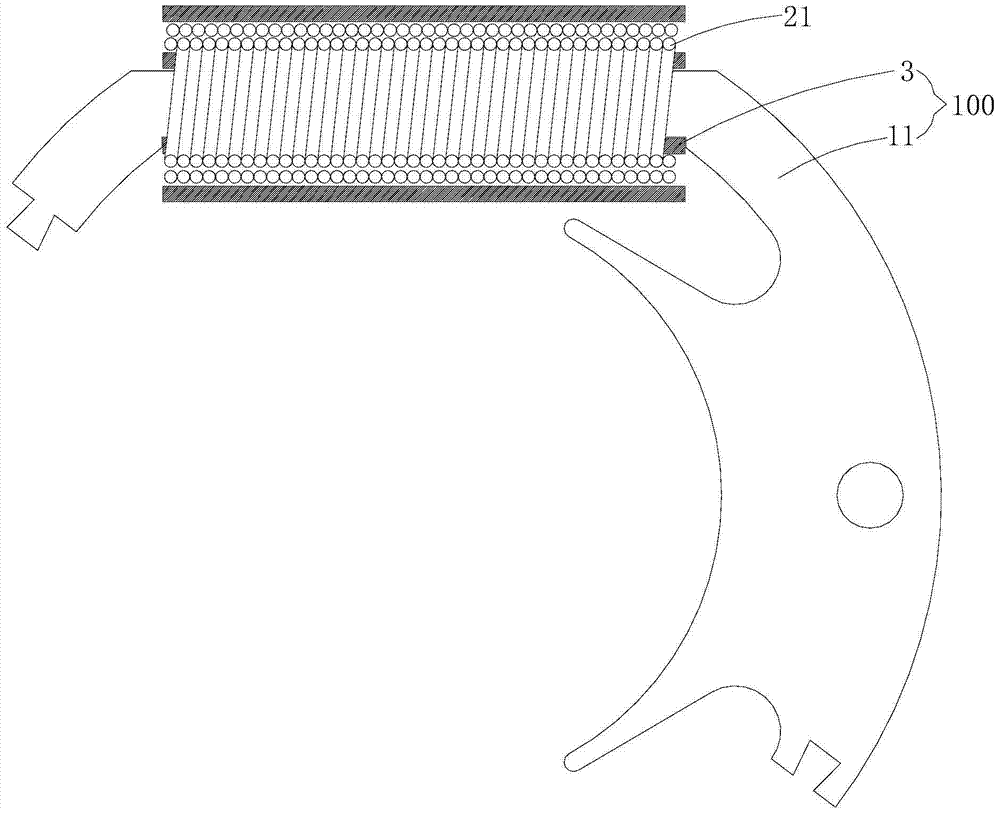
  • Figure 3
    Figure 3
Patent Text Reader

Abstract

The invention is suitable for the field of motors and provides a series motor stator iron core, a series motor stator, a manufacturing method of the series motor stator, and a series motor, wherein two iron core parts are spliced along the circumferential direction along the series motor stator iron core, each iron core part comprises a sub stator yoke and a stator tooth arranged on the sub stator yoke in a projected manner. The sub stator yoke comprises a first arc-shaped yoke part, a straight yoke part whose one end is connected with one end of the first arc-shaped yoke part, and a second arc-shaped yoke part whose one end is connected with the other end of the straight yoke part. The stator tooth is arranged on the first arc-shaped yoke part in a projected manner. The first arc-shaped yoke part and the second arc-shaped yoke part of one iron core part are respectively connected with the second arc-shaped yoke part and the first arc-shaped yoke part of the other iron core part. According to the invention, the winding efficiency of a stator winding is improved; sizes of end parts, projected from two ends of the stator iron core along the axial direction of the stator iron core, of the stator winding are reduced; the coil perimeter of the stator winding is reduced, the utilization rate of the stator winding is improved, and the cost of the series motor is lowered.
Need to check novelty before this filing date? Find Prior Art

Description

technical field

[0001] The invention belongs to the field of motors, and in particular relates to a series-excited motor stator core, a series-excited motor stator with the series-excited motor stator core, a manufacturing method of the series-excited motor stator and a series-excited motor with the series-excited motor stator. Background technique

[0002] The existing manufacturing method of the stator of the series excitation motor is as follows: first punch out the integral stator punching sheet, then stack each stator punching sheet to form an integral stator core, and then use a winding machine to wind the integral stator core. Stator windings are wound on the upper stator teeth. The stator manufacturing method of this existing series motor has the following deficiencies in specific applications:

[0003] 1) Due to the limitation of the winding space, the winding of the stator winding is relatively difficult, and the winding efficiency is very low. Thereby seriously ...

Examples

Embodiment Construction

[0030] In order to make the object, technical solution and advantages of the present invention clearer, the present invention will be further described in detail below in conjunction with the accompanying drawings and embodiments. It should be understood that the specific embodiments described here are only used to explain the present invention, not to limit the present invention.

[0031] It should be noted that when an element is described as being “fixed” or “disposed on” another element, it may be directly on the other element or there may be an intervening element at the same time. When an element is described as being "connected to" another element, it can be directly connected to the other element or intervening elements may also be present.

[0032] It should also be noted that the orientation terms such as left, right, up, down, top, and bottom in the following examples are only relative concepts or refer to the normal use status of the product, and should not be rega...