
CFO Estimation Method Based on Dual Training Sequences
A training sequence and factor technology, applied in digital transmission systems, electrical components, transmission systems, etc., can solve problems such as OFDM performance degradation, achieve the effects of simplifying calculations, reducing system bit error rates, and improving customer perception
- Summary
- Abstract
- Description
- Claims
- Application Information
AI Technical Summary
Problems solved by technology
Method used
Image

Examples
Embodiment Construction
[0034] The present invention will be further described below in conjunction with the accompanying drawings and specific embodiments.
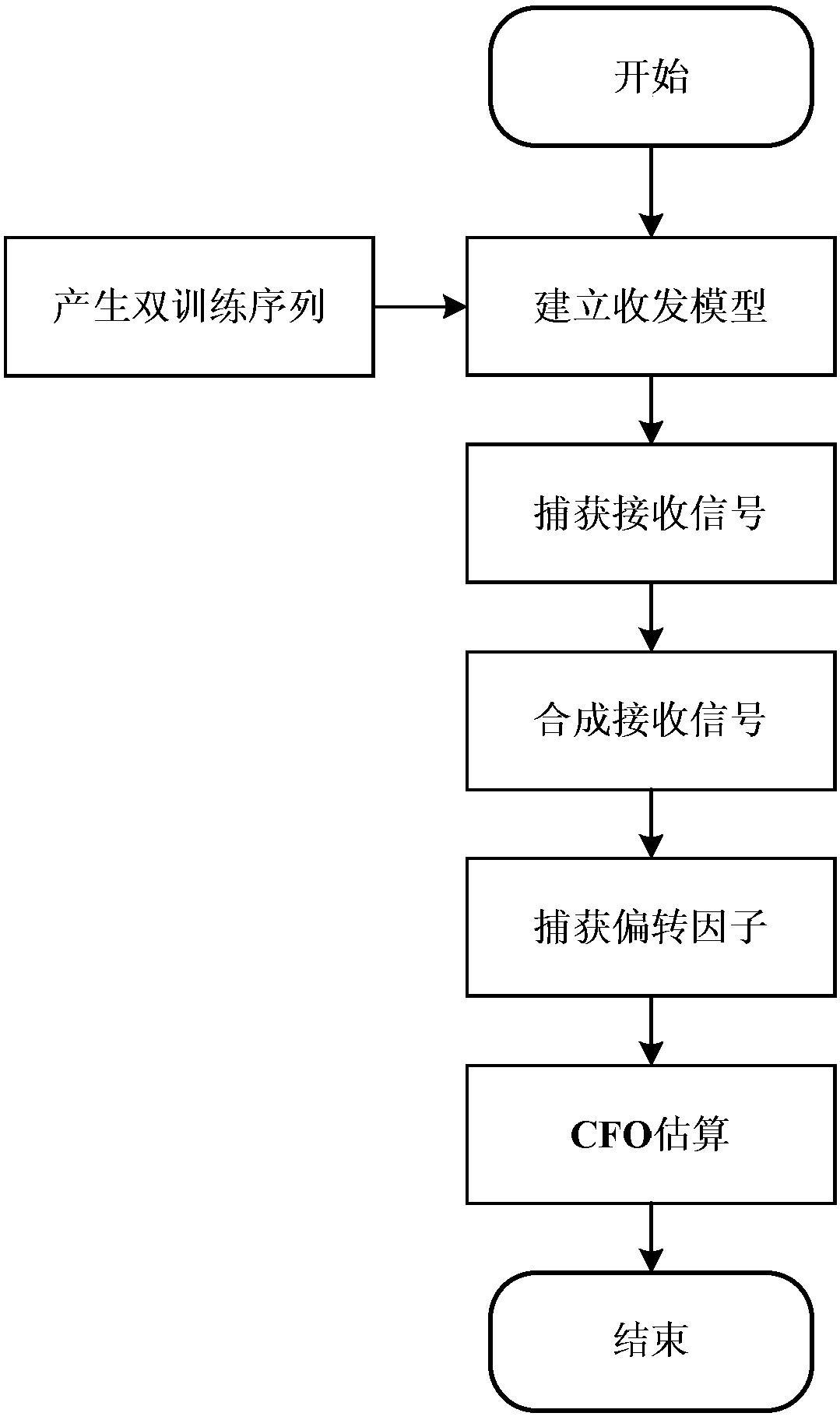
[0035] Such as figure 1 The illustrated embodiment is a method for estimating CFO based on dual training sequences, including establishing a transceiver model, adding dual training sequences, synthesizing received signals, capturing deflection factors, and estimating CFO.
[0036] Step 1: Establish a transceiver model;
[0037] Set the transmitted signal as x(n), the received signal as y(n), the length of x(n) is N, N=N g 2 , y(n)=x(n)*δ(ε)+w(n), where δ(ε) is the signal deflection factor, ε is the CFO to be estimated, w(n) is the channel noise, N g Be a constant, n=0,..., N-1;
[0038] Step 2: Add dual training sequences;
[0039] Add two different training sequences u(n) and v(n) to the transceiver model to get Z 1 (n)=u(n)*δ(ε)+w(n) and Z 2 (n)=v(n)*δ(ε)+w(n);
[0040] Step 3: Receive Signal Synthesis
[0041] Step 3-1: Use the form...
PUM
 Login to View More
 Abstract
Description
Claims
Application Information
 Login to View More