Laser radar weak signal extraction and decomposition method based on fractional order Fourier transformation

A technology of fractional Fourier transform and laser radar, which is applied in the direction of radio wave measurement system, instrument, etc., to achieve the effect of strong noise filtering ability and high precision of component extraction

CN108872962AActive Publication Date: 2018-11-23NANJING UNIV OF AERONAUTICS & ASTRONAUTICS
5 Cites 18 Cited by

Patent Information

Authority / Receiving Office
CN · China
Current Assignee / Owner
Publication Date
2018-11-23

Smart Images

  • Figure 1
    Figure 1
  • Figure 2
    Figure 2
  • Figure 3
    Figure 3
Patent Text Reader

Abstract

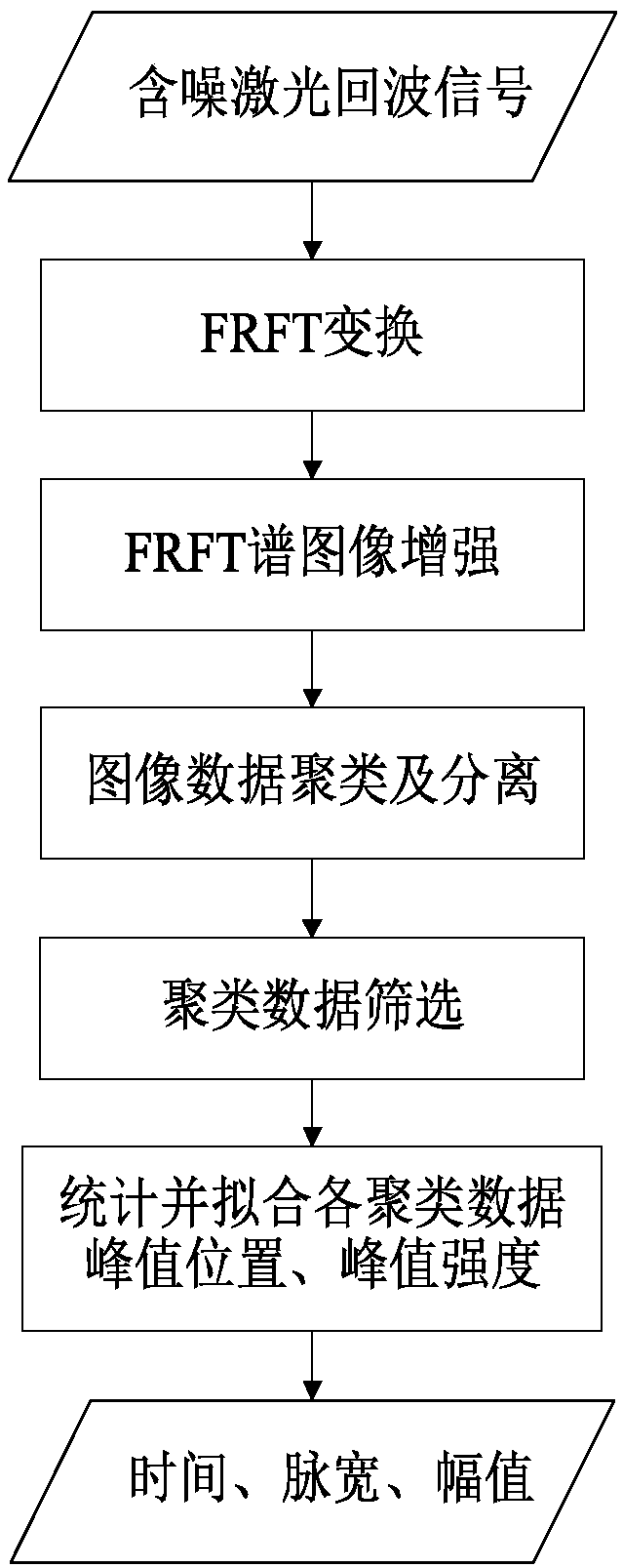
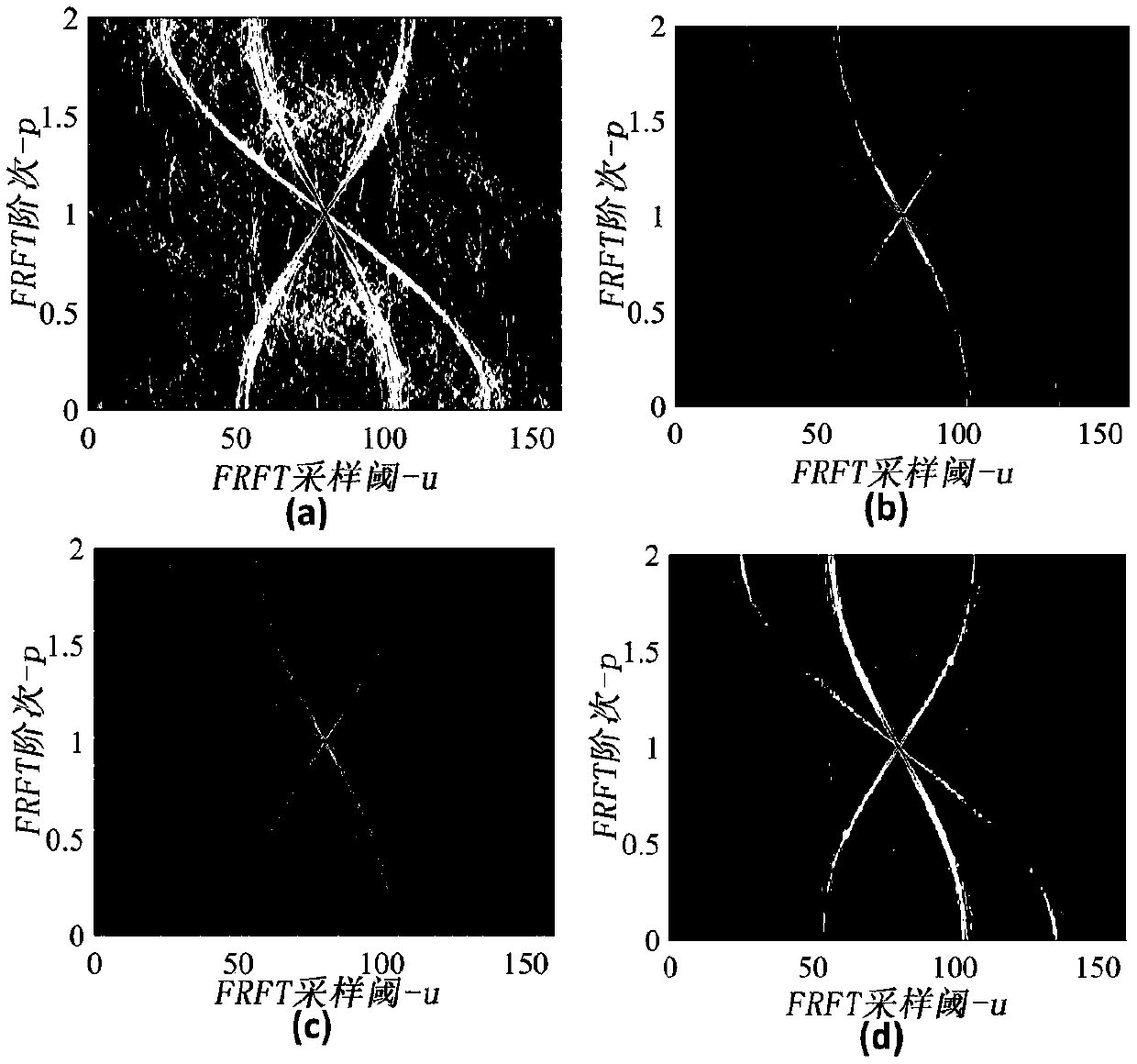
The invention discloses a laser radar weak signal extraction and decomposition method based on fractional order Fourier transformation, and belongs to the laser radar signal processing technical field; the method comprises the following steps: 1, carrying out fractional order Fourier transformation for noise-containing laser radar echo signals, obtaining a FRFT spectrum, and converting one dimension signals into a 2D image; 2, using a mean filtering, wavelet filtering and Butterworth filtering compound filtering method to make image enhancement for the FRFT spectrum; 3, clustering enhanced FRFT spectrum image data, and determining a clustering quantity and separating each piece of cluster data; 4, recording position and intensity of separated each piece of cluster data, screening valid data points, carrying out least square fitting for reserved data so as to obtain a flight time, a pulse width and an amplitude, thus finishing laser radar echo signal extraction and component decomposition. The 2D time-frequency analysis method for the laser radar signal processing has a stronger anti-noise ability and a more accurate decomposition result.
Need to check novelty before this filing date? Find Prior Art

Description

technical field

[0001] The invention relates to a method for extracting and decomposing weak laser radar signals based on fractional Fourier transform, and belongs to the technical field of laser radar signal processing. Background technique

[0002] The Fourier transform (FT) was proposed in 1807. It establishes the transformation relationship between the signal time domain and the frequency domain, and is an effective tool for analyzing and processing stationary signals. However, in practical engineering and natural phenomena, most signals are non-stationary. The frequency domain and time domain of non-stationary signals are related, so the signal characteristics cannot be fully reflected through the expression in the time domain or frequency domain. Therefore, in recent years, a signal processing technique—Time-Frequency Analysis (TFA) has been widely used. By converting the one-dimensional signal representation into a two-dimensional time-frequency joint representation,...

Examples

Embodiment Construction

[0047] The technical solutions of the present invention will be described in detail below in conjunction with the accompanying drawings.

[0048] A method for extracting and decomposing LiDAR weak signals based on fractional Fourier transform, such as figure 1 As shown, the specific steps are as follows.

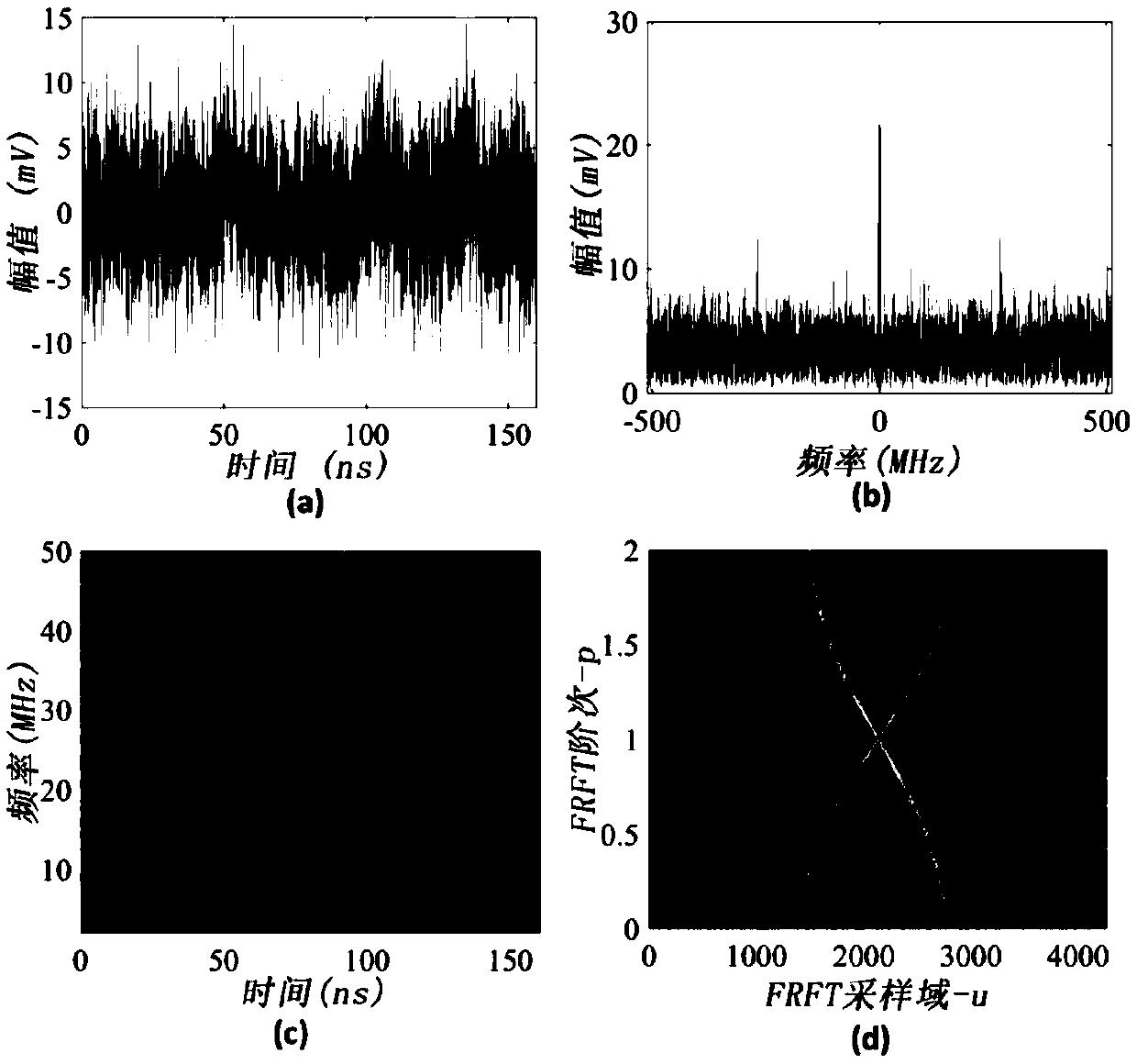
[0049] Step 1: Fractional Fourier transform (FRFT) is performed on the noisy lidar echo signal to obtain the FRFT spectrum, which is converted from a one-dimensional signal to a two-dimensional image.

[0050] At present, lidar is not limited to single-pulse measurement, and can realize multi-pulse measurement, that is, to completely record the target multi-point echo mixed signal, which is called full-wave signal. Since the laser single pulse is a Gaussian distribution, the full-wave signal y(t) can theoretically be described as the sum of multiple Gaussian pulse signals:

[0051]

[0052] Here K is the number of Gaussian components, a k Represents the magnitude of th...