
Saliency-based CTU (Coding Tree Unit) layer code rate allocation method of HEVC (High Efficiency Video Coding) full I frame coding
A technology of bit rate allocation and frame coding, applied in the field of video coding, which can solve problems such as differences in the subjective sensitivity of human eyes.
- Summary
- Abstract
- Description
- Claims
- Application Information
AI Technical Summary
Problems solved by technology
Method used
Image


Examples
Embodiment Construction
[0056] In order to make the technical means, creative features, goals and effects achieved by the present invention easy to understand, the present invention will be further described below in conjunction with specific embodiments.
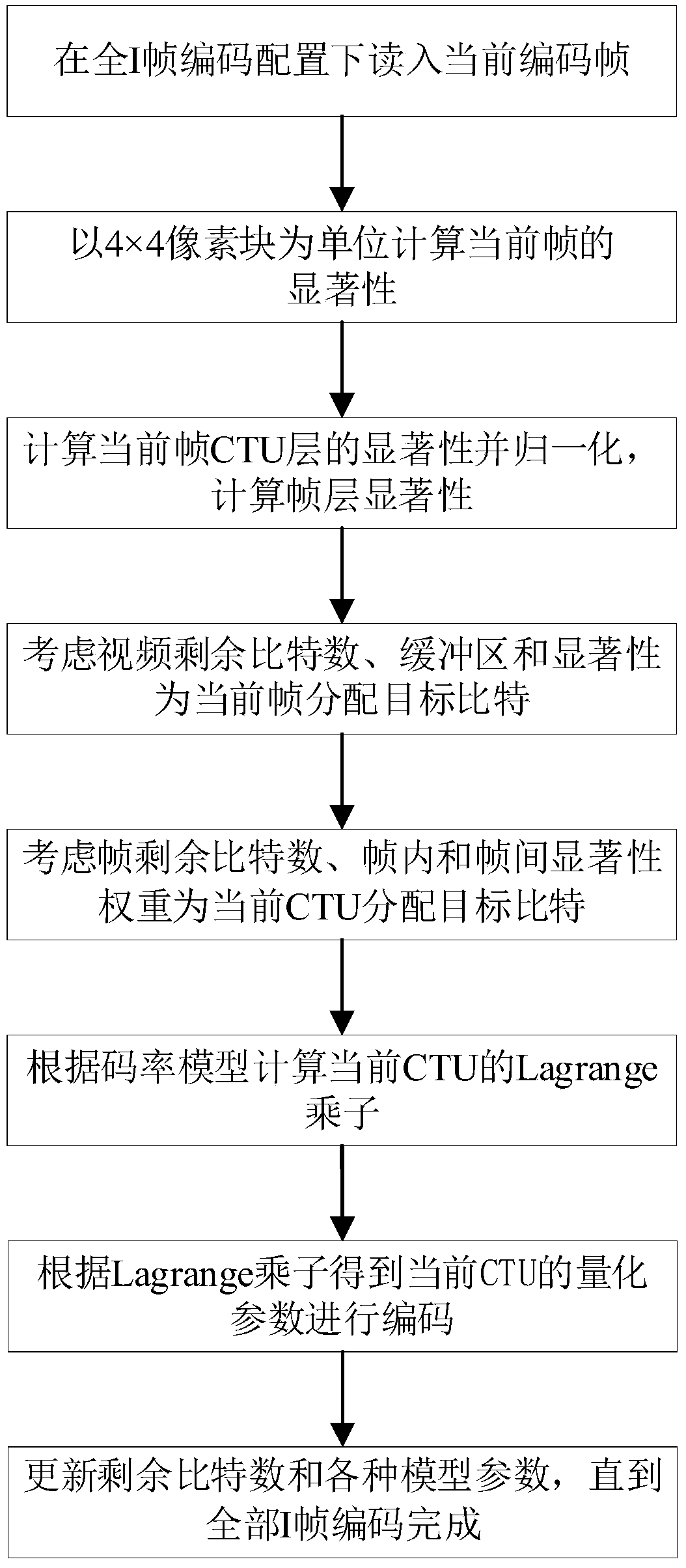
[0057] like figure 1 Shown, a kind of HEVC full I frame coding is based on the significant CTU layer code rate allocation method, comprises the following steps:
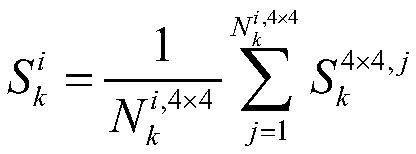
[0058] S1: Read in the current coded frame under the full I-frame coding configuration, and calculate the saliency of different regions of the current frame in units of 4×4 pixel blocks. Step S1 includes the following steps:
[0059] S11: Read in the YUV pixel values of the current encoded frame, divide the brightness channel (Y) according to the size of 4×4 pixel blocks, and combine the 4×4 pixel blocks of the Y channel and the pixel values of the corresponding UV channels to form 4×4 Feature vectors of the block layer
[0060] S12: Utilize the feature vectors of the 4×4 block...
PUM
 Login to View More
 Abstract
Description
Claims
Application Information
 Login to View More