
A kind of breeding method of orange pagoda cauliflower hybrid
A technology of pagoda flowers and hybrids, which is applied in the field of breeding of orange pagoda cauliflower hybrids, can solve problems such as the emergence of orange pagoda cauliflower varieties or breeding research work, and achieve reduced seed production costs, high homozygosity, and comprehensive traits excellent effect
- Summary
- Abstract
- Description
- Claims
- Application Information
AI Technical Summary
Problems solved by technology
Method used
Image

Examples
Embodiment 1
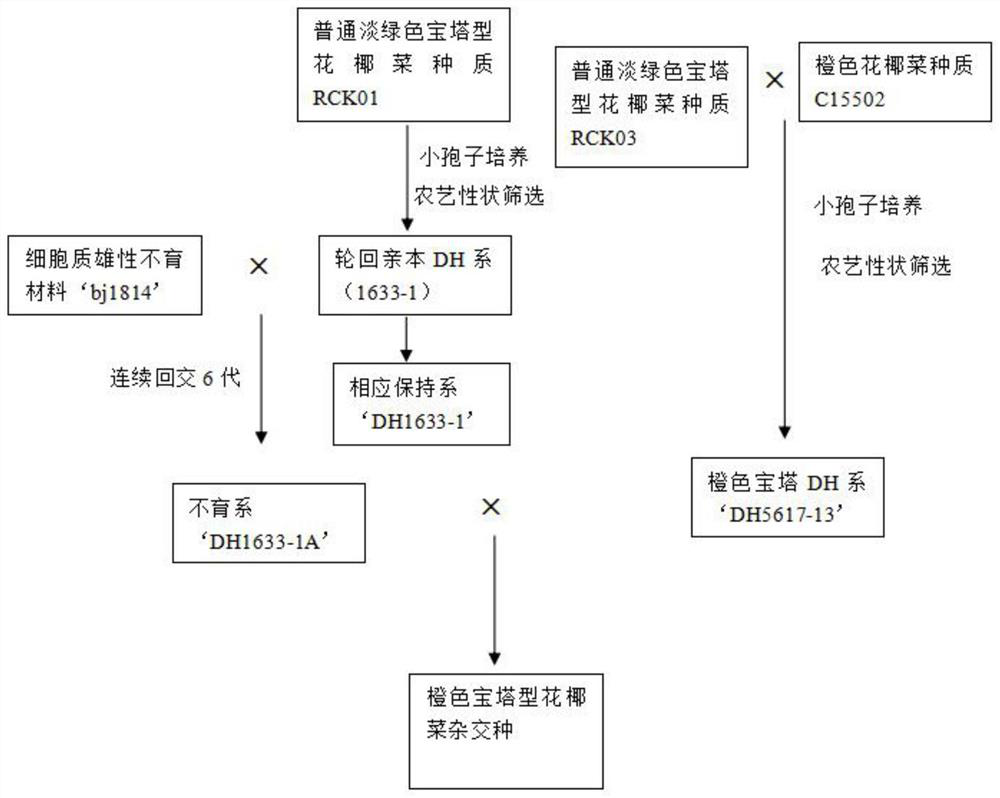
[0024] like figure 1 As shown, the present embodiment provides a breeding method for an orange pagoda cauliflower hybrid, which specifically includes the following steps:
[0025] 1) Screening of germplasm resources. Since 2010, 7 pagoda-shaped cauliflower and 2 orange cauliflower germplasm resources have been collected. Through the observation and identification of agronomic characters, 1 male sterile pagoda-type cauliflower, 3 fertile pagoda-type cauliflowers, and 2 available orange cauliflower germplasms were screened for breeding.
[0026] 2) Male sterility source selection. The male sterile pagoda-type cauliflower hybrid, denoted as bj1841, showed normal petals and nectaries, and was used as the male sterile source breeding material.
[0027] 3) Reincarnation parent breeding. Taking a fertile cauliflower hybrid of pinnatifida type as the donor, denoted as RCK01, 13 double-haploid series were obtained by microspore culture, denoted as DH1633, of which DH1633-1 showed ...
Embodiment 2
[0032] Example 2 Parental breeding
[0033] Because the pagoda cauliflower needs to be cut several times and cultivated over winter, the winter is strong, and the parents need to be bred in the greenhouse to prevent the wound after cutting the ball from being affected by the rain and infecting the disease. Due to self-compatibility of the recurrent parent, seeds can be obtained by bee-assisted pollination in a separate shed; the sterile line of the female parent is planted with the sterile line and the recurrent parent in a 1:1 ratio in a separate shed, which needs to be pollinated by bee-releasing. Seeds are obtained by backcrossing; the male parent is a self-incompatible DH line, which needs to be manually peeled and pollinated in the greenhouse at the flowering stage to obtain seeds.
Embodiment 3
[0034] Example 3 Hybrid Seed Production
[0035] If the first-generation hybrid seed needs to be produced in a relatively large amount, it can be isolated and collected in the open field in an appropriate area. Generally, the isolated seed can be produced in a greenhouse.
[0036] 1) Choose a planting greenhouse: According to the production area, choose ordinary plastic greenhouses, glass greenhouses or solar greenhouses. It is best that no cruciferous crops have been planted before, or the greenhouse soil has been sterilized. Apply enough basal fertilizer and borax before transplanting.
[0037] 2) The ratio of sowing to colonization: the parental seedlings are transplanted, and the proportion of female parent: male parent 2:1 or 3:2 is used for colonization. Because the growth period of the female parent and male parent is similar, it can be sown and transplanted at the same time. Taking the Hangzhou area as an example, the sowing period of the female parent and the male p...
PUM
 Login to View More
 Abstract
Description
Claims
Application Information
 Login to View More